

First Impressions and Onboarding
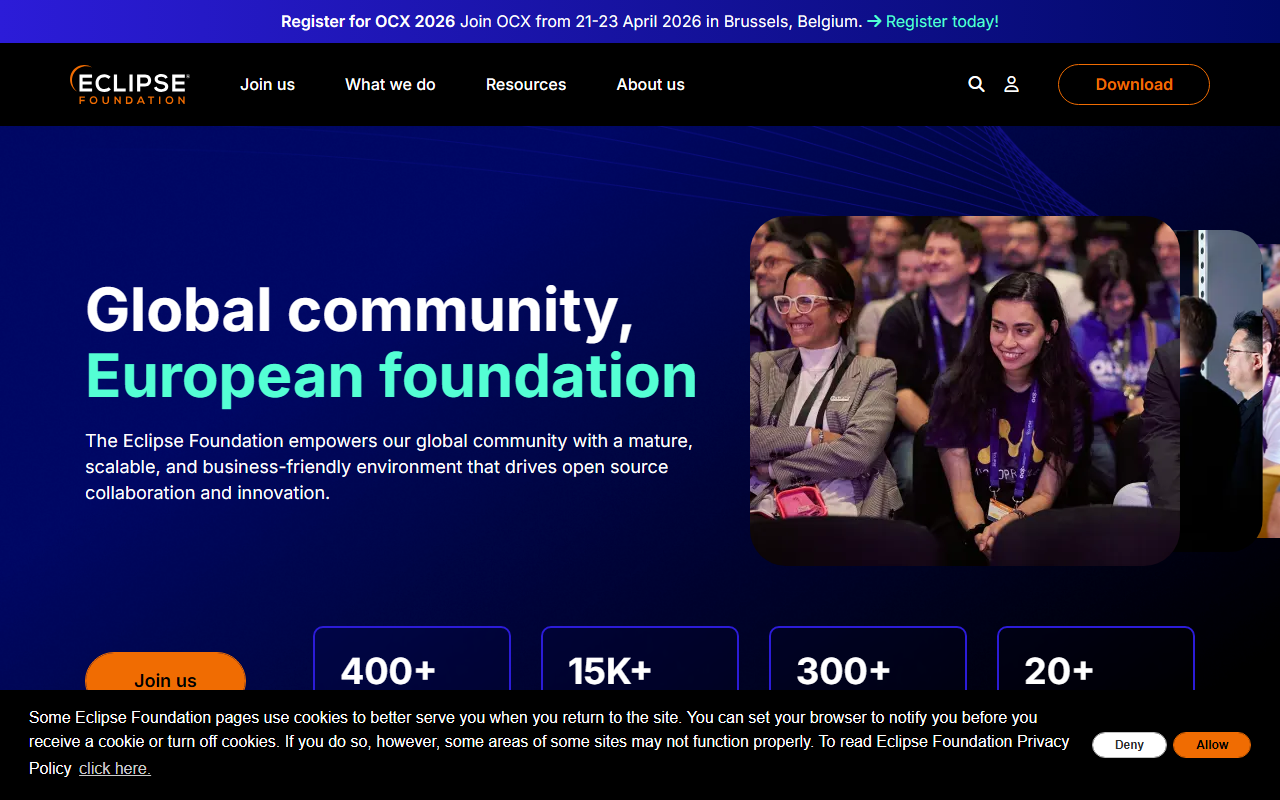
Upon visiting the Eclipse Foundation website at eclipse.org, the homepage immediately conveys a sense of scale and structure. The top navigation includes links to projects, industry collaborations, events, and resources. A prominent call to action invites you to 'Download' or 'Join us'. The dashboard-like landing page highlights key metrics: 400+ projects, 15,000+ contributors, 300+ members, and 20+ collaborations. As a journalist exploring the site for AI development frameworks, I quickly noticed that Eclipse is not a plug-and-play tool but an overarching organization that hosts many open source initiatives.
Scrolling down, I found sections detailing collaboration models, community events, and resources like downloads and marketplaces. The onboarding for a developer would involve browsing the 'Explore projects' link, which takes you to a searchable catalog of Eclipse projects. There, you can filter by domain, including AI, machine learning, and IoT. I clicked on the AI category and found Eclipse Deeplearning4j, a popular deep learning library for Java and Scala, along with other tools like Eclipse Streamsheets for data processing.
What Eclipse Foundation Offers for AI Development
The Eclipse Foundation provides a mature, business-friendly environment for open source innovation, which is particularly valuable for AI development. Instead of a single AI tool, it offers a framework of frameworks: a governance model that ensures neutrality, intellectual property management, and long-term project sustainability. For developers working in Java or JVM languages, Eclipse Deeplearning4j is a standout — it supports deep neural networks, integrates with Hadoop and Spark, and runs on CPUs and GPUs. Other relevant projects include Eclipse Ditto for digital twins and Eclipse Kapua for IoT cloud platforms, both of which can feed into AI pipelines.
Technically, the foundation does not directly provide APIs or models; it hosts projects that do. The technology stack varies by project—some use Python, others Java. The foundation offers infrastructure services like CI/CD, code repositories (GitLab-based), and project management tools. There is no centralized API for the foundation itself, but individual projects often expose REST APIs. Pricing is not publicly listed on the website; membership fees apply for organizations seeking governance roles, while individual contributions are free. The foundation is funded by members like IBM, Bosch, and SAP, which adds credibility.
Ecosystem, Community, and Alternatives
The Eclipse Foundation's ecosystem is vast and deeply rooted in enterprise Java, which sets it apart from alternatives like the TensorFlow ecosystem (focused on Python) or the PyTorch Foundation (also Python-heavy). Unlike those, Eclipse provides a vendor-neutral home for cross-industry collaboration, which is ideal for organizations that require long-term stability and legal protection for open source contributions. The community is active, with regular events like EclipseCon and monthly meetups. However, the learning curve is steep: you need to navigate project-specific documentation and understand the foundation's governance to contribute effectively.
Strengths include a proven governance model, a large contributor base, and support for enterprise-grade AI deployment. Limitations are the lack of a single cohesive AI product—developers must assemble their own stack from multiple projects. The website's resource section is helpful but sprawling, and beginners may feel overwhelmed. For hobbyists or small startups looking for a quick AI toolkit, Eclipse is not the right choice. Instead, consider established frameworks like Hugging Face for NLP or PyTorch for research.
Conclusion: Who Should Consider Eclipse Foundation?
The Eclipse Foundation is best suited for organizations and developers already invested in open source and Java ecosystems, particularly those building industrial AI solutions that require vendor neutrality and scalable governance. If you are an enterprise architect or a team lead evaluating an open source strategy for AI, exploring Eclipse projects like Deeplearning4j or Eclipse EMF can provide long-term benefits. Individual developers will find a rich community but must be prepared to dive deep into project-specific documentation. For a ready-to-use AI framework, look elsewhere; for a trusted home to build and host your own open source AI projects, Eclipse is a solid bet.
Visit Eclipse Foundation at https://eclipse.org/ to explore it yourself.













Comments