
First Impressions: A Platform Built for Impact
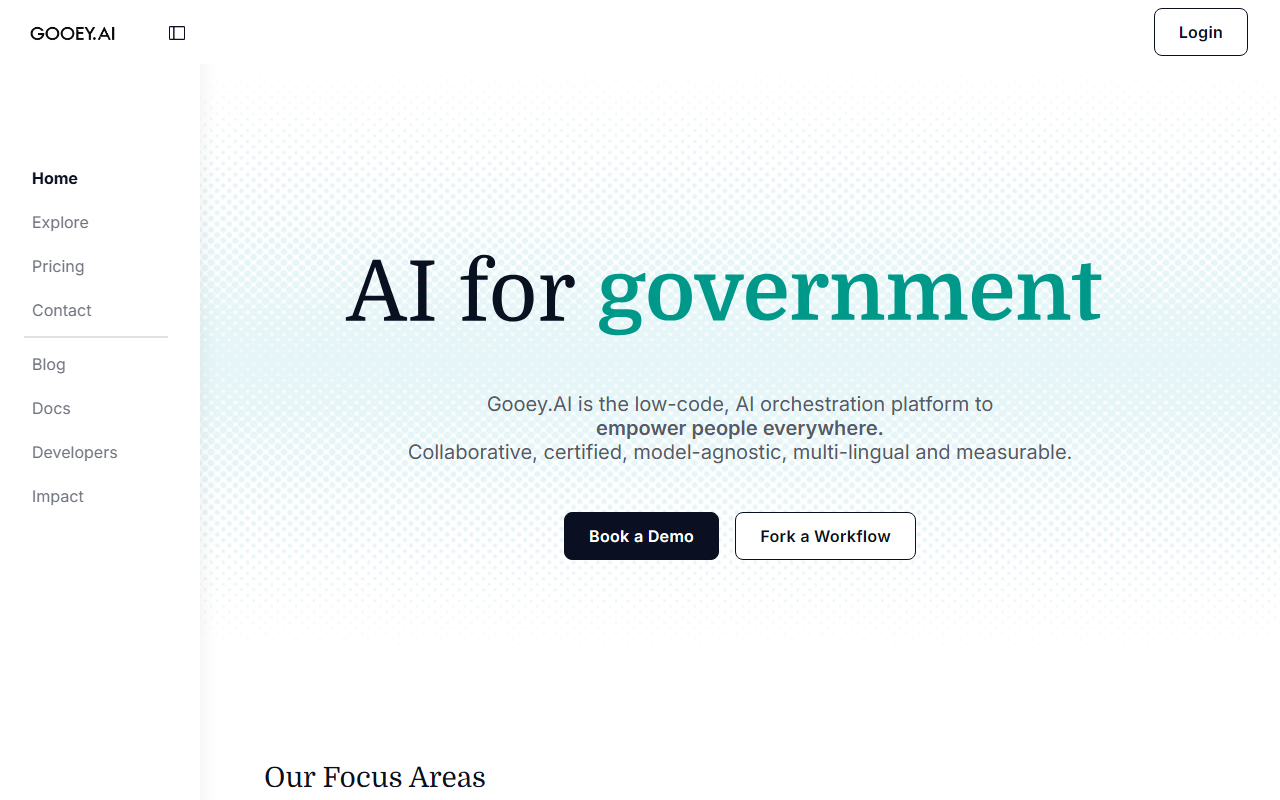
Upon visiting Gooey.AI, the first thing that strikes me is how purpose-driven the homepage feels. The headlines don't shout "disrupt" or "scale"; they talk about empowering farmers, health workers, and educators. The dashboard—or rather, the landing page—immediately directs you to either book a demo or "Fork a Workflow." That phrase is a dead giveaway: this is a low-code, collaborative AI orchestration platform. I immediately forked a sample workflow to see what happens. Gooey.AI is not just another model playground; it's a full orchestration layer that lets you chain LLMs, RAG pipelines, and external channels like WhatsApp, voice, and SMS into one transparent, human-readable AI workflow.
The platform claims to be model-agnostic, supporting models from Google, OpenAI, Meta, DeepSeek, and Mistral through a single billing account. That is a serious differentiator for teams that want flexibility without vendor lock-in. The interface is designed for collaborative discovery: you can browse existing workflows, tweak them, and deploy in minutes. For an AI orchestration tool, that’s remarkably frictionless.
Core Capabilities: Low-Code Orchestration for the Real World
Gooey.AI solves a very specific problem: how to take powerful LLMs and deploy them into production environments with measurable outcomes, especially in underserved communities or resource-constrained settings. The platform is built around "human-readable, low-code AI workflows" made of instruction prompts, team documents, and agentic functions. I tested the free tier by forking a multilingual WhatsApp agent based on Farmer.CHAT—one of their showcased projects with the Gates Foundation. Within a few minutes, I had a simple Q&A flow that understood both English and Hindi. The transparency of the workflow builder is impressive: you see exactly which prompt, which model, and which dataset is used at each step.
The platform also includes an LLM evaluation component called "Language Evaluation," which tests how well models understand under-represented languages. This is not just a nice add-on—it’s central to their mission. Gooey.AI has clearly been shaped by years of on-the-ground work in agriculture (Farmer.AI, Mshauri) and health (UN IOM partnerships). The level of integration with real-world channels—WhatsApp, IVR, SMS, web apps—makes it a practical choice for NGOs, governments, and institutions that need to reach people where they already are.
Pricing and Positioning in the Market
Pricing is not publicly listed on the website. Gooey.AI uses a contact-sales model or custom enterprise pricing, likely because their deployments are often large-scale and tailored to institutional needs. This lack of transparency might frustrate smaller teams wanting to experiment, but their free tier (fork a workflow) does give you a taste. Compared to competitors like Langflow or Dify, Gooey.AI focuses less on developer-heavy customization and more on turnkey deployment with an explicit social impact lens. Another alternative is Hugging Face’s Inference Endpoints, but that lacks the workflow orchestration and channel integrations.
The platform claims to power 1.2M+ users, which is a significant number for a niche tool. Their founder Sean Blagsvedt has 20+ years of AI bot experience, and the company has partnered with the Gates Foundation, Rockefeller Foundation, UN IOM, and Teach for India. These are not vanity logos; these are serious deployment partners. Gooey.AI is best suited for NGOs, government agencies, and educational institutions that need to deploy multilingual AI agents quickly without building infrastructure from scratch. Developers looking for a general-purpose framework might find it too domain-specific.
Strengths, Limitations, and Final Verdict
The genuine strengths of Gooey.AI include its model-agnostic approach, the collaborative and forkable workflow system, and its proven track record in low-resource language settings. The platform makes it easy to measure adoption and outcomes—a crucial feature for grant-funded initiatives. I also appreciate the emphasis on "design for the whole organization," which is evident in their six hard-won lessons on the site.
However, there are real limitations. The documentation and API access are not fully visible on the public site; you need to dig into their developer docs for specifics. The platform is heavily geared toward social impact use cases—if you're a for-profit enterprise building a customer support chatbot in English only, you might find it overkill. Also, the pricing opacity means you cannot quickly estimate costs for small experiments.
Overall, Gooey.AI is a well-crafted tool for a specific mission: scalable, multilingual, measure-driven AI agents for humanitarian and institutional work. If that describes your project, fork a workflow and start building. If not, you may want to look at more general orchestration platforms.
Visit Gooey.AI at https://gooey.ai/ to explore it yourself.













Comments