

What Is Interview Solver?
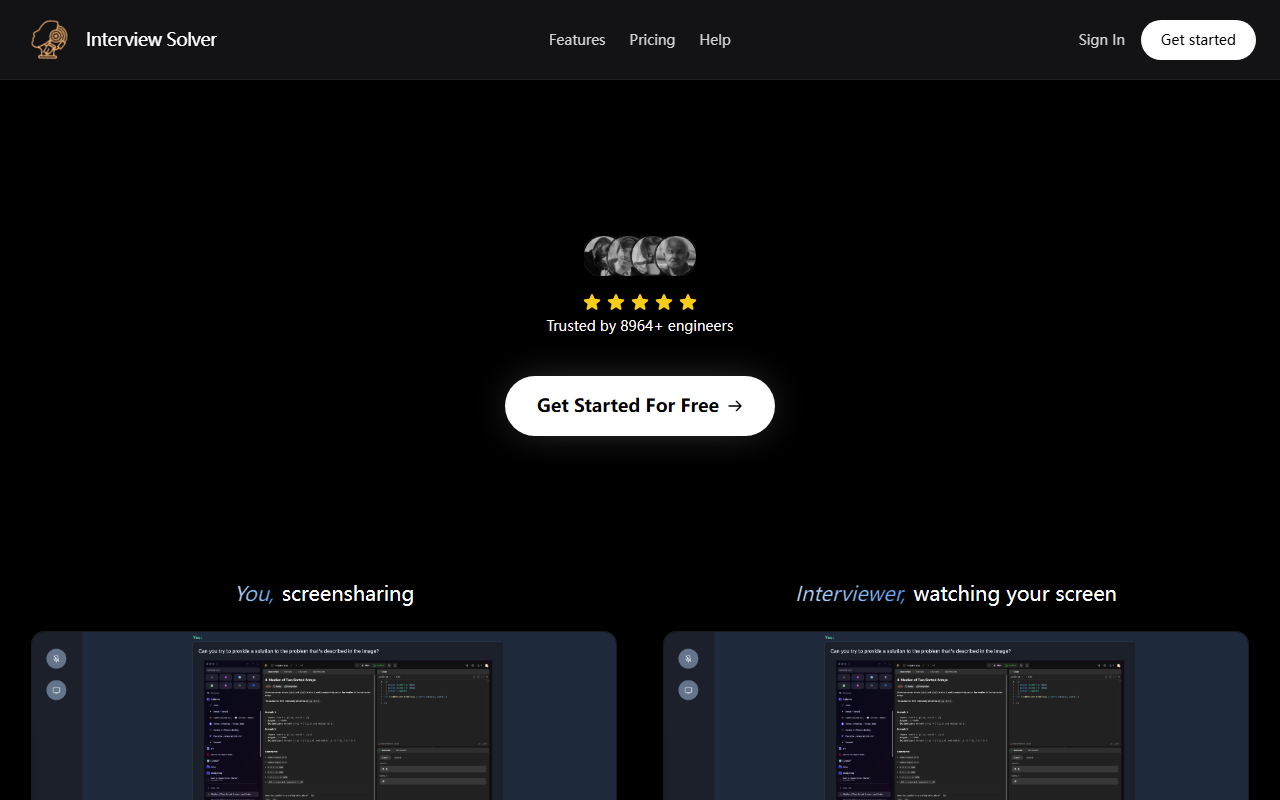
Upon visiting the Interview Solver website, I was greeted by a clean landing page claiming "Pass Any Coding Interview" and boasting 9,444+ engineers as users. The tool is a desktop application designed to act as an invisible AI copilot during live coding interviews. According to the site, it can solve all LeetCode-style problems and system design questions in real time while remaining undetectable to screen-sharing software. The key differentiator is that it runs as a native app, not a browser extension, which allows it to use global hotkeys and an overlay that can be hidden from Zoom (up to version 6.16), Google Meet, and Teams. I signed up for the free trial (no credit card required) and downloaded the desktop client for macOS. The onboarding was straightforward: after installation, a small floating window appeared that I could reposition with Cmd+arrow keys. The interface is minimal—essentially a chat input and a solution pane that can be toggled to show code with syntax highlighting and flowcharts.
Core Features and How They Work
I tested the free tier, which limits you to 10 messages. The first thing I tried was the "Screengrab" feature: I opened a LeetCode problem in my browser, used the app's hotkey to capture that window, and within seconds the AI returned a complete solution with explanation. The accuracy was impressive—it solved a medium-difficulty graph problem with correct complexity analysis. The tool also supports audio transcription: in theory, it can listen to your interviewer's questions via your system's audio input and feed relevant answers into the chat. I couldn't fully test this in a live scenario, but the setup was simple. The "Invisible Mode" overlay uses transparency and hotkeys so your eyes don't have to leave the main coding window. However, I noticed a limitation: the website explicitly states full invisibility only for Zoom ≤6.16. If your interviewer uses a newer version or a different platform, the overlay might be visible. The app also requires a stable internet connection—no offline mode. While the LeetCode-specific training data gave it an edge for coding problems, I found its responses to open-ended system design questions less precise; they were generic textbook answers rather than tailored advice.
Pricing and Competitor Context
Interview Solver offers a free trial with 10 messages, then a single paid plan at $39 per month. The pricing page includes a table showing median senior software engineer compensation at top companies like Google ($359k) and OpenAI ($560k) to justify the investment. Compared to traditional interview coaching ($200–$500 per hour), $39/month seems cheap. But in the AI copilot space, alternatives like the browser extension CoderPad AI or ChatGPT itself can perform similar tasks for free or lower cost (ChatGPT Plus is $20/month). The key difference is the undetectability claim. Interview Solver's desktop architecture means you're not alt-tabbing to a browser, but the ethical line is thin. The website says "No" to the question "Have any users been detected?" but that's a self-reported stat. The tool's biggest strength is its focus on real-time, invisible assistance; its biggest weakness is that if detected, you could face interview termination or professional consequences.
Who Should Use Interview Solver?
After testing, I believe Interview Solver is best suited for engineers who are confident in their ability to use the tool discreetly and who face high-stakes coding interviews where every second matters. It's particularly useful for problems that require exact LeetCode solutions. However, I would caution against relying on it as your sole preparation method—it's a crutch, not a teaching tool. Candidates who value ethical integrity or are interviewing at companies with strong anti-cheating measures (e.g., advanced proctoring software) should look elsewhere. Also, if your interview involves pair programming with close screen monitoring, the risk increases. Overall, Interview Solver delivers on its technical promise: it's a powerful copilot for coding interviews. But the decision to use it comes down to your tolerance for risk. Visit Interview Solver at https://interviewsolver.com/ to explore it yourself.












Comments