

First Impressions and Onboarding
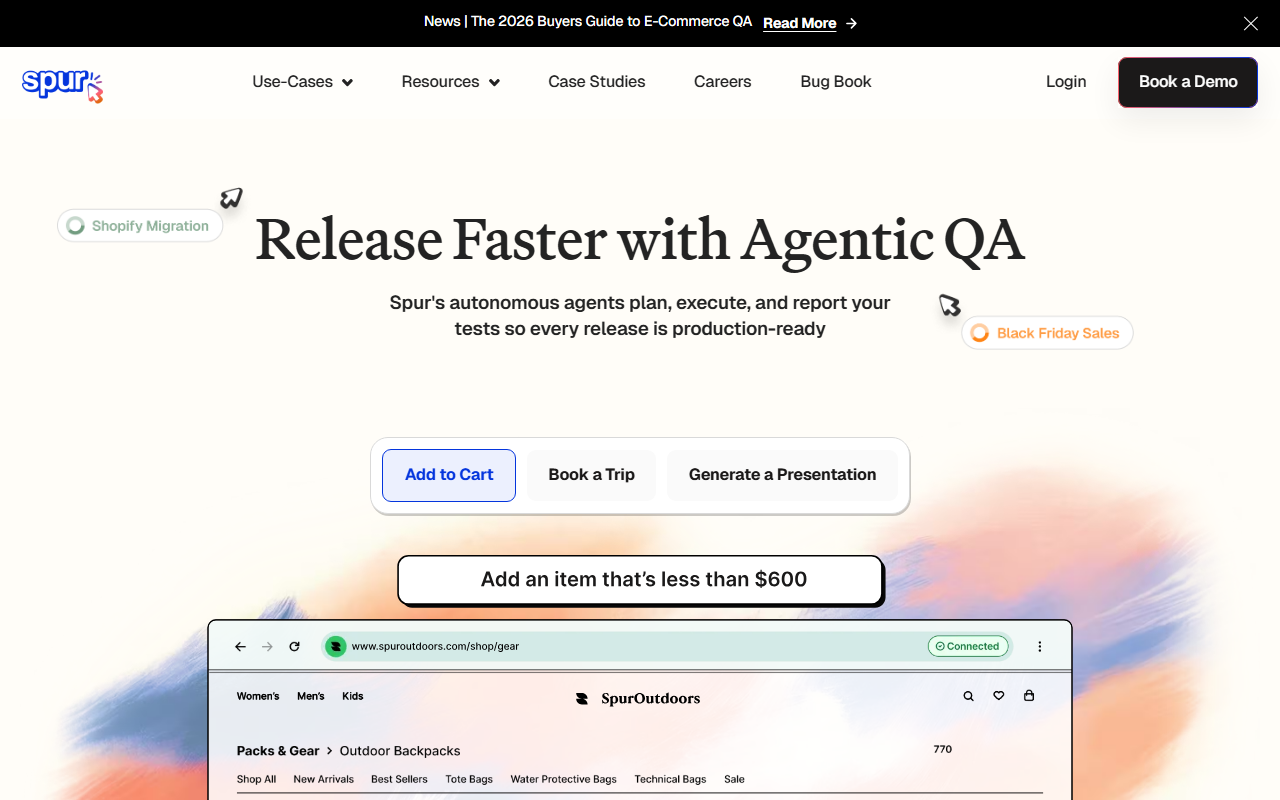
Upon visiting spurtest.com, I was greeted by a clean, testimonial-heavy landing page that immediately made a strong case for agentic QA. The tagline "Release Faster with Agentic QA" is backed by impressive logos from Eight Sleep, Y Combinator, Wander, and August. The site highlights three example workflows: Add to Cart, Book a Trip, and Generate a Presentation — which suggests Spur can handle more than just e-commerce. After clicking around, I found case studies and a list of features like parallel execution and dynamic adaptation to pop-ups. There is no public sign-up form; instead, a "Book a Demo" button is prominent. This tells me Spur is a enterprise-focused tool that requires a sales conversation to start.
How Spur Works
Spur describes itself as an autonomous QA agent that plans, executes, and reports tests. The core value proposition is that you describe what you want to test in plain English, and the AI agent handles the rest. From the website, I learned that Spur runs tests in parallel across web and native mobile, and it adapts to real-world complications like cookie banners, promotions, and out-of-stock items. The AI is built to simulate actual customer behaviors without sacrificing reliability. Key use cases include exploratory testing, localization, UI/UX testing, functional testing, and even AI feature testing. For example, under "Core Agent Objectives" for exploratory testing, Spur claims to test unpredictable user paths automatically and locate bugs that scripts cannot. This suggests it uses some form of generative AI to navigate applications in an unscripted manner. The case studies reinforce the message: one QA manager at Wandercites "50x the one-person QA team" and running thousands of regression tests daily. Another case study from a furniture retailer reports a 95% reduction in manual QA time before Black Friday. These are strong claims, but backed by named individuals and companies — lending credibility.
Pricing and Market Position
Pricing is not publicly listed on the website. The only call to action is “Book a Demo,” which indicates that Spur prices are custom based on usage or team size. This puts it in the same category as enterprise QA platforms like Mabl and Testim. However, Spur differentiates itself by focusing on agentic, self-adapting tests rather than scripted automation. Unlike Mabl, which uses record-and-replay, or Testim, which relies on ML-stabilized selectors, Spur seems to use a more generative approach — it tells the AI agent what to achieve, not how to click. This could be a game-changer for teams tired of brittle test scripts. I would say Spur is best suited for e-commerce and consumer-facing teams that need to test complex user flows frequently. If you are building internal tools or simple web apps, a lighter framework like Playwright or Cypress might suffice. For teams that need to cover localization, checkout, and promotions across devices, Spur looks like a strong candidate.
Strengths and Limitations
Spur’s biggest strength is its ease of use. The natural language interface means you do not need dedicated QA engineers to write tests; product managers or even non-technical stakeholders can describe flows. The autonomous adaptation to changing UI elements (pop-ups, stock changes) is another major plus — it reduces false negatives that plague traditional automatio. On the reliability side, case studies claim 90% application-flow test coverage and hundreds of parallel runs daily. However, I see a few limitations. First, the tool appears to require a demo to even see pricing, which creates a barrier to evaluation for small teams. Second, while the focus on e-commerce is clear, the “Generate a Presentation” example suggests it may stretch beyond that — but whether it works well for non-e-commerce flows is unknown without hands-on testing. Third, Spur’s AI agent is a black box; you cannot inspect its reasoning or step-by-step actions, which may be a concern for teams that require transparency in test execution. Finally, there is no public API documentation or self-serve option, so integration into existing CI/CD pipelines may require heavy support from Spur’s team.
In conclusion, Spur appears to be a powerful agentic QA solution for teams that prioritize speed, coverage, and natural-language test creation. If you can afford the likely enterprise-tier pricing and are willing to rely on an AI agent to handle the nitty-gritty of UI automation, it’s worth booking a demo. For smaller shops or teams needing full control over test scripts, traditional frameworks may be a better fit. Visit Spur at https://spurtest.com/ to explore it yourself.













Comments