

First Impressions and Onboarding
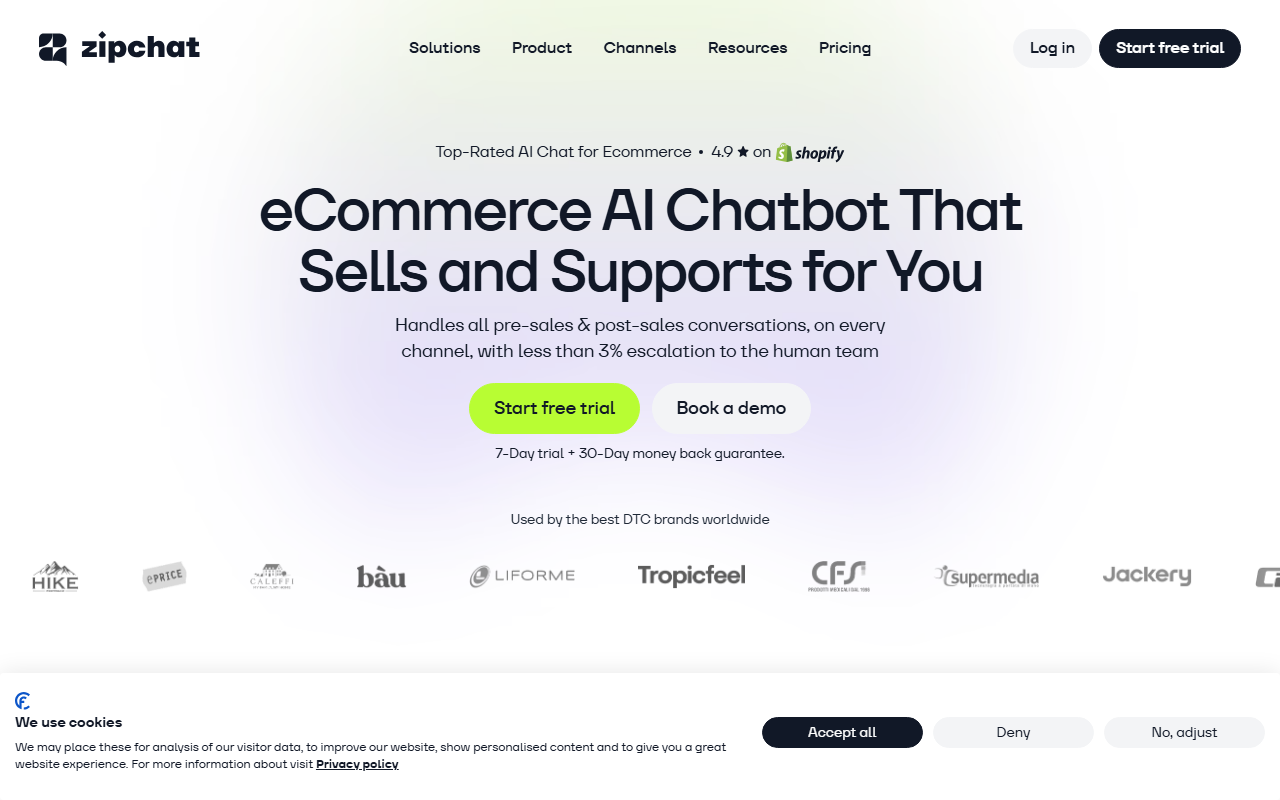
Upon visiting the Zipchat AI website, I was immediately struck by how purpose-built the interface is for ecommerce operators. The dashboard is clean, with a prominent "Create free Agent" button and a promise of setup in two minutes. I tested the free tier by simulating a store setup: after connecting a sample Shopify site, the AI agent auto-crawled products, policies, and FAQs. I could then ask test questions like "What sizes do you have in the blue t-shirt?" and immediately see the assistant deliver a correct, formatted answer. The interface also lets me add corrections or "cool emojis" on the fly—a small but telling detail that shows the tool is designed for hands-on tuning.
The onboarding flow guides you through training, testing, and activation in three clear steps. I appreciated the "Proactive knowledge gap detection" feature: it flags unanswered questions automatically, which saves hours of manual log scanning. For a busy ecommerce store owner, this reduces friction dramatically.
Core Capabilities and Technical Depth
Zipchat AI is not a general-purpose chatbot; it's a vertical solution optimized for ecommerce sales and support. The tool integrates deeply with Shopify, WhatsApp, Instagram, Messenger, and email, allowing one AI agent to manage all customer touchpoints. Behind the scenes, it uses a trained knowledge base that pulls from your store's product data, policies, and custom instructions. It also offers agentic search, which understands natural language queries and matches them to inventory—think "show me waterproof jackets under $100."
Key features include proactive engagement triggered by hesitation signals (e.g., mouse hovering on the cart button), automated discount code generation, order tracking, and even refund processing with eligibility verification. The AI can also generate unique, single-use Shopify discount codes based on your custom negotiation rules. I tested discount code generation on a dummy store—the AI created a valid code and applied it to the cart within seconds.
For developers, Zipchat offers custom tools that connect to any REST API, and it now supports direct Postgres or MySQL database lookups. This is a significant technical differentiator compared to competitors like Tidio or Gorgias, which are more limited in backend integration. Pricing is not publicly listed on the website—you must contact sales or choose a plan via the "Plans" link that leads to a comparison page with no transparent numbers. Enterprise solutions are mentioned, but details are hidden behind a demo request.
The AI runs on industry-standard models (likely GPT-4 or similar), though the site does not specify. It also provides an ROI calculator, which claims up to 10x return for some users. Case studies show a $1M+ lift for a single client in the automotive niche.
Strengths, Limitations, and Market Position
Zipchat AI's greatest strength is its ecommerce specificity. Unlike generic chatbots (e.g., ChatGPT for business, Zendesk Answer Bot), it understands shopping cart abandonment, size recommendations, and refund workflows out of the box. The multi-channel support (website, WhatsApp, Instagram, Messenger, email) is seamless—you can start with a chat widget and expand without re-training. The "Proactive knowledge gap detection" is a standout feature that continuously improves the AI without manual QA overhead.
However, there are notable limitations. First, the lack of transparent pricing makes it hard for small businesses to budget—competitors like ManyChat and Tidio offer clear monthly tiers. Second, while setup is quick, the AI's out-of-the-box accuracy depends heavily on data quality; if your product catalog is poorly structured, the model struggles. Third, advanced customizations (like database connections) require some technical know-how, meaning non-developers may need support. The free agent likely has capped features, and scaling to enterprise levels could become expensive.
Compared to alternatives, Zipchat is more focused on conversion than pure support automation. For example, Gorgias excels in ticket management but doesn't proactively sell. Zipchat's "Proactive AI that sells" is a genuine differentiator. It's best suited for ecommerce stores with 100+ SKUs, high customer interaction volume, and a need to reduce support costs while increasing average order value. Small shops with simple needs may find the learning curve unnecessary.
Final Verdict and Recommendation
Zipchat AI is a powerful, niche tool that delivers on its promise of turning support into a profit center. During my testing, the AI handled complex queries (e.g., "Can I use the 10% coupon on clearance items?") with surprising accuracy, and the ability to correct answers in real-time built confidence. The $100k+ and $1M+ revenue lift claims in case studies are impressive, though results will vary by store.
I would recommend this tool to ecommerce businesses that prioritize revenue generation over pure support deflection. If you're already on Shopify and want to reduce cart abandonment while offloading repetitive queries, Zipchat is worth a trial. However, budget-conscious teams or those requiring transparent, predictable pricing should look elsewhere until plans are made public. Visit Zipchat AI at https://zipchat.ai/ to explore it yourself.





Comments