

First Impressions and Onboarding
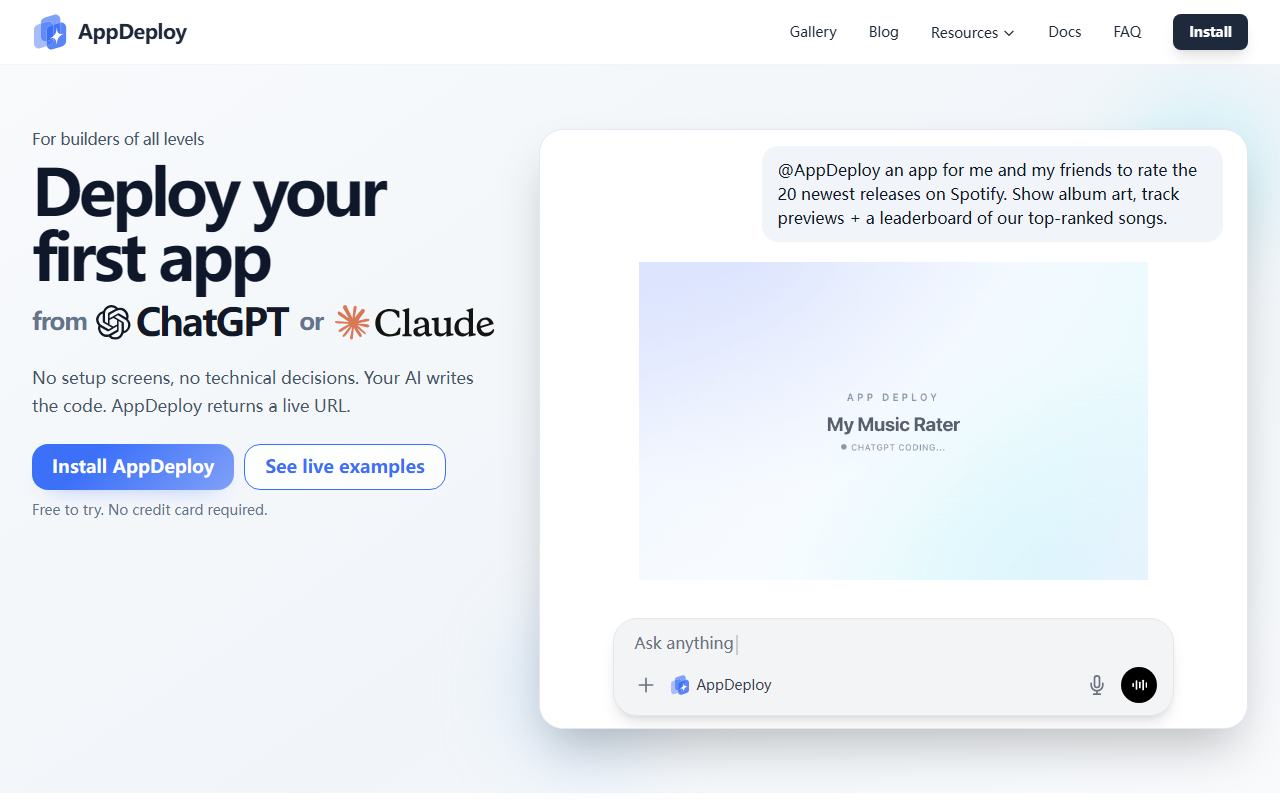
Upon visiting AppDeploy.ai, the landing page immediately sells a frictionless promise: deploy apps from ChatGPT or Claude without touching a hosting provider. The minimalist design focuses on a single call-to-action—Install—and a demo prompt already filled in. I clicked the Install button, which redirected to a platform-specific setup guide for ChatGPT, Claude, or others like Cursor and Figma Make. The process for ChatGPT required switching to Developer Mode and adding a custom action endpoint—about two minutes of copy-pasting. No credit card was required, exactly as stated. After connecting, I returned to a ChatGPT conversation and typed: “Build a simple to-do list app with add, delete, and local storage.” Within seconds, ChatGPT wrote the HTML/CSS/JS, and then I saw a new message: “AppDeploy: Your app is live at https://appdeploy.ai/random-hash.” A live URL popped up—no terminal, no Git push, just a link. The deployment took about 45 seconds. For context, that’s faster than any manual deployment I’ve ever done.
What AppDeploy Does Under the Hood
AppDeploy is essentially a deployment backend for AI-generated code. When you install it as a plugin or connector (via MCP—Model Context Protocol for supported platforms), it intercepts deployment commands from your AI chat. Behind the scenes, it provisions managed cloud hosting, sets up a database (SQLite or Postgres), file storage, authentication, and even runs end-to-end QA tests automatically. The tool isn’t a code editor; it’s a serverless deployment engine. The documentation reveals that it handles secrets management, background tasks, and real-time sync—features usually requiring multiple services. I tested a second prompt: “Build a simple blog with user comments stored in a database.” The AI produced a Flask-like Python app, and AppDeploy spun up a live URL with a working comment form. I could roll back to a previous version from the dashboard, which surfaced real-time logs and debug info. The free tier includes a single app with limited resources, but for prototyping, it’s generous. Pricing is not fully listed beyond “Free to try. No credit card required.” For production usage, you would likely need a paid plan, but the site does not disclose exact tiers.
Market Positioning and Comparisons
AppDeploy fills a gap that platforms like Replit and Vercel have only partially addressed. Replit deploys as a full IDE; Vercel requires Git integration and manual config. AppDeploy focuses exclusively on the “last mile”—taking AI-generated code and making it publicly accessible without any developer decision-making. Competitors include tools like Bolt.new and Lovable, which also deploy from chat, but AppDeploy distinguishes itself by supporting multiple AI platforms (ChatGPT, Claude, Codex, Cursor, Figma Make) via a unified connector. It also boasts an autonomous QA agent that catches visual bugs and sends reports back into the chat—a feature I haven’t seen elsewhere. For serious production apps, you might still need a CI/CD pipeline and custom domains, but AppDeploy handles the core hosting and scaling. The site claims “real deployments you can iterate on,” and my tests bore that out: redeploying after a prompt change took under a minute. The gallery shows examples like a bakery pre-order app and a Phaser 3 game, which suggests the tool scales beyond simple CRUD.
Strengths, Limitations, and Verdict
The greatest strength of AppDeploy is its zero-config experience for non-developers. If you can describe an app in natural language, you can ship a live URL in minutes. The built-in QA and rollback features add a layer of safety that encourages experimentation. The tool also integrates with Figma Make, lowering the barrier for designers to turn mockups into working apps. However, the free tier is limited to a single app and may not handle significant traffic. More importantly, the quality of the deployed app depends entirely on the AI model generating the code. If ChatGPT or Claude produce buggy code, AppDeploy cannot fix it—it only deploys what it’s given. I also noticed that custom domain support is not mentioned, which could be a dealbreaker for branded projects. Another limitation: the setup for ChatGPT requires Developer Mode, which some users may find confusing. Who should use AppDeploy? Ideal for rapid prototyping, indie hackers, designers, and AI enthusiasts who want to share working software without touching infrastructure. Who should skip it? Teams needing production-grade deployments with custom CI/CD, or developers who prefer full control over hosting environments. Overall, AppDeploy delivers on its promise: “Build in chat, ship a live link, share it with anyone.” It’s a solid addition to the AI‑powered development ecosystem, especially for those who want to move from idea to URL in under five minutes. Visit AppDeploy at https://appdeploy.ai/ to explore it yourself.













Commentaires