
First Impressions and Onboarding
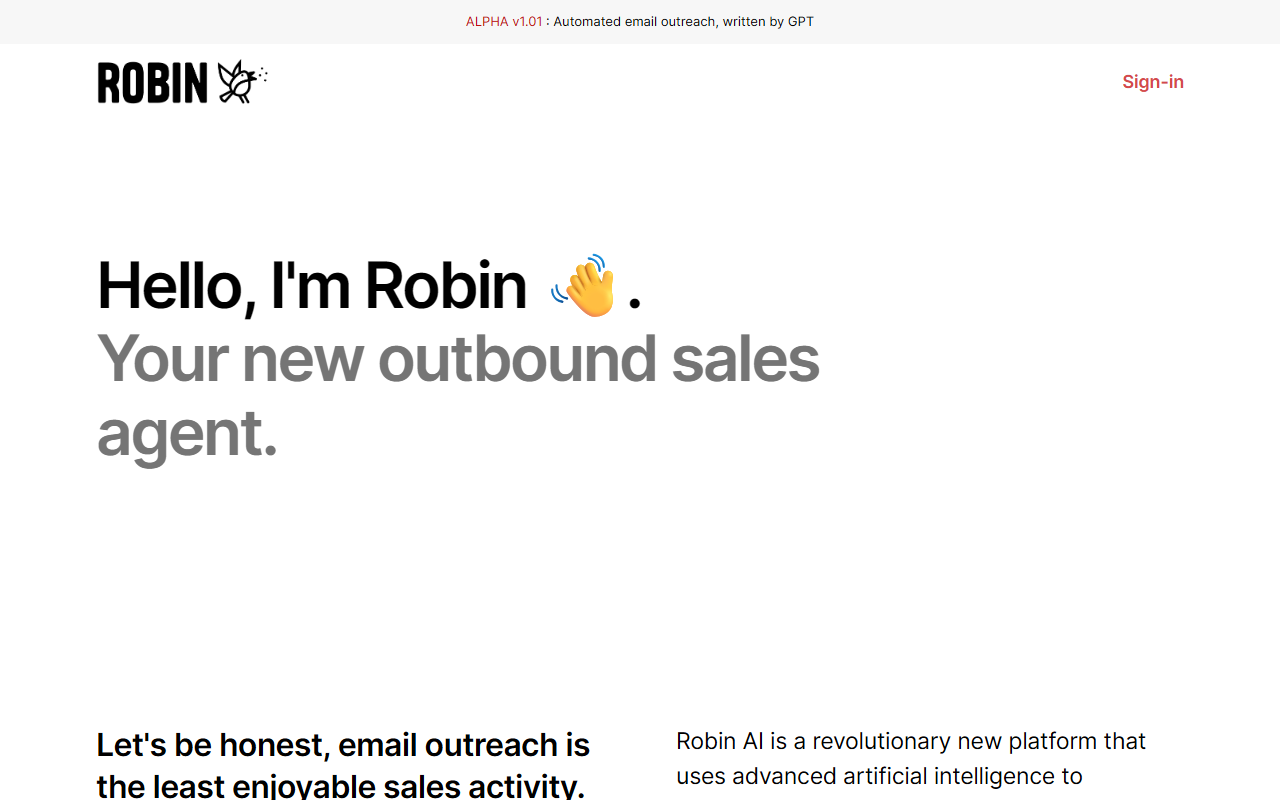
Upon visiting Robin AI at hellorobin.ai, the landing page presents a clean, modern interface with a clear value proposition: “Your new outbound sales agent.” The site highlights that the tool is currently in Alpha v1.01, powered by GPT. A large “Join the waitlist” button dominates the page, with a sign-in link for early testers. I clicked the beta demo link, which led to a short interactive walkthrough showing how Robin crafts and sends emails from the user’s own email address, tailoring copy based on lead information. The onboarding flow is minimal—understandable for an alpha product—but the demo effectively communicates the core workflow: compose, send, forward replies, and let Robin handle objections.
Core Features and Technology
Robin AI uses GPT-based language models to automate sales outreach. According to the site, the tool writes emails from your email address, adjusting copy for each lead. When a lead responds, you forward the email to Robin, and it crafts objection-handling replies with the goal of booking a call for your sales team. The platform claims to integrate with major CRMs, SMS, chat, and voice. Specifically, it supports targeted outreach, email campaigns, customer retention, and top-of-funnel lead generation. A case study mentions Balloons.Online, which used Robin to optimize birthday balloon sales and generated over $20,000 in the first month. However, no technical details about the specific GPT model version are provided, and the alpha status suggests limited feature availability.
Market Position and Alternatives
Robin AI enters a competitive space alongside established sales engagement platforms like Outreach and SalesLoft, as well as newer AI-native tools such as Lavender and Copy.ai’s sales features. Unlike Outreach, which is a full-fledged sales engagement platform with sequencing, analytics, and leaderboards, Robin focuses narrowly on automating the initial email outreach and objection handling. This makes it potentially simpler for small teams, but also more limited in scope. The alpha stage and waitlist access mean it’s not yet broadly available, and pricing is not publicly listed on the website. Given that it’s built by top sales experts, as stated, the team likely has domain knowledge, but the lack of transparency about roadmaps and pricing reduces credibility for immediate adoption.
Strengths, Limitations, and Recommendation
A genuine strength of Robin AI is its clear focus on the least enjoyable sales activity: cold email outreach. Using GPT to generate and adapt copy in real time could save significant time for sales reps. The ability to forward replies and let the AI handle objections is also novel and could accelerate pipeline creation. However, the alpha status is the biggest limitation. The tool may have bugs, limited customization, and no guarantee of future availability. Additionally, the waitlist means most readers cannot test it today. There is no visible pricing, which makes it impossible to assess value. For small business owners or solo entrepreneurs who hate prospecting and want to try an AI-driven assistant, joining the waitlist is worthwhile. But teams requiring robust analytics, multi-channel sequencing, or enterprise-grade integrations should stick with proven platforms like Outreach or SalesLoft for now. Visit Robin AI at https://hellorobin.ai/ to explore it yourself.











Commentaires