

First Impressions and Onboarding: A Platform Built for Scale
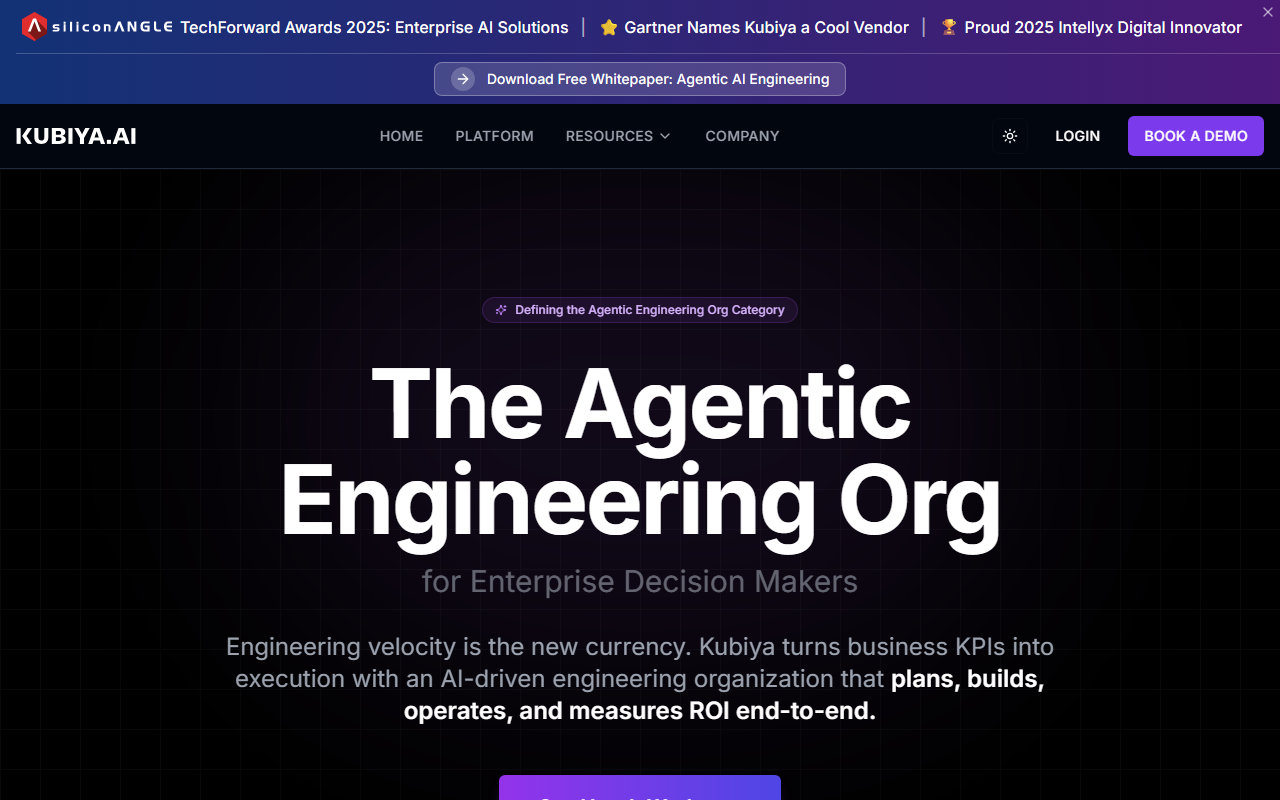
Upon visiting kubiya.ai, the landing page immediately signals that this is not a tool for solo developers. The hero section positions Kubiya as an "Agentic Engineering Org for Enterprise Decision Makers," and a quick scroll reveals logos from Atlassian, Microsoft, Ford, and Volkswagen. The interface is clean, with a seven-step operating system explained through a visual flowchart—from defining a virtual team structure to tracking work on a real-time engineering board. I clicked through the "See How It Works" area, but the demo video failed to load in my browser (a small frustration). However, the downloadable whitepaper on Agentic AI Engineering is available. The FAQ section is well-organized and addresses core concerns: no need to rewrite existing agents, support for any agent framework, and zero lock-in on infrastructure. For a first-time user, the site does a good job of explaining a complex concept, though I wished there was a sandbox or free tier to actually interact with the platform. Pricing is not publicly listed on the website; the only call-to-action is a "Request a Demo" button.
Core Technology and Differentiators: Deterministic Execution Meets Context Awareness
Kubiya solves a classic enterprise problem: how to make AI agents production-ready without sacrificing control or reliability. The platform sits between your agent code and the real world, enforcing what it calls "100% Deterministic" execution via strictly defined code paths. This is a breath of fresh air in an era of hallucination-prone LLMs. The architecture diagram shows a governance layer built on Open Policy Agent (OPA), RBAC, and compliance enforcement—all standardized as policy as code. Below that sits a Unified API Layer (REST, GraphQL, Webhooks), then a Context Graph & Intelligence Layer that uses a vector database for real-time semantic understanding. The orchestration layer manages durable execution and state, while distributed task workers run in microVM isolation across multi-environments. In practice, this means Kubiya can ingest tribal knowledge from Slack threads, docs, and code to build a "living map" of your systems. When an incident occurs, agents can surface the right logs and past solutions because they understand your topology and history. The platform claims zero latency (optimized for edge) and supports any API or existing CLI scripts. Compared to generic AI coding assistants like GitHub Copilot or Devin, Kubiya is not a code generator—it is an operating system for orchestrating agents that plan, build, and operate infrastructure. Competitors in this space include ServiceNow's AIOps and Rundeck, but Kubiya focuses specifically on agentic engineering with guaranteed deterministic outcomes.
Strengths and Real-World Limitations
The biggest strength of Kubiya is its enterprise-grade guardrails. The promise of no hallucinations for critical operations, combined with full audit logs, VPC deployment support, and policy enforcement, will appeal to regulated industries like finance or healthcare. The result metrics displayed on the site—0M+ automated tasks per month, $0M+ in engineering productivity gains, and 0% average ROI annualized—are impressive, though they lack source citations. The endorsements from Gartner (Cool Vendor) and Intellyx (Digital Innovator) add credibility. However, there are notable limitations. First, the platform is clearly aimed at large organizations with existing agent frameworks and mature DevOps pipelines. Small teams or individual developers will find the onboarding heavy and the pricing opaque. Second, while the site claims zero lock-in, the deep integration with its context graph and orchestration layer might create a soft lock-in over time. Third, the lack of a self-service free tier or sandbox makes it hard to evaluate before committing to a demo. Additionally, the deterministic execution claims are bold but unverified—users will need to test whether their custom agents truly remain deterministic inside Kubiya's runtime. Finally, the video demo not loading was a minor but off-putting technical hiccup for a tool that sells reliability.
Final Verdict: Who Should Use Kubiya?
Kubiya is best suited for enterprise engineering organizations that are already running multiple AI agents in production and need to enforce governance, context, and measurable ROI. If your team is tired of ad-hoc agent deployments and wants a unified platform to plan, build, operate, and track outcomes, Kubiya is a strong candidate. The HashiCorp co-founder quote on the site reinforces its credibility in infrastructure automation. On the flip side, if you are an indie developer or a small startup experimenting with LLM-based agents, look elsewhere—try something like Prefect for workflow orchestration or LangChain for agent frameworks. There is no pricing transparency, so be prepared for a sales conversation. I recommend requesting a demo if your organization handles hundreds of monthly automated tasks and requires secure, auditable, and deterministic AI execution. Visit Kubiya at https://kubiya.ai/ to explore it yourself.













Commentaires