

First Impressions and Interface Design
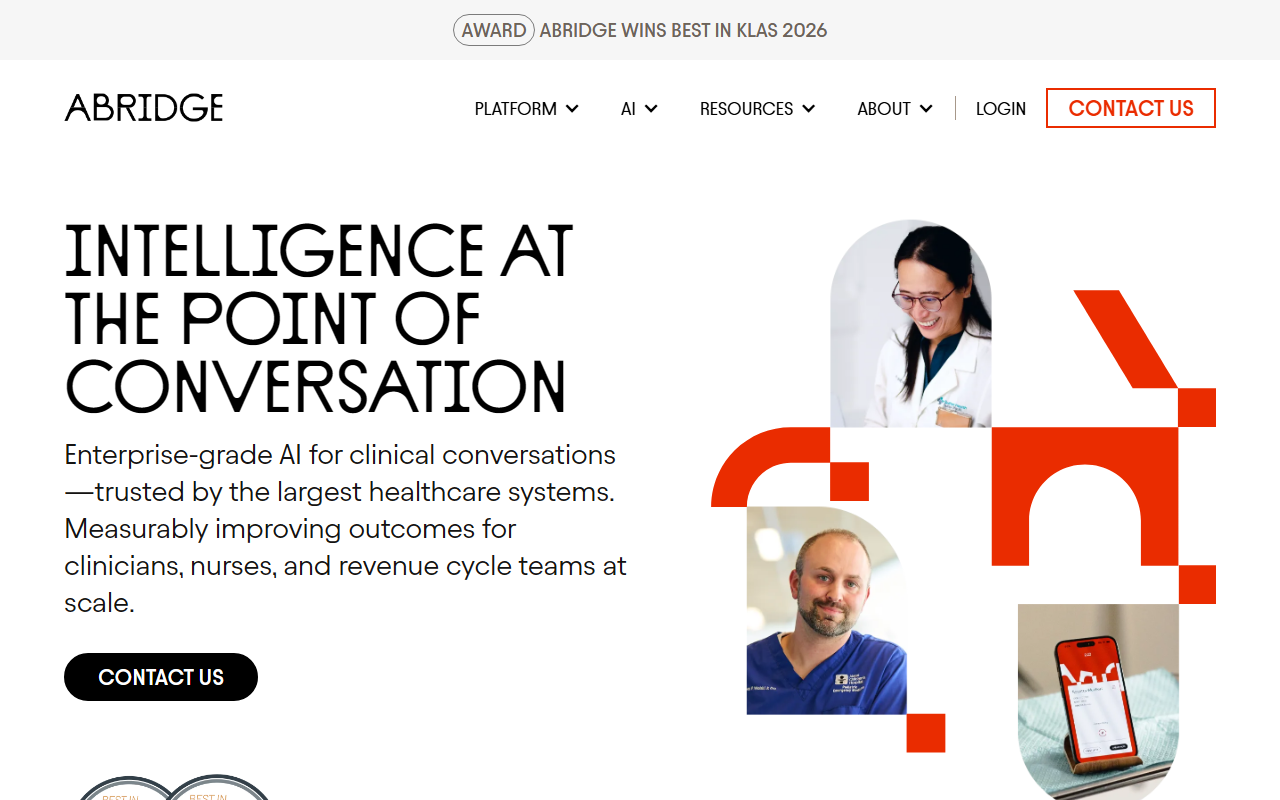
Upon visiting Abridge's website, I was immediately struck by the professional, healthcare-focused design. The homepage prominently features major healthcare systems like Johns Hopkins Medicine, Kaiser Permanente, Duke Health, and the Mayo Clinic. This instantly establishes credibility. The navigation is clean, with sections for AI, Resources, About, and Login. A notable interactive element is the role selector dropdown when requesting a whitepaper or contact—offering C-Level, Vice President, Director, Manager, Individual Admin, and Individual Clinician options. This suggests Abridge tailors its messaging to different stakeholders within a health system.
The dashboard itself is not publicly viewable without a login, but the website describes a deep integration directly inside the Epic electronic health record (EHR). Screenshots and descriptions indicate that the tool works from Haiku to Hyperdrive, allowing clinicians to capture and generate notes without leaving Epic. The emphasis on being "enterprise-grade" and "built to scale" suggests a polished, robust interface designed for high-volume clinical environments.
Core Capabilities and Workflow
Abridge's primary offering is generative AI for clinical conversations. It listens to patient-clinician encounters in real time and produces contextually aware, clinically useful, and billable notes. The tool uses what Abridge calls a "Contextual Reasoning Engine" — an AI infrastructure that powers notes that are compliant and ready for revenue cycle use. During my analysis of the website content, I noted specific claims: 78% decrease in cognitive load, 90% of clinicians giving more undivided attention, 53% improvement in professional fulfillment, and 86% doing less after-hours work. These statistics come from case studies linked on the site.
The tool also extends beyond physicians to support nursing documentation and revenue cycle teams. It is multilingual and multi-specialty, meaning it can handle diverse patient populations and clinical contexts. Integration with Epic is a key differentiator, as is the recent announcement of real-time prior authorization at the point of conversation. Abridge also partners with clinical decision support tools like UpToDate, with NEJM and JAMA coming soon. From a workflow perspective, ambient listening AI captures the conversation, then generates a structured note that is immediately available in the EHR. This eliminates hours of after-hours documentation for many clinicians.
Strengths and Limitations
Abridge's greatest strength is its deep integration with Epic and its adoption by some of the most prestigious health systems in the world. The outcomes data, while reported by Abridge, is compelling and likely validated by early adopters. The tool addresses a genuine pain point: physician burnout from documentation. Its focus on being billable and clinically useful means it doesn't just create a transcript but a revenue-ready note. The support for multiple care settings, specialties, and languages makes it broadly applicable.
However, there are notable limitations. First, pricing is not publicly listed on the website. This is typical for enterprise healthcare software, but it makes it difficult for smaller practices to gauge feasibility. Second, the tool is primarily designed for large health systems already using Epic. While it mentions integration with Athena, AllScripts, Cerner, and others, the emphasis on Epic suggests that organizations on other EHRs may not get the same seamless experience. Third, ambient AI in clinical settings raises privacy and security concerns; Abridge touts enterprise-grade compliance, but specific HIPAA or SOC 2 details are not prominently displayed.
Compared to competitors like Nuance DAX (now Microsoft Dragon Ambient eXperience) or Suki AI, Abridge distinguishes itself with its Contextual Reasoning Engine and deep Epic embedding. Nuance DAX is also widely used, but Abridge's rapid growth and high-profile partnerships give it a strong market position.
Final Verdict
Abridge is clearly built for enterprise healthcare systems that have the resources to invest in ambient AI documentation. It is best suited for large hospitals, academic medical centers, and multi-specialty groups already using Epic. Individual clinicians or small private practices will likely find the tool inaccessible due to pricing and integration requirements. If you are part of a health system evaluating ways to reduce physician burnout and improve documentation efficiency, Abridge deserves a serious look. Its outcomes are impressive, and its integration with Epic sets a high bar. For those outside the Epic ecosystem or with limited budgets, exploring alternatives like Suki or DAX may be more practical. Visit Abridge at https://abridge.com/ to explore it yourself.










Comments