

First Impressions and Onboarding
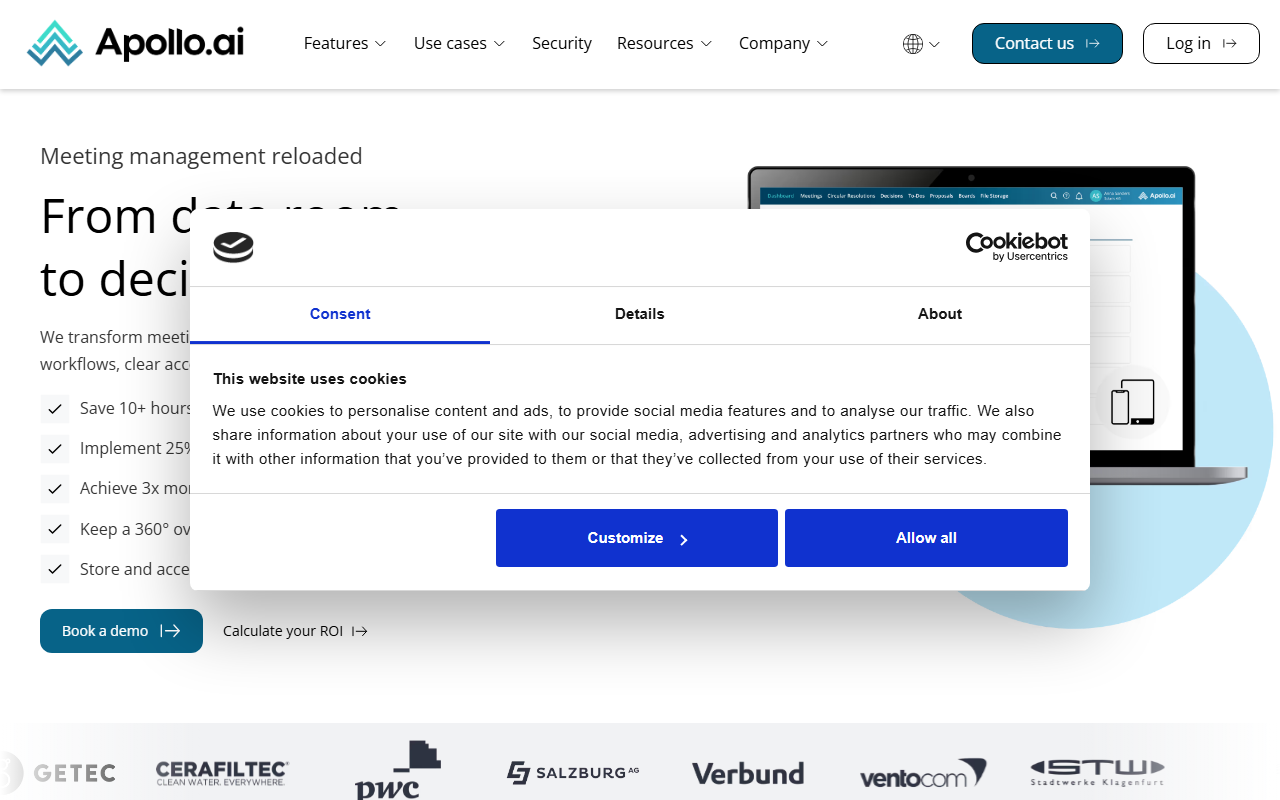
Upon visiting the Apollo.ai website, I was immediately struck by its focus on structured governance rather than flashy AI features. The landing page clearly markets itself as a board management solution, not a general-purpose office tool. The call to action is obvious: "Book a demo" or "Calculate your ROI." There is no free tier to test directly, which suggests a strong enterprise focus. The onboarding appears to be handled entirely by the Customer Success team, and the site promises a quick go-live in days with no complex setup. That level of hand-holding is typical for high-ticket enterprise software. I noted the separate user personas listed: Executive Board Members, Supervisory Board Members, Executive Assistants, Governance Officers, and IT Managers. This segmentation immediately tells me the tool is built for high-stakes decision-making environments, not casual users. The site itself is clean, with a simple layout that mirrors its promise of structured workflows. The emphasis on "100% secure – hosted in EU" and "made in EU" was prominent, signaling a selling point for European companies needing GDPR compliance.
Core Features and AI Integration
So what does Apollo.ai actually do? It replaces messy email chains and PDF data rooms with a step-by-step meeting workflow. The AI component is not spelled out in technical detail, but the site claims "AI-driven meeting management" and helps save over 10 hours per meeting, implement 25% more decisions, and achieve 3x more commitment. The dashboard is described as a 360° overview where users can track action items, decisions, and documentation in real time. I observed that the platform integrates structured agendas, clear action points, automated follow-ups, and audit-ready decision logs. For compliance officers, it offers full compliance tracking with audit trails. For IT managers, it is a cloud-native, security-first platform that integrates without friction. The underlying technology appears to be a proprietary cloud-based system hosted in the EU, though the specific AI models or engines are not disclosed. There is no mention of API availability on the landing page. Competitors in this space include Boardable and Diligent Boards, but Apollo.ai differentiates itself with its EU hosting, focus on decision commitment tracking, and the promise of rapid onboarding. It is not a text generation tool; rather, it uses AI to automate governance workflows, track decisions, and ensure accountability.
Pricing and Market Position
Pricing is not publicly listed on the website. The call to action is to book a demo or calculate ROI, indicating a custom quote model. Given the enterprise nature, expect a per-user per-month fee likely in the range of several hundred dollars per seat annually. Apollo.ai lists impressive statistics: 94% customer retention, 4.8/5 satisfaction score, and over 4,000 meetings held on the platform. These numbers suggest a mature, well-loved product. However, the lack of transparent pricing may be a hurdle for smaller boards or nonprofits with limited budgets. For context, alternatives like Boardable offer transparent starting tiers, while Diligent often serves larger public companies. Apollo.ai seems best suited for mid-to-large European organizations that value strict data sovereignty and want a dedicated governance tool. It is less suited for teams looking for a general AI writing assistant or simple to-do list for meetings. The tool’s strength lies in its structured, secure collaboration and decision tracking, not in generating content or brainstorming ideas.
Verdict and Recommendations
Honestly, Apollo.ai does what it promises: it transforms chaotic board meetings into streamlined, accountable workflows. The genuine strength is its focus on decision implementation and commitment tracking, which most meeting tools ignore. The testimonial from a CEO and a General Counsel reinforce that it addresses real governance pain points. However, a real limitation is that it is a niche tool. If you’re not an executive assistant, board member, or compliance officer, you likely don’t need it. Also, without a free trial, you cannot assess the user interface firsthand before committing to a demo. The AI aspect is understated – it is more about process automation than generative intelligence. For whom is it ideal? European boards and leadership teams that need audit-proof, secure meeting management with clear accountability. Everyone else should look at simpler tools like Notion or Trello for basic meeting notes. My recommendation: if you spend hours on agenda preparation and follow-ups, book that demo. Here is a balanced final word: Apollo.ai excels at structured governance, but verify the price tag matches your budget.
Visit Apollo.ai at https://apollo.ai to explore it yourself.










Comments