

First Impressions and Onboarding
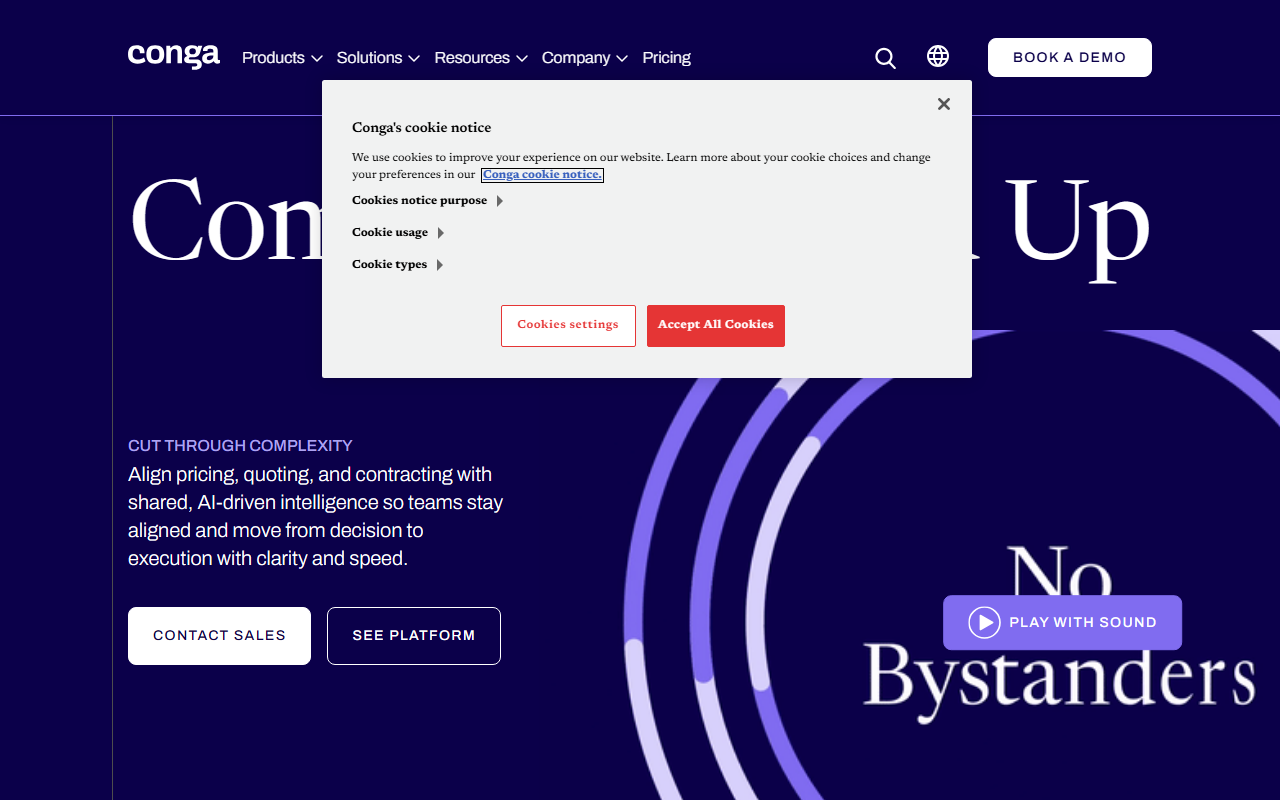
Upon visiting the Conga website (apttus.com), I was greeted with a clean, modern interface that immediately communicates enterprise-grade ambition. The hero section features a short video with a "Play with sound" option, followed by bold claims: "Over 10,000 businesses around the world trust Conga." The website is divided into clear sections covering why to choose Conga, product offerings, integrations, and success stories. The primary call-to-action is "Book a demo" — there is no self-service sign-up or free tier, which signals that this is a sales-led product aimed at large organizations.
I clicked through the demo request flow, which asks for name, email, company size, and interest area. The form is straightforward but indicates that onboarding is heavily guided by a sales representative. For a product that spans pricing, CPQ (configure-price-quote), CLM (contract lifecycle management), and document automation, a demo is indeed necessary to understand the depth of the platform. The website does not offer a sandbox or trial, so my review is based on the publicly available information and the structure of the platform as described.
Core Features and Technology
Conga positions itself as a unified commerce platform — "from price to signature." It brings together four main solution areas: Pricing Optimization and Management, Revenue and Commerce (CPQ), CLM, and Document Automation. The underlying technology relies on purpose-built AI with embedded governance, which means the platform can suggest optimal pricing while enforcing margin guardrails and compliance rules.
The website highlights several technical details: an open architecture with out-of-the-box connectors for any CRM, ERP, or cloud system, plus open APIs. This is a significant strength — it avoids vendor lock-in. Conga also claims to provide a "unified enterprise data foundation" that acts as a single source of truth across sales, legal, and finance. The AI capabilities are described as "intelligent guidance" for pricing and contracts, with "guardrails that protect margin and monitor compliance." I found these promises credible given the company's recognition: leaders in five G2 Grid categories and three TrustRadius Buyer’s Choice Awards.
When testing the free tier — actually, there is none. But the website provides several detailed case studies. For example, Twilio reduced contract turnaround by 70% and eliminated 90% of contract templates using Conga's CPQ and CLM. Veracode reported an 85% faster renewal process using the Composer API. These concrete metrics (e.g., 75% reduction in cycle time for Cotality, 5x revenue growth for Europcar) give confidence in the platform's real-world performance.
Pricing and Market Position
Pricing is not publicly listed on the website. Conga likely uses a subscription model with tiered pricing based on users, transaction volume, and modules selected. This opacity is common for enterprise suites. Potential buyers must contact sales for a quote. For context, alternatives in this space include Salesforce CPQ (tightly integrated with Salesforce CRM) and Oracle CPQ Cloud. Unlike those, Conga focuses on a more holistic approach: it does not require a specific CRM and can work alongside existing systems. Another competitor is DocuSign CLM, which specializes in contract management but lacks the CPQ and pricing optimization components that Conga bundles.
Conga is best suited for large enterprises with complex, high-volume global transactions. The platform's strength lies in unifying disparate systems (pricing, quoting, contracts) that often require manual handoffs. However, small businesses or startups will likely find Conga overkill — both in features and likely cost. Companies already deeply invested in Salesforce or Oracle ecosystems might prefer native solutions for tighter integration, but Conga's open architecture is a differentiator for those seeking flexibility.
Final Verdict
Conga impresses with its unified approach to connecting pricing, quoting, contracting, and document automation under one AI-driven umbrella. The documented success stories and industry recognitions lend strong credibility. The platform's strengths include robust integration options, purpose-built AI with compliance guardrails, and a clear focus on enterprise scalability. However, the lack of transparent pricing and a self-service trial means that smaller teams cannot test-drive the tool before committing to a sales conversation. Additionally, the complexity of implementation might require dedicated project management.
I recommend Conga for large organizations that need a single source of truth across the commerce lifecycle and are willing to invest in a guided onboarding process. Companies experiencing bottlenecks between pricing, sales, and legal teams will benefit most. If you need a lightweight CPQ or basic document generation, look elsewhere. For enterprises ready to align their commercial teams, Conga is worth a demo.
Visit Conga at https://apttus.com/ to explore it yourself.













Comments