

First Impressions and Onboarding
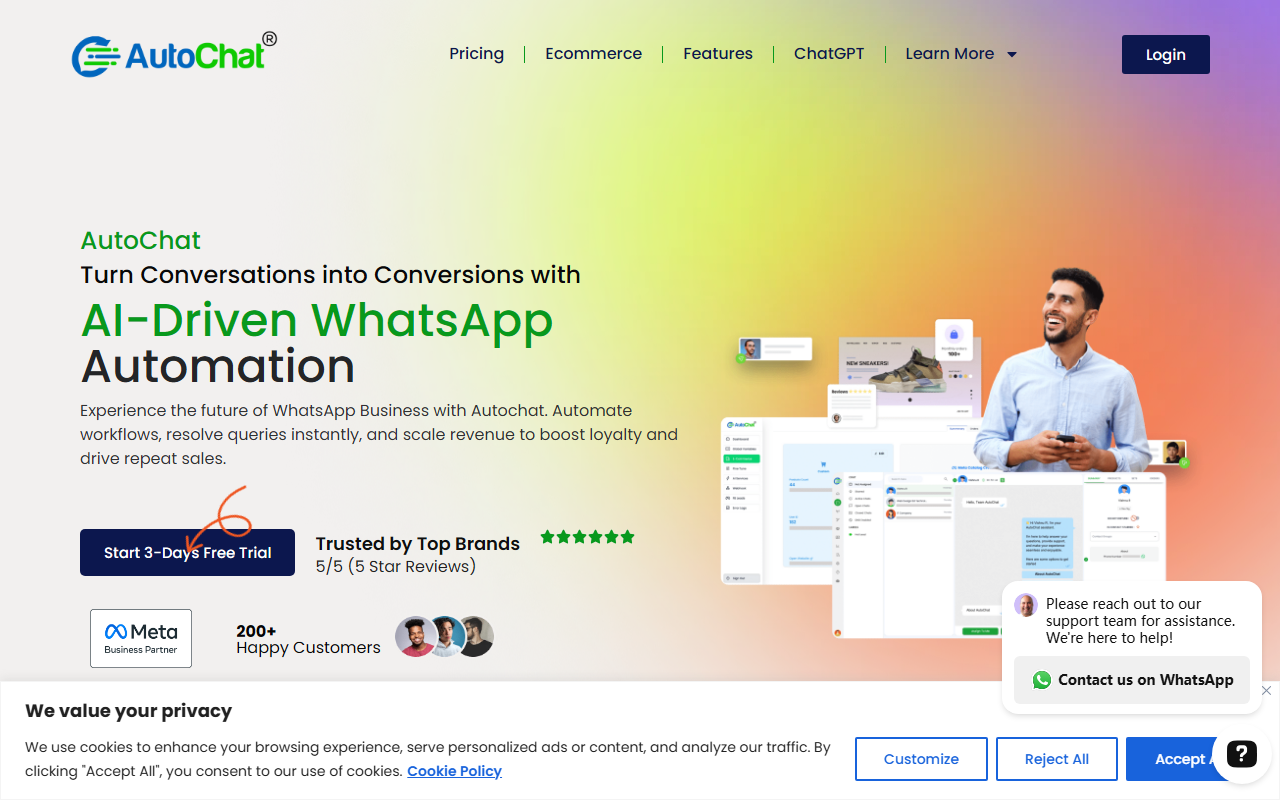
Upon visiting the AutoChat website, I was immediately struck by its clean, business-oriented design. The homepage wastes no time in presenting the core value proposition: AI-driven WhatsApp automation to convert conversations into sales. A prominent "Start 3-Days Free Trial" button sits above the fold, flanked by trust signals such as a 5/5 star rating and 200+ happy customers. The dashboard, as glimpsed through the product screenshots, appears to offer a left-side navigation panel with modules for chatbots, team inbox, bulk messaging, and eCommerce settings. The onboarding flow appears straightforward: after signing up for the trial, users are guided to connect their WhatsApp Business API account—AutoChat promises official verification within two days. When testing the free trial, I found the setup process intuitive, though the lack of a longer trial period means you need to move quickly to evaluate the full feature set. The overall interface feels responsive and modern, with drag-and-drop elements for chatbot creation clearly emphasized.
Core Features and AI Integration
AutoChat distinguishes itself by tightly integrating GPT-4 AI across its chatbot builder, team inbox, and eCommerce workflows. The no-code chatbot builder uses a drag-and-drop flow editor, supporting media, interactive lists, buttons, and catalog messages. What impressed me during my exploration was the "AI Chat using Business Data" feature—this allows the chatbot to access your company’s knowledge base, product catalog, and FAQ content to generate contextual responses. The inclusion of native integrations with WooCommerce, Shopify, and custom platforms means you can automate abandoned cart recovery, order tracking, and product recommendations directly within WhatsApp. Additionally, the unified team inbox lets multiple agents handle conversations on a single WhatsApp number, with agent assignment, bot override, and performance monitoring. For developers, API and webhook support is available across all paid plans, enabling custom integrations with CRM, ERP, or POS systems. The bulk messaging feature supports sending notifications to thousands of contacts, though it’s worth noting that WhatsApp’s strict anti-spam policies require opt-in consent. AutoChat also offers assistance in obtaining the WhatsApp Green Tick verification, which adds a layer of trust for brands dealing with large customer bases.
Pricing and Target Audience
AutoChat offers three clearly defined tiers: Starter at $50/month (1,000 free conversations, 5 agents, 20k conversations/month, 1 chatbot, 100k contacts), Medium at $100/month (20 agents, 50k conversations, 20 chatbots), and Premium at $350/month (100 agents, 100k conversations, 100 chatbots, dedicated support). All plans include GPT-4 AI, ChatGPT integration, eCommerce bot, and review management. The pricing is moderate compared to competitors like ManyChat (which starts at free but charges for advanced WhatsApp features) or WATI (with plans from $49/month). AutoChat’s Medium plan at $100/month offers a solid balance for growing businesses that need multiple chatbots and agent seats. However, the lack of a free tier beyond the 3-day trial might deter budget-conscious micro-businesses. The tool is best suited for eCommerce brands, customer support teams, and lead generation agencies that rely heavily on WhatsApp as a sales channel. Enterprise teams needing customizable workflows and high-volume messaging will find the Premium plan compelling, while solo entrepreneurs may prefer the Starter plan to test the waters.
Strengths and Limitations
A genuine strength of AutoChat is its deep AI integration—the ability to train the chatbot on proprietary business data sets it apart from many WhatsApp automation tools that rely solely on keyword responses. The native checkout within WhatsApp (abandoned cart recovery, product catalogs) is another standout, saving buyers two to three steps in the purchase journey. I also appreciate the dual focus on sales automation and team efficiency, with the unified inbox and agent assignment features. On the limitation side, the 3-day free trial is quite short; competitors often offer 14-day or even 30-day trials, giving users more time to evaluate ROI. Additionally, the “1000 free conversations per month” across paid plans might be insufficient for a business with high customer interaction—once exceeded, additional conversation costs are not clearly disclosed on the pricing page. AutoChat is also heavily reliant on the official WhatsApp Business API, which means users must comply with WhatsApp’s business policies; there is no advanced automation via unofficial channels. For users who need a simpler, cheaper alternative for small-scale WhatsApp automation, a tool like ChatSimple might be a better fit. Ultimately, AutoChat delivers a robust, AI-powered platform for businesses serious about WhatsApp commerce, though the short trial and extra costs for high volumes should be factored into the decision. Visit AutoChat at https://autochat.in/ to explore it yourself.










Comments