

First Impressions and Onboarding
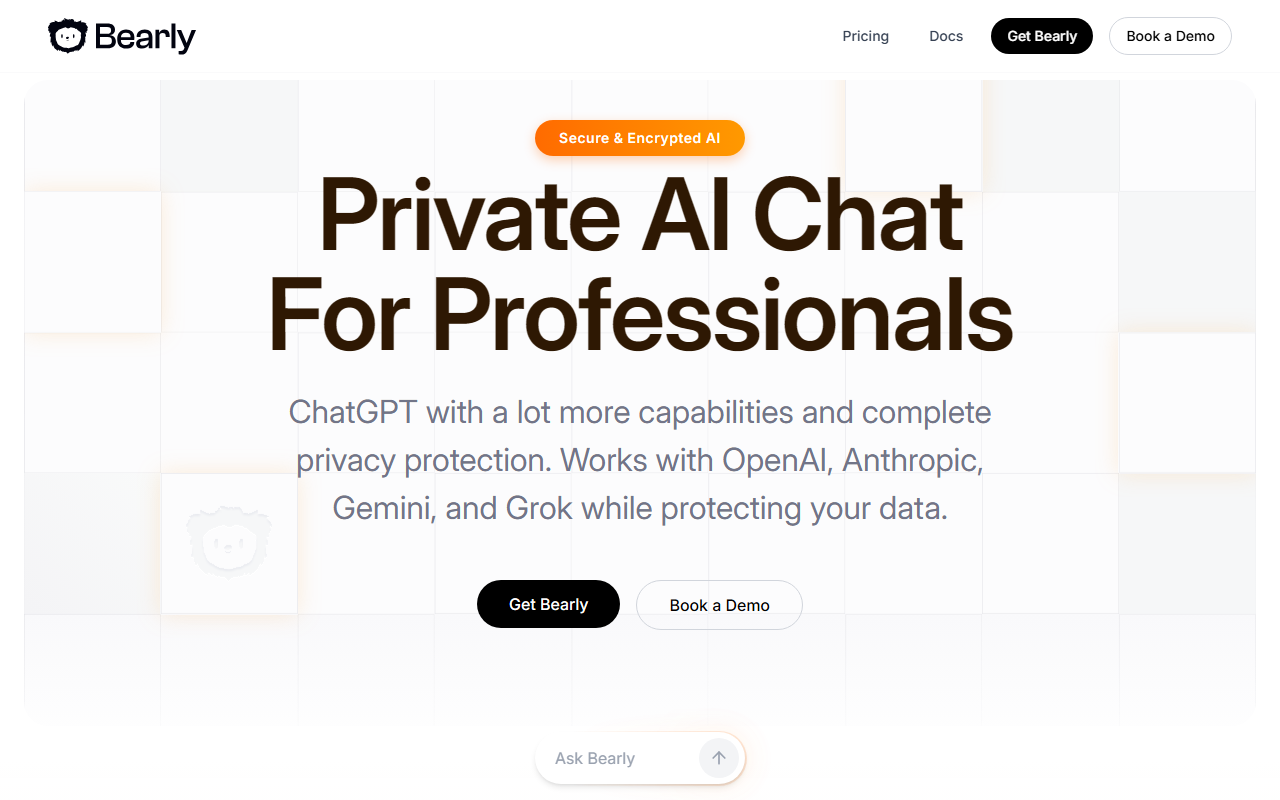
Upon visiting the Bearly AI website, the message is immediate and clear: this is a privacy-first platform designed for professionals. The homepage greets you with the tagline "The Private ChatGPT Platform" and a prominent call-to-action to get Bearly or book a demo. The design is clean and corporate, with sections highlighting security, enterprise features, and multi-model support.
I signed up for the free tier to explore the interface. Onboarding is straightforward — you choose between using the web app or downloading a desktop application. The dashboard presents a chat interface similar to ChatGPT but with additional panels for memory, agents, and artifacts. The left sidebar lets you switch between different AI models, including OpenAI, Anthropic, Gemini, and Grok.
During my test, I asked Bearly to draft a market analysis report. It responded by offering to use a "research agent" that could pull live data and structure the output. The response was well-formatted, and I appreciated the transparency about which model was handling the request. The canvas feature also allowed me to collaborate on the document in real time — a nice touch for team workflows.
Features and Technical Capabilities
Bearly AI is not just a chatbot; it's an all-in-one AI suite. The platform integrates cutting-edge models from OpenAI, Anthropic, Grok, Google, Meta Llama, and Mistral. This means you can switch between models per task — for example, using Claude for analytical reasoning and GPT-4 for creative writing — all within one session.
Beyond chat, Bearly offers smart agents for research and data analysis, a collaborative canvas for real-time editing, and a secure code interpreter that runs in an isolated environment. The "Insightful Artifacts" feature lets you build interactive dashboards and even dynamic websites directly from the chat. Multimodal capabilities include image generation, transcription, and speech-to-text/text-to-speech.
One standout technical detail is the advanced memory system. It leverages past interactions to build a sustainable knowledge base, so Bearly remembers your preferences and project context over time. The company claims daily updates and continuous innovation, which is ambitious but plausible given the fast-moving AI landscape.
For developers, Bearly provides API flexibility and the option to use your own API keys. This is a significant advantage for teams that already have contracts with specific providers and want to avoid additional per-seat costs.
Privacy and Enterprise Readiness
Privacy is Bearly's core selling point. The platform enforces a zero-logging policy — your conversation content is never stored. All chats, files, and memories are encrypted using ephemeral session keys, and queries sent to third-party AI models are anonymized to prevent linkage back to your identity. You can also manage your own encryption keys if you prefer.
For enterprises, the platform supports SSO, SAML, and IAM integration, along with granular user management and budget controls. Compliance with SOC 2, GDPR, and CCPA is promised. White-labeling and custom workflows are available for teams that need to align the tool with their brand. The integrations marketplace offers pre-built modules to extend functionality — though I couldn't verify the depth of these integrations without a deeper trial.
One limitation: the website does not list specific pricing tiers. While it states "transparent pricing with unlimited users, modules, teams, and agents," actual costs are only disclosed via demo or signing up. This opacity may frustrate smaller teams or solo professionals who want a clear upfront cost before committing.
Pricing, Competitors, and Recommendations
Pricing is not publicly listed on the website. The platform appears to operate on a subscription model, likely with custom enterprise plans. There is a free tier, but its limitations are not spelled out. For comparison, ChatGPT Enterprise charges per user per month, while tools like Poe offer multi-model access with transparent pricing. Bearly differentiates itself through its uncompromising stance on privacy and the breadth of enterprise features.
The platform is best suited for professionals and teams handling sensitive data — legal, finance, healthcare, or any organization subject to strict compliance regulations. It also appeals to power users who want to switch between multiple AI models without juggling separate accounts. However, casual users or those on a tight budget may find the lack of clear pricing and the enterprise-heavy focus less accessible.
Genunine strengths include unmatched data protection, multi-model integration, and a feature-rich platform. Real limitations include limited public pricing information and a steeper learning curve due to the sheer number of options. If you prioritize privacy and need a secure AI assistant that adapts to your workflows, Bearly AI is a strong contender.
Visit Bearly AI at https://bearly.ai/ to explore it yourself.










Comments