

What Is Crowdfire Today?
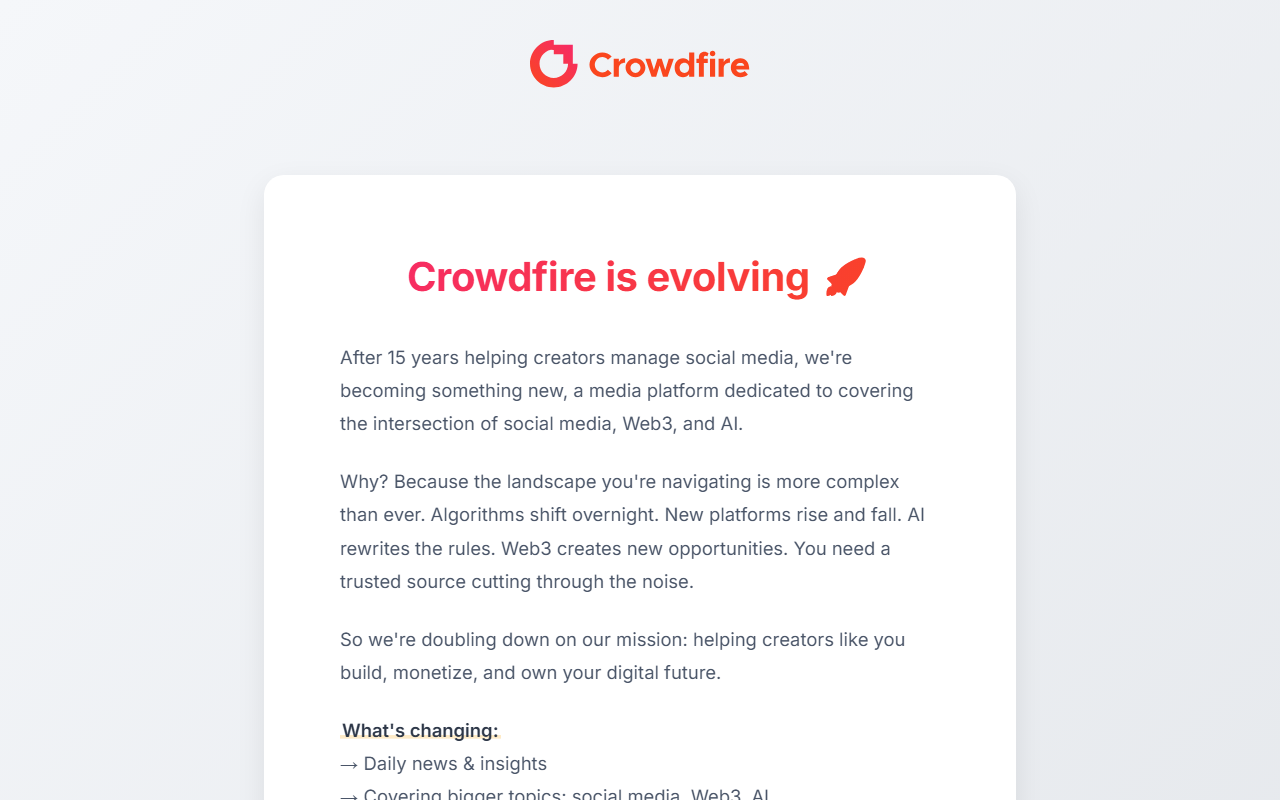
Upon visiting Crowdfire's website, I was greeted not with a dashboard or a login screen, but with a bold announcement: “Crowdfire is evolving.” After 15 years as a social media scheduling and analytics tool, the company is pivoting to become a media platform dedicated to covering social media, Web3, and AI. The site now resembles a blog more than a software product, with a focus on daily news and insights. There is no sign of the old tool or any AI writing features currently available. This is a complete transformation, not an incremental update.
For context, Crowdfire originally helped creators schedule posts, manage multiple accounts, and analyze engagement. It competed with tools like Buffer and Hootsuite. Now, those functionalities appear to be retired. The new Crowdfire aims to be a trusted source for navigating the shifting landscape of algorithms, new platforms, and decentralized technologies.
My Experience Browsing the New Platform
When I landed on the site, the homepage was clean and minimal, featuring a mission statement and a list of what's changing versus what's staying the same. There is no product demo, no free tier to test, and no dashboard. The only call to action is a likely future newsletter signup or article feed, though at the time of review, I found no active subscription form or content archive. The site appears to be in a very early stage of this pivot.
Because there is no actual tool to interact with, I cannot evaluate response quality or workflow. The announcement promises daily news and insights, but as of now, no articles are published. This makes it impossible to assess the depth or accuracy of their coverage. The community and “No BS approach” are cited as staying the same, but without visible community forums or recent posts, that claim is hard to verify.
Strengths and Limitations
The primary strength of this pivot is Crowdfire's established reputation. The brand has been around for 15 years and has a built-in user base of creators. The focus on AI and Web3 is timely, and if executed well, the platform could become a valuable resource. Additionally, the commitment to creators and an honest, straightforward tone is refreshing.
However, the limitations are significant. As of this writing, there is no active tool or service. If you are looking for an AI writing assistant or a social media management solution, Crowdfire currently offers nothing. The pivot is essentially a restart; the old product is gone, and the new one has not yet launched. Pricing is not publicly listed because there is nothing to sell yet. Competitors like Buffer and Hootsuite continue to offer robust tools, and AI writing platforms like Jasper or Copy.ai provide immediate value. Crowdfire's future depends entirely on its ability to produce high-quality journalism, which is a completely different skill set from building a SaaS product.
Who Should Pay Attention and Final Verdict
This new Crowdfire is best suited for creators and professionals who want to stay informed about social media trends, AI developments, and Web3 opportunities. If you previously relied on Crowdfire for scheduling, you should look elsewhere for now—Buffer or Later are more reliable alternatives. If you are interested in a media platform that promises to cut through the noise, keep an eye on Crowdfire's next steps, but don't expect a working tool anytime soon.
In summary, Crowdfire is in a transition period with no active product. The idea is ambitious, but execution remains to be seen. I would not recommend it as a current tool for any workflow. However, if the team succeeds, it could become a go-to news source for the creator economy. For now, proceed with cautious interest.
Visit Crowdfire at https://crowdfireapp.com/ to explore it yourself.










Comments