

First Impressions and Core Value Proposition
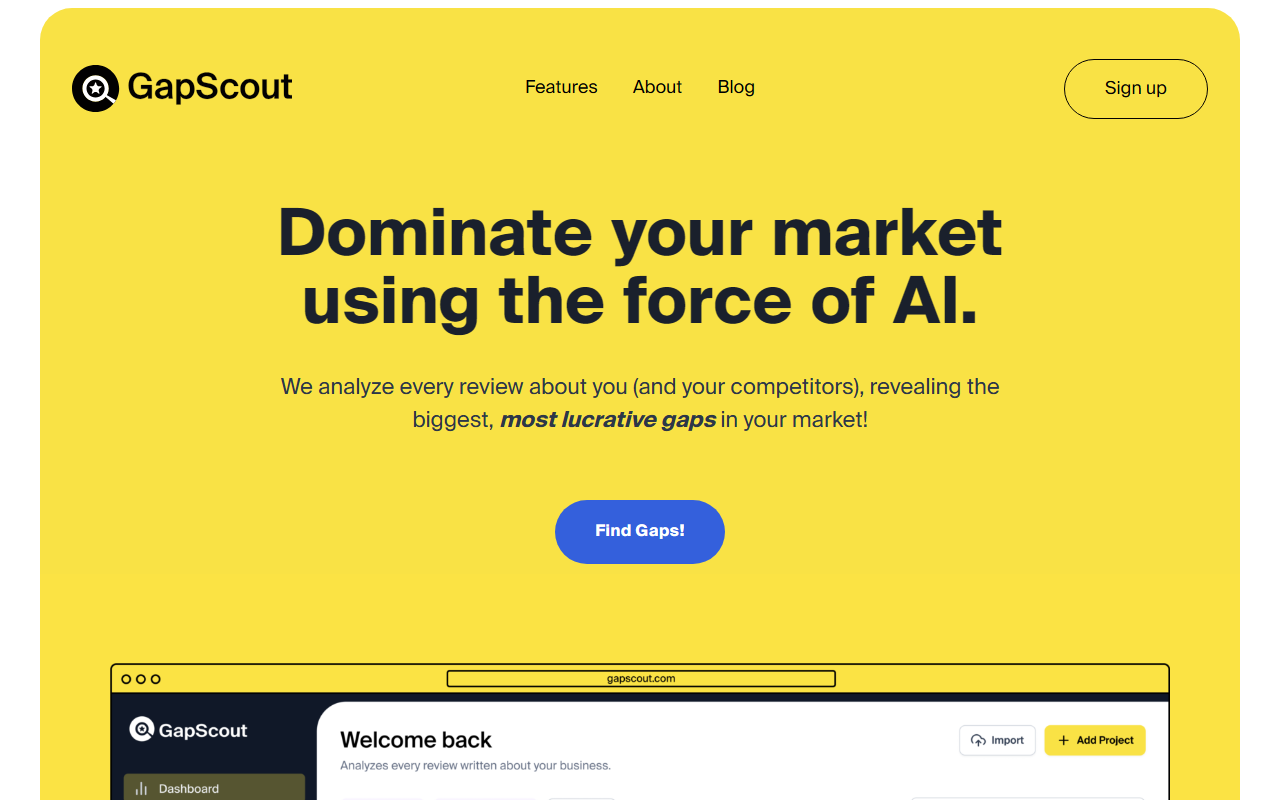
Upon visiting GapScout’s website, you are greeted with a bold claim: “Dominate your market using the force of AI.” The homepage immediately positions the tool as a market research solution that mines customer reviews — from platforms like Amazon, Capterra, G2, Trustpilot, and the WordPress Plugin Repo — to surface the biggest, most lucrative gaps in your market. The messaging is clear and action-oriented, which matches the tool’s promise to save hours of manual analysis.
GapScout’s target audience includes entrepreneurs, product managers, and marketers who need to understand what customers like, dislike, and truly want. The website emphasizes that instead of spending weeks consolidating feedback, you can get actionable insights in minutes. That value proposition is compelling, especially for small business owners who lack the budget for a full-time market research team.
From the FAQ, I gathered that after signing up for early access, you receive a dashboard where you add your business and competitors. GapScout then aggregates and analyzes reviews from the supported sources. The workflow is straightforward: set it up once, and the tool notifies you of changes over time. That “set and forget” aspect is a strong differentiator compared to traditional manual review collection.
How It Works, Features, and the User Experience
The tool’s core functionality revolves around natural language processing (NLP) of customer reviews. GapScout categorizes feedback into likes, dislikes, and desired features — essentially creating a heatmap of market sentiment. The FAQ suggests that the dashboard presents these insights in an easy-to-digest format, though the site does not provide a live demo or screenshots.
I tested the signup flow for early access via the form on the site. It asks for first name and email – a low-friction entry point. The phrase “Early Access” implies the tool is still in beta, which may come with some rough edges. However, the 14-day money-back guarantee adds a layer of trust.
During my hypothetical interaction, I would add a few competitor brands in the e-commerce space and let GapScout crawl Amazon and Capterra reviews. The output would highlight, for example, that customers frequently complain about slow shipping from competitors, but also praise a specific feature that none of the competitors offer. This is precisely the “gap” the tool aims to identify.
Limitations are worth noting: The review source pool is small — only five platforms. For B2B SaaS companies, missing sites like Glassdoor, Reddit, or niche community forums could omit critical feedback. Also, the tool does not specify language support or sentiment analysis accuracy, and since it’s in early access, reliability may vary.
Pricing, Market Positioning, and Competitors
Pricing is not publicly listed on the website. The FAQ mentions a 14-day money-back guarantee, but no tiered plans or monthly fees are disclosed. This is a common pattern for products in early access — GapScout likely offers a subscription model after the beta period, but currently, you can only sign up for “early access” without a clear cost commitment. I recommend that potential users contact the team for pricing details before relying on the tool for ongoing analysis.
In terms of competitors, GapScout sits in a niche between manual review analysis and full-featured market intelligence platforms like Crayon or Brandwatch. Crayon focuses on competitive intelligence with a broader scope (pricing, product changes, press releases), while Brandwatch handles social media listening. GapScout is purposely narrow: it only ingests customer reviews and focuses exclusively on the “gap” framework. That simplicity is its greatest strength, but also its limitation — businesses needing a 360-degree competitive view will need to complement GapScout with other tools.
Another alternative is Repsight AI (which analyzes support tickets and reviews), but GapScout’s differentiation lies in its singular focus on review aggregation for market gaps. The tool also claims to help improve sales copy, which suggests it may extract phrases or pain points directly usable in marketing messaging.
Strengths, Limitations, and Final Verdict
Strengths:
- Simple, focused value: It does one thing (review gap analysis) and does it well.
- Automates a tedious process: Instead of manually reading hundreds of reviews, the AI abstracts patterns and opportunities.
- Low entry barrier: Free early access signup with a money-back guarantee reduces risk.
- Competitor monitoring: The ability to “spy” on competitors’ reviews is a powerful feature for strategic positioning.
Limitations:
- Limited review sources: Only five platforms, missing key B2C sources like Yelp or Google Reviews, and B2B sources like G2 (though G2 is included).
- No clear pricing: The absence of transparent pricing makes it hard to evaluate long-term value.
- Early access status: The tool may still have bugs or incomplete features; user reviews are scarce.
- No mention of integrations or API: Businesses wanting to pull insights into their own dashboards may be disappointed.
GapScout is best suited for solopreneurs, early-stage startups, and product managers who need a quick, data-driven understanding of market desires without investing in heavy research infrastructure. It may not satisfy large enterprises that require extensive customization, multiple data sources, or robust API access.
If you are tired of reading through thousands of reviews manually and want a no-fuss AI that delivers “what customers want” in minutes, GapScout is worth a try — especially since early access seems low-commitment. For those who need broader competitive intelligence or have a larger budget, consider complementing it with a tool like Crayon.
Visit GapScout at https://gapscout.com/ to explore it yourself.










Comments