

First Impressions and User Experience
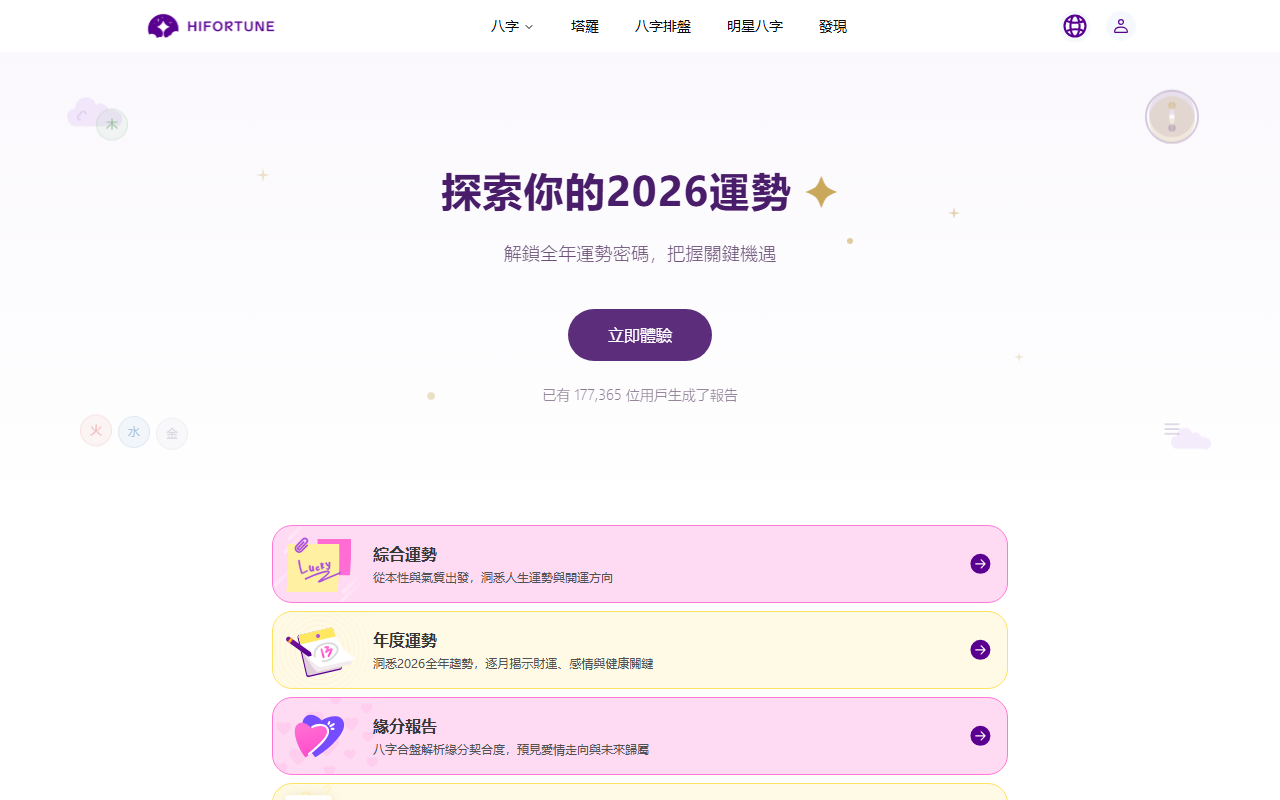
Upon visiting HIFORTUNE’s website, I was greeted by a visually rich interface blending traditional Chinese elemental symbols—wood, fire, water, metal, earth—with modern, clean design. The homepage prominently features a counter showing 192,379 users have already generated reports, which immediately signals social proof. The onboarding is straightforward: you see options like “明星合盤” (celebrity compatibility chart), “綜合運勢” (comprehensive fortune), and “年度運勢” (yearly fortune). There is no required sign-up to browse the features, but to generate a report you need to input your birth date and time. I tested the free “2026年1月財運前瞻” (January 2026 wealth forecast) report. After entering sample data, the AI delivered a concise textual analysis within seconds, written in traditional Chinese. The presentation includes a simple chart and a paragraph describing wealth trends for the month. The dashboard is navigation-heavy with icons and Chinese labels, which may feel overwhelming if you are not familiar with Chinese astrology terminology. However, the tool provides helpful tooltips (in Chinese) when you hover over menu items. Overall, the user experience is tailored for a Chinese-speaking audience interested in esoteric predictions.
What HIFORTUNE Offers and How It Works
HIFORTUNE positions itself as an AI writing tool specifically for Chinese metaphysics. It uses your birth data (year, month, day, hour) to calculate your “Bazi” (eight characters) and then generates narrative reports covering love, wealth, career, and life milestones. The reports I saw include structured sections like “本性與氣質” (nature and temperament), “開運方向” (luck direction), and “逐月分析” (month-by-month breakdown). The underlying model appears to be a custom GPT-like system trained on classical Chinese fortune-telling texts, though the website does not specify which base model is used. API availability is not mentioned. For integrations, there are none visible; it’s a standalone web app. Pricing is not publicly listed on the website as a standard subscription. Instead, you can purchase individual reports: for example, the celebrity compatibility report costs HK$68, while the January 2026 wealth forecast is free. Other reports are likely priced similarly. This pay-per-report model is different from most AI writing tools, which charge monthly fees. Compared to alternatives like AstroAI or Kojicode, HIFORTUNE focuses exclusively on Chinese astrology rather than general horoscopes or Western zodiac.
Pricing, Market Position, and Final Verdict
Because HIFORTUNE does not display a comprehensive pricing page, I estimate costs range from free to around HK$100 per report, depending on depth. This makes it affordable for casual users but expensive if you want multiple reports. The tool’s strength is its niche: it solves a specific problem for Chinese-speaking users who want AI-generated personalized fortune readings without consulting a human master. The reports I read felt surprisingly coherent and culturally accurate, with references to traditional concepts like “地支” (earthly branches) and “十神” (ten gods). However, a real limitation is the language barrier—all content is in Chinese, with no English interface. This restricts its audience. Additionally, there is no scientific validation of the predictions, so it should be treated as entertainment. For whom is HIFORTUNE best suited? Chinese-speaking individuals curious about their Bazi who want quick, AI-generated insights. It is less suitable for those seeking English support or rigorous data-driven tools. I would recommend giving the free report a try—it takes two minutes and shows the quality of the AI. Just keep expectations realistic: it’s fortune-telling, not fortune-guaranteeing. Visit HIFORTUNE at https://hifortune.ai/ to explore it yourself.










Comments