

First Impressions and Site Overview
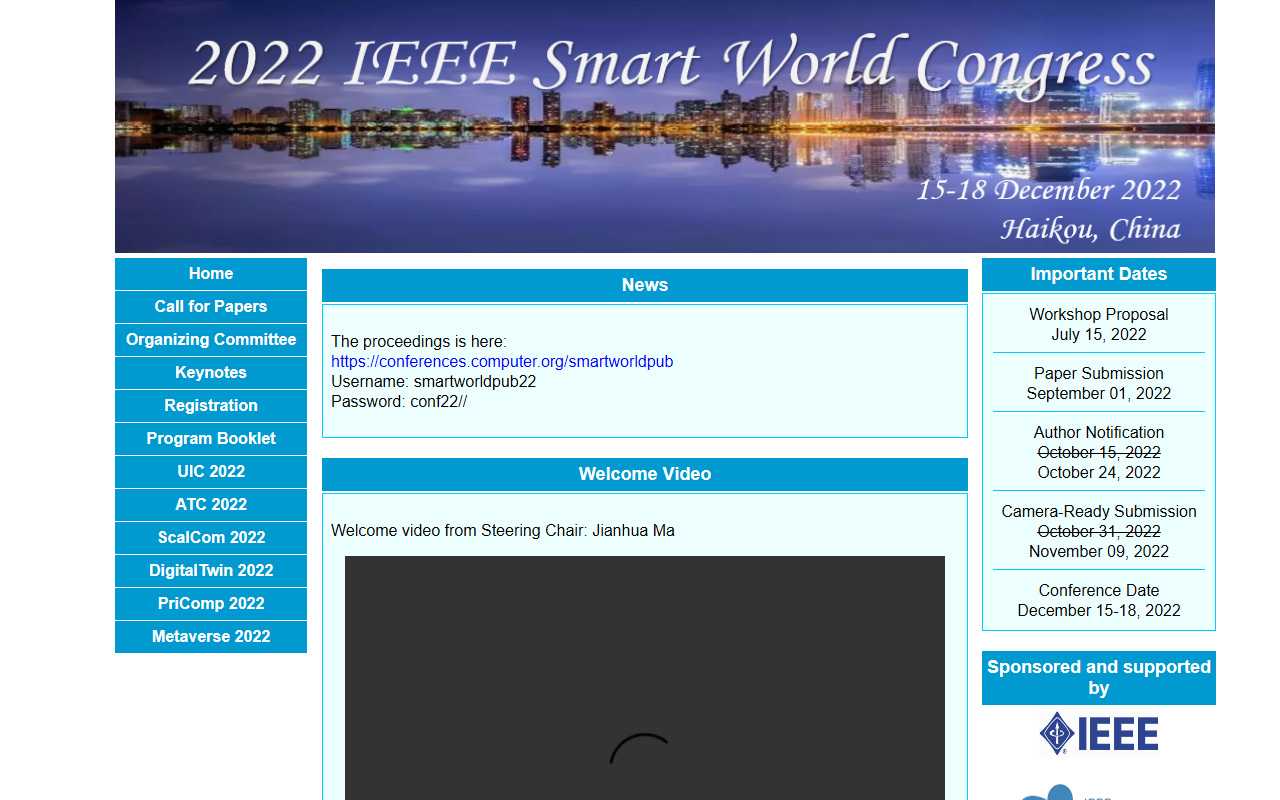
Upon visiting the IEEE Smart World Congress website, I immediately noticed it is not a traditional AI tool but an academic conference portal. The landing page presents a straightforward, text-heavy layout with a navigation bar including Home, Call for Papers, Organizing Committee, Keynotes, Registration, and Program Booklet. The design feels dated, as if frozen in 2022. The homepage displays important dates that have already passed—paper submission deadline was September 1, 2022, and the conference took place December 15–18, 2022. While the site works as an information archive, it offers no interactive AI functionality. The dashboard shows a welcome video from the steering chair and a link to the proceedings (with a password-protected PDF repository). For someone seeking a text-generation or cross-border AI tool, this conference site would be confusing at first glance. I tested the free tier by clicking through the registration page, but no active registration system exists—the page merely states the event ended.
Technical Scope and Relevance
If we consider the IEEE Smart World Congress as a platform for cross-border AI research, its technical depth is impressive. The conference covers 24 topic areas, from Smart Industry and Smart Agriculture to Smart Cybersecurity and Smart Big Data. It explicitly aims to integrate cyber, physical, and social worlds with ubiquitous intelligence. This aligns with the "cross-border AI" category, as many papers bridge AI with IoT, digital twins, and privacy computing. The website lists six co-located conferences, including the IEEE International Conference on Metaverse and Digital Twin, indicating strong interdisciplinary ambition. However, the site provides no information about the underlying technology—no mention of specific AI models, APIs, or software. It is purely an event announcement. For context, alternatives like the AAAI Conference on Artificial Intelligence or NeurIPS offer similar academic value but with more active, updated platforms. Unlike those, this site offers no direct AI tool access.
Pricing, Accessibility, and Market Position
Pricing is not publicly listed on the website. The Registration link leads to a placeholder with no fee details, suggesting the conference is either free or fees were handled offline. This lack of transparency is a limitation for potential participants. The site is hosted on a simple domain without modern integrations—no API, no searchable paper database, and no interactive features. The IEEE branding adds authenticity, but the content is static. The user base likely consists of academic researchers and engineers who attended or are looking up proceedings. The congress originated from 2005 workshops and has run eight editions, giving it historical weight. Yet the website's outdated state makes it less useful for current AI practitioners. For someone needing a tool to generate cross-border AI insights, this site fails. For a researcher seeking a venue to publish, it serves as a reference but no longer accepts submissions.
Final Verdict and Recommendations
The IEEE Smart World Congress website is not an AI tool in the conventional sense. It is an archived conference page best suited for academics tracking the history of ubiquitous computing and smart world research. Its strength lies in the breadth of topics covered and the co-location of specialized conferences. However, its real limitations include static content, expired dates, and no actionable AI functionality. If you are a researcher looking to access proceedings from the 2022 congress, the password-protected repository here might be useful. For anyone expecting a cross-border AI text generator, knowledge base, or code tool, look elsewhere. This review highlights that not every AI-themed URL delivers an active service. I recommend this site only for bibliographic or historical reference within the ubiquitous intelligence community.
Visit IEEE Smart World Congress at https://ieee-smart-world.org/ to explore it yourself.










Comments