

First Impressions and Onboarding
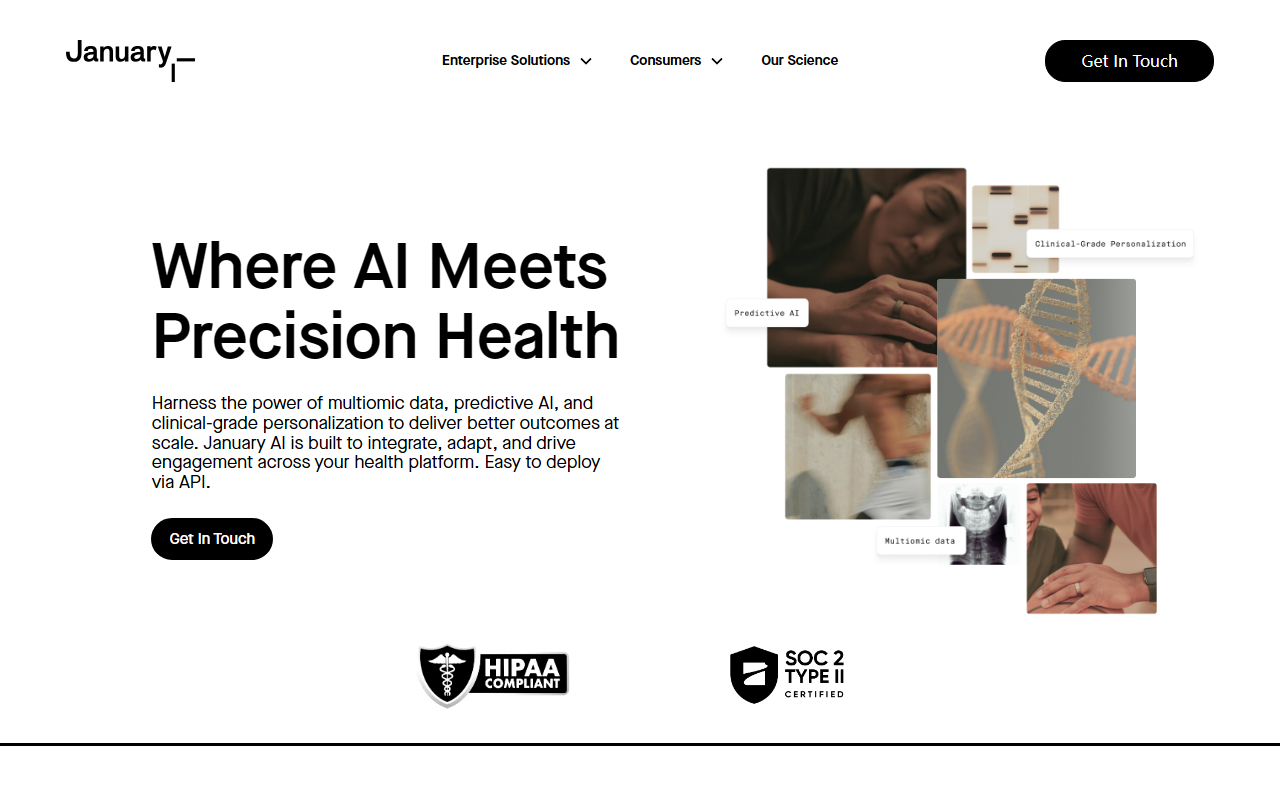
Upon visiting the January AI website, I was struck by the polished, clinical aesthetic. The tagline “Where AI Meets Precision Health” immediately signals a serious B2B play, not a consumer diet app. The homepage prominently features a “Get In Touch” call to action rather than a sign-up or free trial, which suggests enterprise-level onboarding. There is no visible pricing or tier structure, and the site makes clear that January is built to integrate via API into existing health platforms. Scrolling further reveals a section about the iOS consumer app, but the emphasis remains on backend infrastructure and clinical partnerships. For a tech reviewer used to testing tools with instant access, this was a notable barrier — January clearly targets organizations, not individuals. However, clicking through to the “Mirror” backend platform description shows a well-documented API designed to unify diverse health data. The lack of a public demo or sandbox means hands-on testing is limited for unaffiliated reviewers, but the site’s clear language and professional tone inspire confidence in the underlying technology.
How January AI Works: Multiomic Precision and Lifestyle Intelligence
January AI positions itself at the intersection of multiomic data (genomics, metabolomics, etc.) and predictive AI to deliver personalized health insights. The core offering appears to be the “January Mirror” backend platform, which ingests data from food logs, continuous glucose monitors (CGMs), fitness trackers, and lab results. The AI engine then generates actionable recommendations tailored to user biomarkers and preferences. One highlighted feature is the “world’s most accurate food scanner” — a photo-based logging tool that uses computer vision to estimate macronutrients and glycemic impact. The website also mentions “evidence-based synthesis of multiomic data,” which implies machine learning models trained on clinical research. While I couldn’t test the API directly, the technical description aligns with current precision health trends: combining real-time lifestyle data with genomic predispositions to drive behavior change. The consumer iOS app gives individuals a taste of this intelligence, offering personalized coaching and insights. For health platforms, January serves as a white-label solution, handling data ingestion and AI analysis while partners focus on user experience. This is a sophisticated approach, but it also means the tool requires significant integration effort.
Strengths and Real-World Applications
January AI’s primary strength is its clinical-grade personalization, which goes far beyond standard calorie counting. Unlike consumer apps such as MyFitnessPal or Cronometer, January integrates multiomic data to provide context-specific advice — for example, recommending meal timing based on a user’s glucose response and genetic markers. The food scanner is claimed to be the most accurate in the world, a bold statement that, if true, would address a major pain point in nutrition tracking. The platform is already trusted by clinicians and health platforms, as evidenced by user testimonials dating back to 2022. For healthcare providers and digital health companies, January offers a turnkey AI engine that can improve patient outcomes for conditions like diabetes, metabolic syndrome, and obesity. The API-first design makes it adaptable to existing apps, and the company’s track record since 2017 adds credibility. I also appreciate the clear focus on evidence synthesis — January is not just collecting data but is using validated models to generate recommendations.
Limitations and Who Should Use It
The most significant limitation is the lack of transparent pricing. The website repeatedly directs visitors to “Get In Touch,” which suggests customized enterprise contracts that may be prohibitively expensive for small teams or individual developers. Additionally, the B2B focus means casual consumers cannot directly sign up for the AI-powered platform unless they download the iOS app — and even then, the full precision health features likely require a subscription and compatible devices (e.g., CGM). Another limitation is the complexity of integration. While the API is flexible, healthcare data is highly regulated, and implementing a multiomic AI pipeline demands technical expertise. For clinicians or health platforms already working with biometric data, January is a powerful tool. For fitness enthusiasts or nutrition coaches looking for a simple app, alternatives like Levels or Nutrisense offer more straightforward CGM-based coaching without the multiomic layer. January AI is best suited for healthcare organizations, digital health startups, and research institutions that need a scalable, evidence-based AI engine to power personalized interventions. Individual users should check the iOS app, but the full value unlocks only when integrated into a clinical or commercial health platform.
Visit January AI at https://january.ai/ to explore it yourself.













Comments