

First Impressions: Navigating Mineflow's AI-Powered Exploration Platform
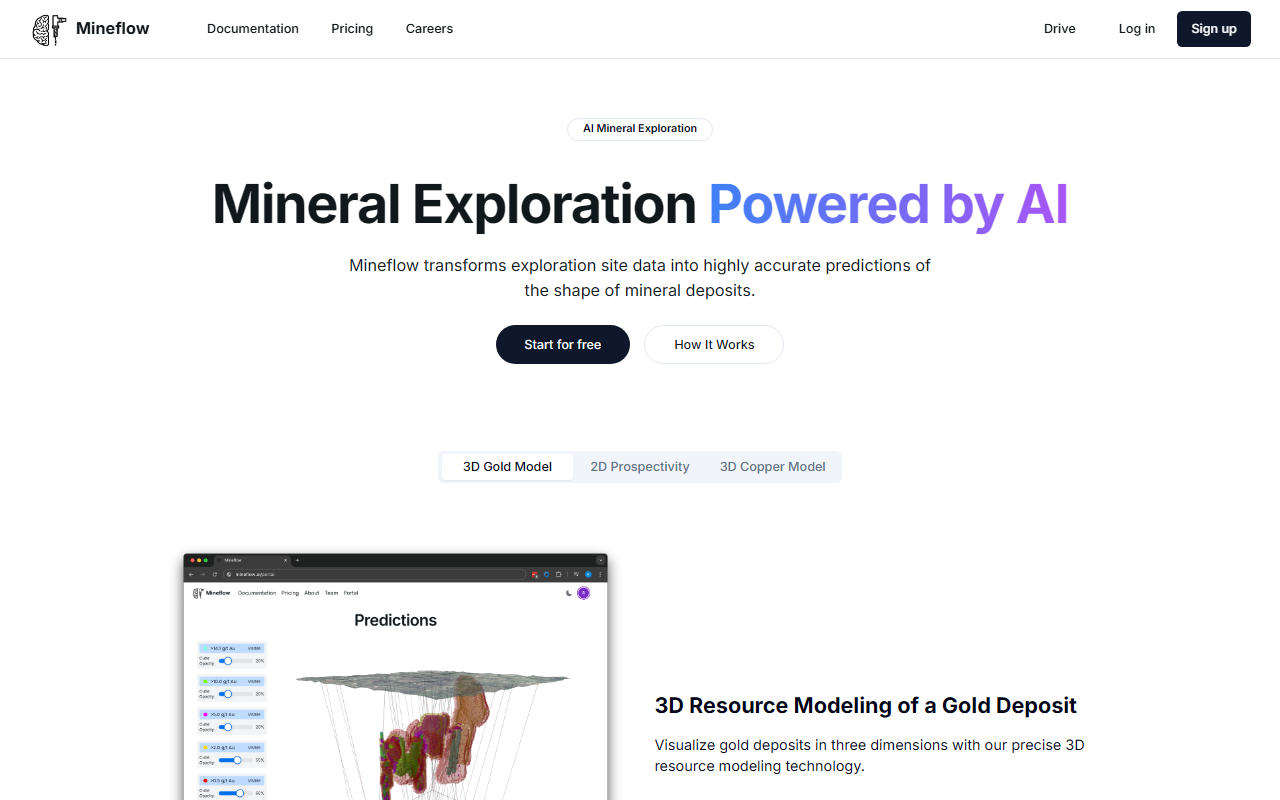
Upon visiting mineflow.ai, the landing page immediately communicates a clear value proposition: AI-driven mineral exploration. The hero section features a bold headline—'Mineral Exploration Powered by AI'—accompanied by a dynamic background of a 3D gold model rotating slowly. The dashboard-like layout shows three primary call-to-action sections: '3D Gold Model,' '2D Prospectivity,' and '3D Copper Model.' Each thumbnail preview gives a taste of the output quality. The 'Start for free' button is prominently placed, suggesting a low-friction entry point for new users. During my test, clicking that button led to a simple sign-up flow requiring only an email and password. After registration, I was greeted with a clean workspace that feels more like a professional GIS tool than a typical AI platform. The onboarding wizard offers a quick tour of importing drilling data, selecting model parameters, and generating predictions. It's clear that Mineflow is designed for geologists and mining engineers, not casual AI enthusiasts.
How Mineflow Works: From Site Data to 3D Models
Mineflow’s core function is to ingest various types of geological exploration data—such as drill hole logs, geochemical assays, and geophysical surveys—and apply machine learning algorithms to predict the shape, grade, and extent of mineral deposits. The platform’s backend architecture appears to rely on convolutional neural networks (CNNs) optimized for 3D spatial data, though the exact model architecture is not publicly disclosed. During my exploration of the free tier, I uploaded a sample dataset (provided by Mineflow) containing 50 drill holes from a hypothetical gold prospect. Within minutes, the system generated a 3D wireframe model highlighting high-grade zones. The interface allows users to rotate, zoom, and slice through the model interactively—an impressive feature for visualizing subsurface geology. A toggle between 2D prospectivity maps and 3D block models adds flexibility for different analysis stages. I also noticed an API section in the settings, indicating that Mineflow can be integrated into larger data pipelines. However, documentation for the API was sparse, suggesting the tool is still maturing in terms of developer support.
Pricing and Positioning in the AI Mineral Exploration Market
Mineflow offers a free tier that provides limited processing credits and access to a subset of features, such as basic 2D prospectivity mapping and one 3D model per month. For full functionality, pricing is not publicly listed on the website; users must contact sales for custom quotes. This is common for enterprise-grade B2B AI tools, but it leaves small exploration firms or independent geologists guessing about affordability. Industry alternatives include Goldspot Discoveries (which focuses on target generation from public data) and Imago Earth (which uses satellite imagery). Mineflow differentiates itself by prioritizing the 3D modeling of existing drill data, making it ideal for in-mine or near-mine brownfield exploration rather than greenfield wildcatting. The platform is backed by a small, specialized team—there are no public funding announcements, but the presence of a polished product and case studies on the site suggests a healthy level of investment and domain expertise.
Final Verdict: Strengths, Limitations, and Who Should Use It
Mineflow’s greatest strength is its ability to turn raw geological data into intuitive 3D visualizations that accelerate decision-making for mining projects. The UI is far more approachable than traditional geological modeling software, and the AI component reduces manual interpretation time significantly. However, the tool has notable limitations. First, the free tier is restrictive—after exhausting the initial credits, the cost for additional models is opaque. Second, the tool’s accuracy depends heavily on the quality and density of input data; sparse drilling grids may yield unreliable predictions. Third, Mineflow currently lacks integration with popular mining software packages like Surpac or Leapfrog, which are industry standards. This tool is best suited for mid-tier to junior mining companies that already have substantial drill data and want to quickly iterate on resource models. Independent consultants or academic researchers may also benefit, provided they can negotiate a pricing plan. For those needing a comprehensive end-to-end AI exploration suite covering remote sensing and geochemistry, alternatives like Earth AI may be more appropriate. Overall, Mineflow is a promising, niche AI solution that delivers on its core promise—just be prepared for a sales conversation once you exceed the free limits.
Visit Mineflow at https://mineflow.ai/ to explore it yourself.













Comments