

First Impressions: The Production Gap
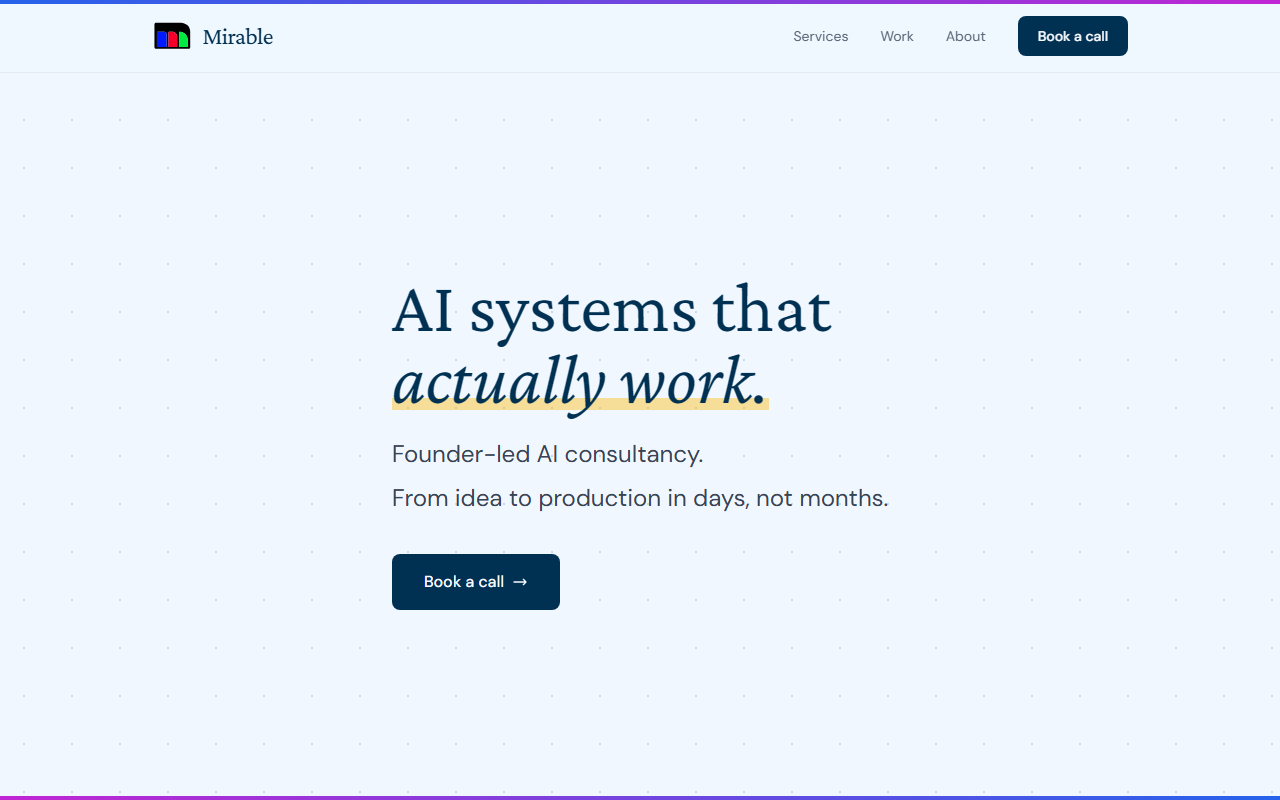
Upon visiting the Mirable website, the first thing that strikes me is the honest framing. The headline reads "Evidence-Based AI Engineering" and immediately acknowledges what many demos gloss over: the gap between a prototype that looks great and a system you can trust in front of real users. The site divides this into three stages — Demo (the first 50%), Better Demo (50%–90%), and Production (90%–99%+). As someone who has evaluated dozens of AI tools, I find this taxonomy refreshingly grounded. The layout is simple, almost austere: a single scrollable page with case studies, service models, and founder credentials. There is no flashy interactive dashboard — this is a consulting firm, not a SaaS product. Yet the clarity of the message immediately signals expertise.
What Mirable Actually Does (And How It Works)
Mirable is not a do-it-yourself AI tool. It is a consulting firm that builds and hardens AI systems using a methodology they call Evidence-Based AI Engineering. The underlying technology varies by project: they mention natural language query over databases (text-to-SQL), audio analysis for sales call intelligence, and enterprise knowledge retrieval using RAG systems. The founder, Dima Kuchin, brings 25 years of experience including leadership as Chief Data Officer at a public company and four startup CTO roles. The site lists former leadership from Databricks and Microsoft — presumably referring to his team’s pedigree. Mirable offers three engagement models: a rapid build from idea to working system (0→1), hardening an existing prototype into a production-ready system (POC→Production), and ongoing fractional AI leadership for strategy and vendor evaluation. Engagements run 2–12 weeks, with weekly updates and full documentation. They emphasize no black boxes and a “business problem first, technology second” approach. Pricing is not publicly listed on the website, which is typical for high-touch consulting services. They likely custom-quote based on project scope.
Strengths and Limitations
The primary strength of Mirable is its realism. Unlike many AI consultancies that hand you a proof-of-concept and walk away, Mirable focuses on the hard part: making stochastic systems produce deterministic outcomes at high reliability. The website explicitly states “Almost nobody does this,” and from my experience, that is true. For companies that have already burned budget on prototypes that fail in production, this approach is a lifeline. Another advantage is the fractional AI leadership option — senior expertise without a full-time executive hire. However, Mirable is not for everyone. It is best suited for growth-stage companies, business units moving faster than corporate IT, and founders with clear domain knowledge and authority to act. If you are an individual developer looking for a tool to write blog posts or generate marketing copy, this is not for you — Mirable is not an AI writing tool in the traditional sense; it is a consulting service for custom AI systems. Alternatives include larger firms like Scale AI or Dataiku, but those often come with bigger price tags and more overhead. Mirable positions itself as lean and fast.
Final Verdict: Who Should Hire Them
After reviewing the Mirable offering, I recommend this service to any organization that has a working AI prototype but struggles with reliability, security compliance (SOC 2, SOX, GDPR experience is mentioned), or scaling in a regulated environment. The evidence-based methodology is a solid differentiator. The main limitation is that you cannot try it for free — there is no self-service plan, and pricing requires a consultation call. For startups and mid-market firms with the budget and a clear need, Mirable is a trustworthy partner. For hobbyists or content creators, look elsewhere. Visit Mirable at https://mirable.io/ to explore it yourself.










Comments