

First Impressions and Onboarding
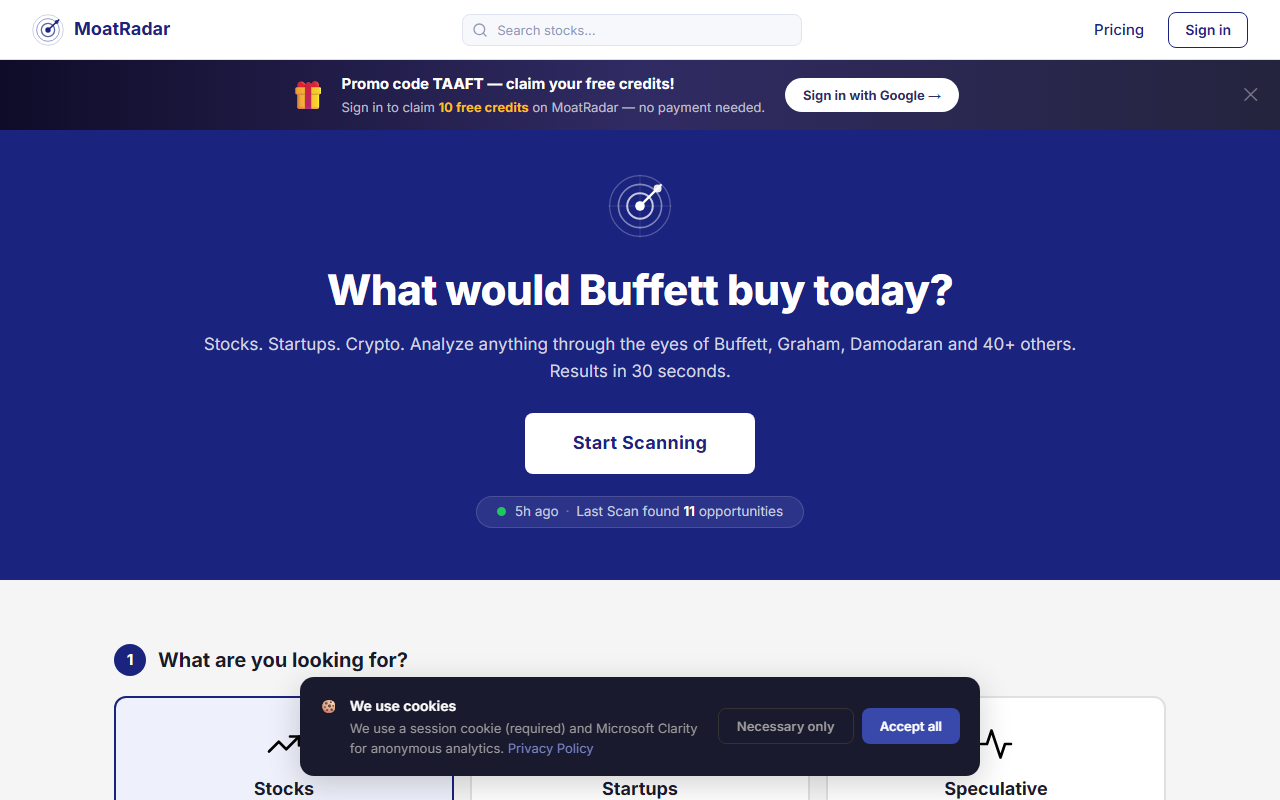
Upon visiting MoatRadar, I was greeted by a clean, modern dashboard with a clear call to action: "What would Buffett buy today?" The site immediately put me into a preview mode, showing example results so I could understand the tool without committing. The onboarding flow is smooth — I signed in using Google and was prompted with a promo code to claim free credits. No payment needed, which lowers the barrier to entry significantly. The interface is divided into three asset classes: Stocks, Startups, and Speculative (crypto). That’s a smart way to serve different types of investors.
Core Features and User Experience
MoatRadar’s primary value proposition is analyzing any asset through the lens of over 40 legendary investors, from Warren Buffett and Benjamin Graham to Ray Dalio and Cathie Wood (though not listed, the site includes many). You can either "Invest like a legend" — pick an investor and let AI find stocks they’d likely buy — or "Configure your search" with custom filters like P/E ratio, moat score, and growth metrics. I tested the Warren Buffett preset for stocks. Within about 30 seconds, the tool returned a list of high-moat opportunities with a summary of why each stock fits Buffett’s criteria. The AI appears to scan fundamental data and qualitative factors to match an investor’s philosophy. The results include a "moat score" and key financial ratios — impressive depth for a tool that’s essentially a reading assistant.
The investor list is exhaustive: value investors (Graham, Klarman), growth (Fisher, Lynch), quant (Simons, Greenblatt), macro (Soros, Dalio), activist (Icahn, Ackman), and even crypto maximalists (Saylor, Pompliano). There are also framework-based screens like Dividend Aristocrats and Magic Formula. This variety makes MoatRadar a versatile research companion for both traditional and alternative assets. The crypto section includes on-chain and narrative-driven thinkers like Willy Woo and Coin Bureau, which is a nice touch.
One limitation I noticed: the free credits are limited, and after the preview, you’re prompted to sign in. The tool doesn’t show full pricing on the website, which makes it hard to assess long-term value. Also, the AI’s "thinking" is opaque — you don’t see the underlying data sources or reasoning steps, just the final picks. For deeper due diligence, you’d still need to cross-check elsewhere.
Pricing, Limitations, and Market Position
Pricing is not publicly listed on the website. You get free credits with a promo code, but after that, it’s unclear what the cost structure is — likely a subscription or pay-per-scan model. This lack of transparency is a drawback for budget-conscious users. Competitors like Alpha Vantage or Finviz offer more fundamental data with open pricing, but they lack the curated investor lens. Unlike those tools, MoatRadar focuses on qualitative matching — applying an investor’s mental model to current opportunities. It’s more like a decision-support tool than a pure data feed. The tool is best suited for retail investors who want to mimic top investors’ thinking without reading hundreds of pages of letters. It’s less useful for professional analysts who need raw data and model-building flexibility.
Final Verdict
MoatRadar delivers on its promise: it quickly surfaces high-moat opportunities using the frameworks of famous investors. The interface is intuitive, the investor list is vast, and the 30-second scan is genuinely fast. However, the lack of transparent pricing and the black-box nature of the AI’s analysis are real limitations. I’d recommend this tool to intermediate investors who follow value or growth strategies and want a quick filter for ideas. Power users and professionals may find it too shallow. Try the free credits first — if the results resonate, it could become a staple in your research toolkit.
Visit MoatRadar at https://moatradar.com/ to explore it yourself.










Comments