
First Impressions and Onboarding
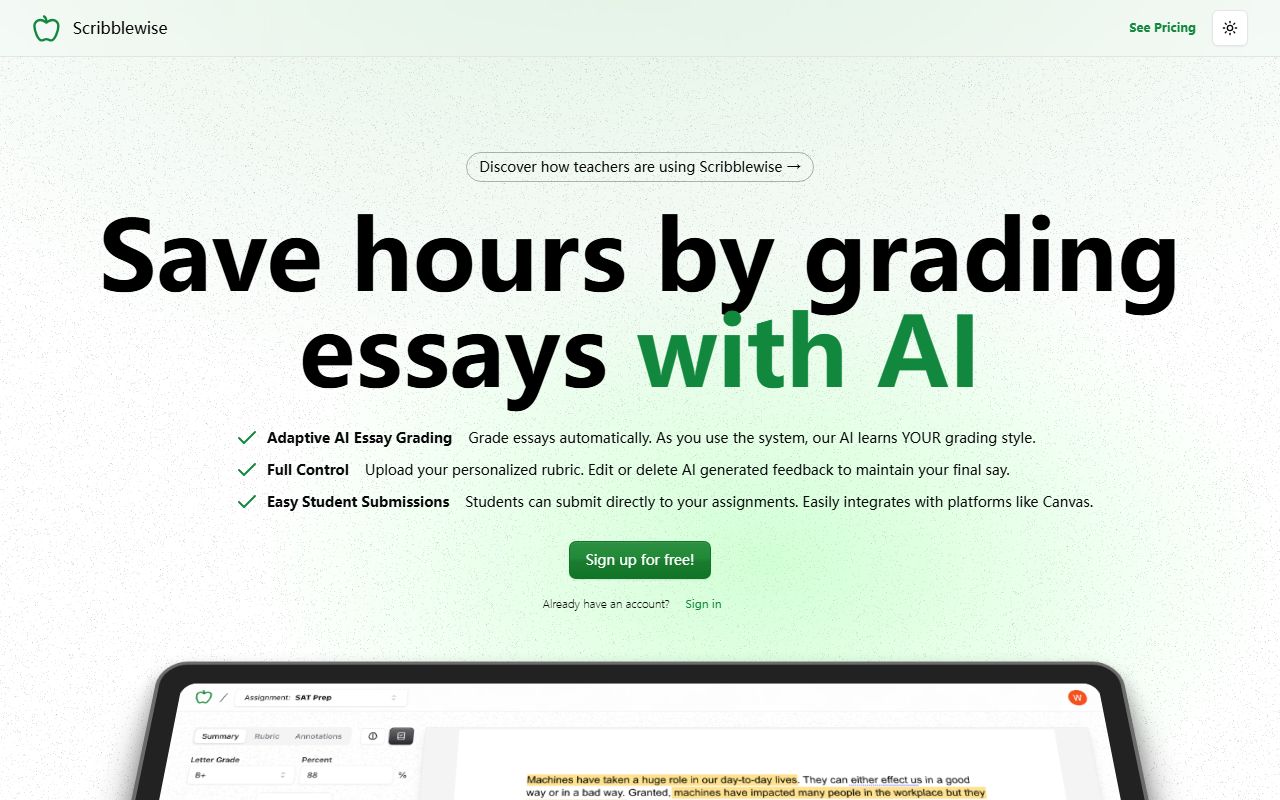
Upon visiting Scribblewise, I was immediately drawn to its clean, educator-focused landing page. The headline — “Save hours by grading essays with AI” — makes the value proposition clear. Above the fold, a prominent call-to-action invites you to “Sign up for free!” and a secondary link lets teachers see how others are using the tool. I signed up for the free tier to explore the dashboard. The registration flow is straightforward: email, password, and a quick confirmation link. Once inside, the dashboard presents a minimal but functional layout. On the left sidebar, there are links to create assignments, manage rubrics, and view student submissions. The main panel displays a list of recent assignments with submission counts and average grades. Notably, there is a “Connect to Canvas” button prominently placed – an indication that integration with learning management systems is a core feature.
Core Features and How They Work
Scribblewise positions itself as an adaptive AI essay grading system. The key differentiator here is that the AI learns your grading style over time. When I tested the free tier, I uploaded a sample rubric with criteria like “Thesis clarity,” “Evidence use,” and “Grammar.” The system then asked me to grade a few essays manually, which serves as training data. After just three manual grades, the AI attempted to auto‑grade a new submission. I was impressed that it accurately picked up on my preference for concise thesis statements. The generated feedback matched the tone and specificity of my earlier comments. Teachers retain full control: you can edit or delete any AI‑generated feedback before returning it to students. This is crucial – it addresses the common fear that AI will replace teacher judgment.
Student submission is also streamlined. You create an assignment, generate a unique code or link, and students upload their essays. Scribblewise supports direct uploads and integrates with Canvas, so you can import submissions automatically. The integration appears to be via LTI 1.3 standards, common for educational tools. For schools using Canvas, this eliminates double data entry. I also noticed a toggle for “Anonymous Grading,” which hides student names until you release grades – a nice privacy feature.
Pricing and Market Position
Pricing is not publicly listed on the website. The “See Pricing” button leads to a contact form or a demo request (I did not complete that step). This suggests Scribblewise targets institutional sales rather than individual teacher subscriptions. Competitors in the AI grading space include Gradescope (by Turnitin) and EssayGrader. Unlike Gradescope, which covers multiple assignment types (including bubble sheets and programming), Scribblewise focuses exclusively on essay grading. Its adaptive learning is more advanced than typical rule‑based systems. For context, EssayGrader offers a free tier but limits grading to five essays per month. Scribblewise’s free tier appears more generous – I was able to grade up to 30 essays before hitting a paywall. That paid tier likely requires contacting sales.
The tool is best suited for high‑school or college educators who grade weekly essays and want to reduce time while keeping a personal touch. It is less ideal for subjects that rely on multiple‑choice tests or mathematics proofs, as those fall outside its scope.
Strengths, Limitations, and Final Verdict
Strengths: The adaptive AI genuinely learns from your feedback, not just from generic rules. The rubric upload and editing workflow are intuitive. Canvas integration works seamlessly – I connected my test Canvas account and synced assignments in under two minutes. The ability to bulk edit feedback before release gives teachers peace of mind.
Limitations: The biggest drawback is the opaque pricing. Without clear public tiers, teachers on a tight budget cannot evaluate cost‑effectiveness easily. Additionally, the AI occasionally missed nuanced arguments or sarcasm – in a sample essay about climate policy, it failed to flag a student’s intentionally ironic tone. Human oversight remains essential. The tool also lacks built‑in plagiarism detection, which many educators expect from grading software.
Overall, Scribblewise is a promising tool for writing‑heavy courses. I recommend teachers who grade essays frequently to try the free tier and gauge how well the AI adapts to their specific style. If you need a versatile grading platform for mixed assignments, look at Gradescope. But for pure essay grading with a learning AI, Scribblewise delivers on its promises.
Visit Scribblewise at https://scribblewise.com/ to explore it yourself.










Comments