

First Impressions and Interface
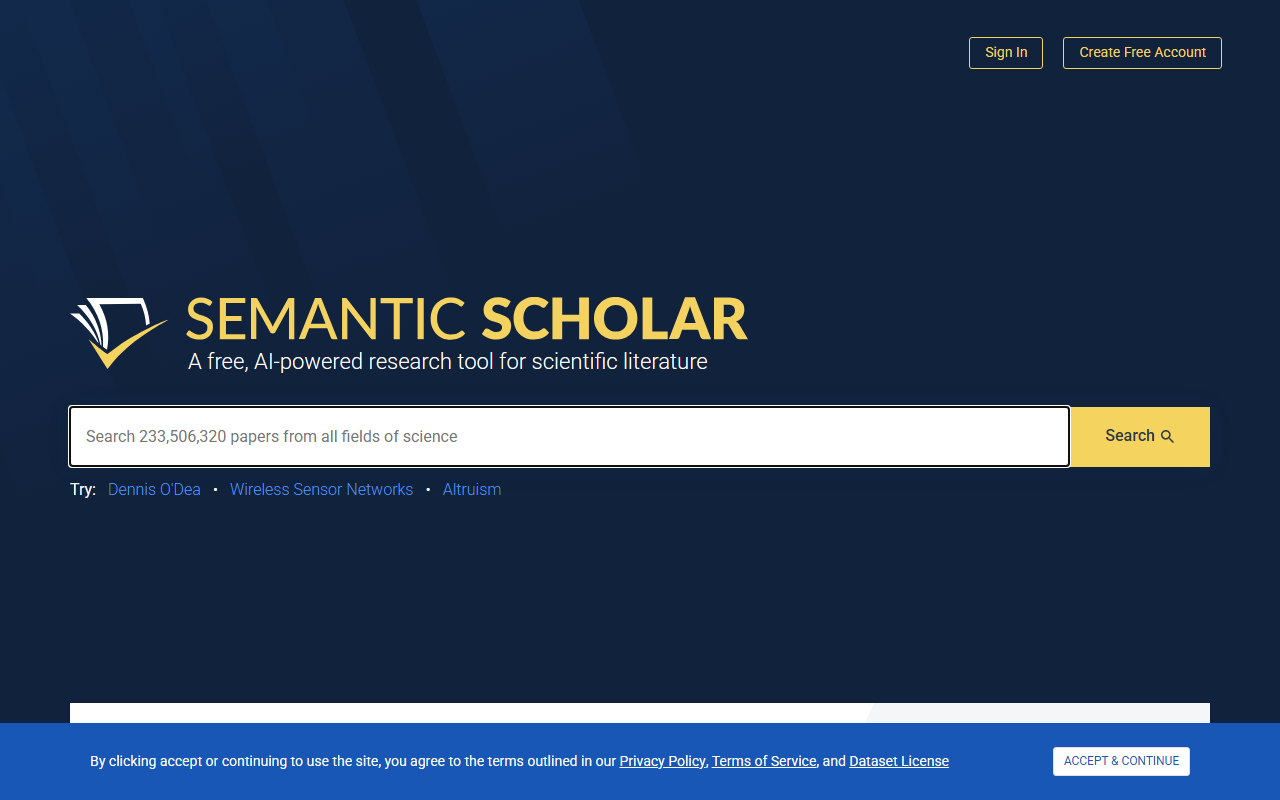
Upon visiting the site, I was greeted by a clean, minimal interface dominated by a large search bar and a counter showing 234,587,378 indexed papers. The homepage presents example searches like "Emily Breza," "Hedge Funds," or "Ideal Gas Law," instantly signaling its academic focus. Navigation is streamlined with a skip-to-search option and a persistent menu. I found the onboarding intuitive—no account required to start searching. The search bar accepts natural language queries and returns results ranked by relevance, with filters for date, field, and publication type. Loading times were snappy even for broad queries, and the layout adapts well to both desktop and mobile.
Core Features and AI Capabilities
Semantic Scholar uses AI to parse paper abstracts, extract key insights, and generate citation graphs. When I tested a search for "Hedge Funds," the results included a summary of top papers, a list of influential citations, and a timeline of research activity. The AI also highlights TL;DR summaries for many entries, saving time when scanning the literature. I explored the Semantic Reader beta, an augmented reader that overlays definitions, related figures, and citation context directly onto PDFs. This tool is still in beta but shows promise for making dense papers more accessible. For developers, the New & Improved API offers paper search, better documentation, and stability—a clear move to support scholarly app builders. The underlying technology likely involves transformer-based models (similar to those used in NLP), but the site does not specify the exact architecture. Integration with ORCID and other academic identifiers is also present, allowing users to track authors and their work.
Pricing and Value Proposition
Semantic Scholar is completely free for all users, a rarity among AI-powered research tools. There are no premium tiers or hidden fees—the API is also free for developers, though usage limits apply (not explicitly stated but typical for free APIs). This zero-cost model is a significant advantage over competitors like Google Scholar, which offers no API without heavy restrictions, or PubMed, which has limited coverage outside biomedicine. The value lies in the breadth of coverage (all fields of science) and the AI enhancements: citation influence scores, paper recommendations, and the Semantic Reader. However, not all papers have available full text—the tool indexes metadata and open-access papers but cannot bypass paywalls. Researchers in the biomedical, computer science, and engineering fields will find the richest content; humanities and social sciences are less represented.
Standing in the AI Reading Landscape
Semantic Scholar competes with Google Scholar, Scite, and PubMed. Unlike Google Scholar, which relies on basic keyword matching, Semantic Scholar uses AI to surface highly influential papers and provides structured metadata. Compared to Scite, which focuses on citation context, Semantic Scholar offers broader search and a free API. The tool is backed by the Allen Institute for AI, a reputable nonprofit, lending it credibility and a commitment to open science. One limitation is that the Semantic Reader is still in beta and works only for select papers—I tried it on a paper from 2020 (Green AI by Schwartz et al.) and found the contextual annotations helpful, but many older papers lack this feature. Another limitation: search occasionally returns irrelevant results for niche queries, reflecting the challenges of automated indexing.
Overall, Semantic Scholar is best suited for researchers, graduate students, and developers who need fast, AI-driven discovery of scientific literature. It is less ideal for casual readers or those requiring exhaustive coverage in the humanities. I recommend it wholeheartedly to anyone who values free, scalable access to scholarly information. Visit Semantic Scholar at https://semanticscholar.org/ to explore it yourself.










Comments