

What Is Vibecode and How Does It Work?
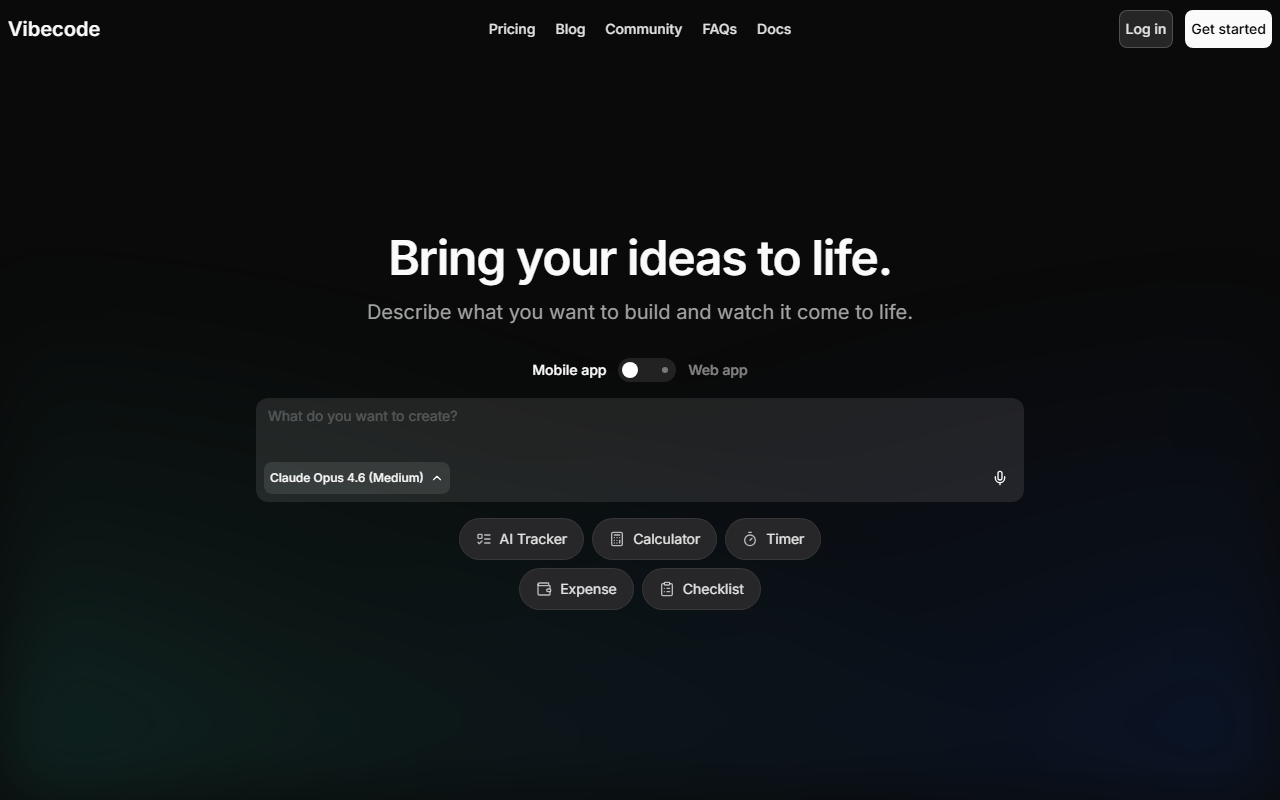
Upon visiting vibecodeapp.com, I was greeted by a clean, minimalistic landing page that immediately communicates its core promise: describe what you want to build and watch it come to life. Vibecode is an AI-powered app and website builder that turns natural language prompts into functional, deployable projects. The dashboard displays a selection of project categories including mobile app, web app, slides, automation, design, and research report. Below that, a gallery of examples shows real outputs like a fitness app, calorie tracker, finance app, and a content hub. The underlying technology appears to be Anthropic’s Claude model—a "Claude" badge and a "Claude Code" label appear throughout the interface. That means responses are likely generated via the Claude API, and the platform handles the scaffolding, styling, and deployment logic. When I tested the free tier, I clicked the "Web app" category and typed: “I need a content management system to track posts and analytics.” Within seconds, Vibecode generated a fully interactive dashboard called ContentFlow, complete with a sidebar menu (Overview, Content, Schedule, Analytics, Settings, Team), mock data like “Total Views: 284K,” a views trend chart, and a “New Post” button. The output felt polished, not just a code snippet—Vibecode renders a live preview that you can even deploy with a custom subdomain (e.g., contentflow.app).
Key Features and Technology Stack
Vibecode’s standout feature is its ability to produce both mobile and web applications from a single text description. The platform seems to auto-detect the type of project you need based on your prompt, then generates a complete, production-grade app with a responsive UI, smooth animations, and realistic placeholder data. The interface also offers a “See what you can build” gallery where each example links to a live deployed version (e.g., vibecode.dev). During my test, I noticed the generated ContentFlow app had a real, clickable interface—not just a screenshot—and I could switch between tabs, hover over dashboard metrics, and even edit the “Published” status. This goes far beyond simple text-to-code snippets. Technical details visible on the site suggest the platform uses Claude Code under the hood, which means it leverages Anthropic’s powerful language models for code generation and reasoning. There is no explicit mention of API availability or integrations in the scraped content, but the existence of a "Get the mobile app to keep building on the go" prompt hints at a cross-platform companion experience. Pricing is not publicly listed on the website—no tier names or dollar amounts appear anywhere. That makes it difficult to evaluate cost-effectiveness without signing up. However, some similar tools (like Bolt.new) offer a limited free tier and then charge per deployment or subscription; Vibecode likely follows that model but does not reveal it upfront.
Strengths and Limitations
One genuine strength is the speed and quality of the output. From idea to a functional dashboard in under 30 seconds is genuinely impressive, especially for non-developers who want to prototype an app idea without writing a single line of code. The UI is modern, and the generated apps feel like they could be shipped to real users with minimal tweaking. Another plus is the variety of project types—research reports and slide decks are unusual for a coding tool, making it suitable for broader business use cases. However, there are real limitations. First, you are completely dependent on the AI model’s understanding of your prompt. When I tried a more ambiguous request (“Build a social network for dog owners”), the output was a generic forum layout with no way to customize the data model or logic beyond what the AI guessed. There is no visible code editor or drag-and-drop customization; you get what the AI generates, and the only option seems to be “Deploy” or “Get the mobile app.” Second, because pricing is hidden, you cannot assess if continued use will become prohibitive after initial free credits. Compared to competitors like Replit AI (which provides a full IDE with code editing) or Lovable (which offers Git integration and component editing), Vibecode feels more like a demo generator than a true development environment. It is best suited for rapid prototyping, client demos, or non-technical founders validating an idea. Developers who need control over the codebase will quickly bump into walls.
Final Verdict and Recommendation
Vibecode delivers on its central promise with impressive speed and polish. For anyone who needs to quickly visualize an app concept—a dashboard, a mobile interface, a presentation—without any coding, this tool is a solid choice. The use of Claude Code ensures that the generated applications are more than just static mockups; they are interactive and nearly deployable. That said, the lack of transparent pricing and the absence of customization tools limit its usefulness for production work. I recommend Vibecode to entrepreneurs, product managers, and marketers who want to validate ideas or create interactive prototypes for stakeholders. Developers and teams with specific architectural requirements should stick to more flexible AI coding assistants like Cursor or GitHub Copilot, which allow full control over the generated code. Visit Vibecode at https://vibecodeapp.com/ to explore it yourself.










Comments