

First Impressions: A Retired Community Archive
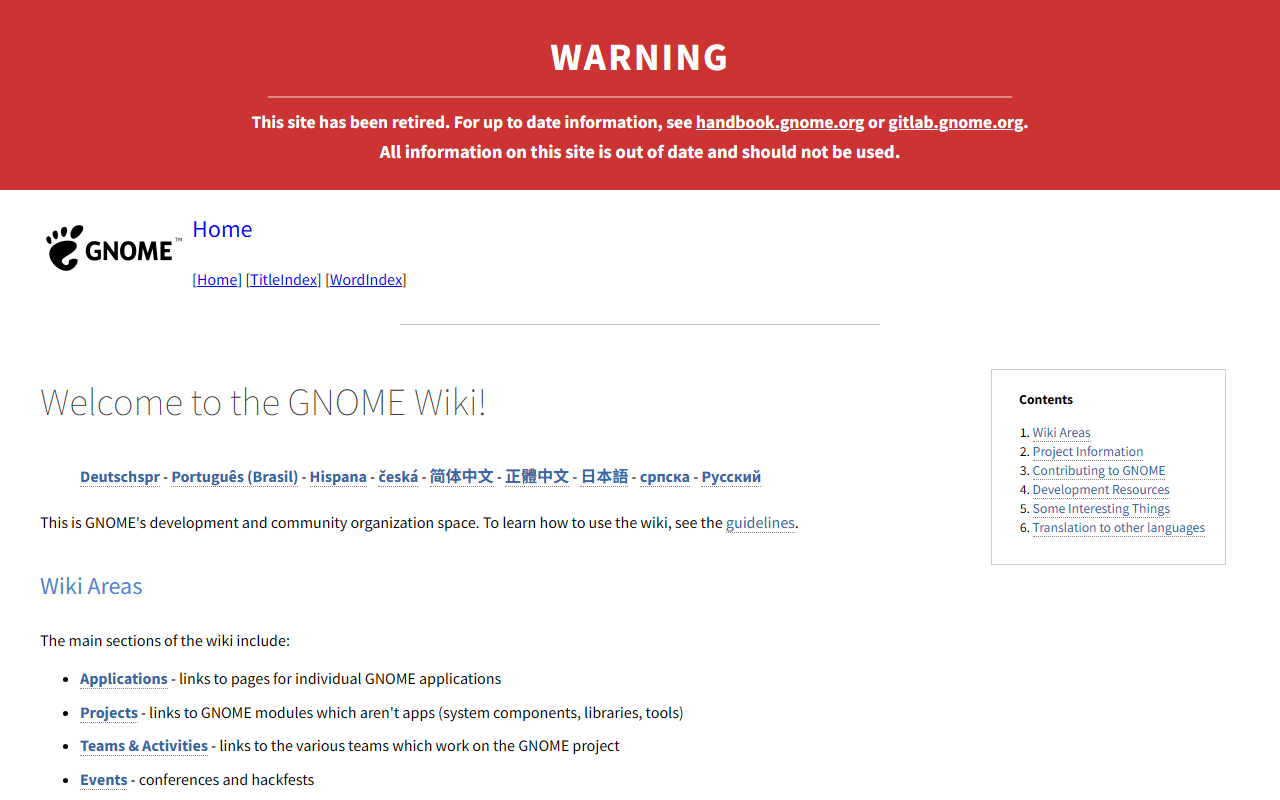
Upon visiting wiki.gnome.org, I was greeted with a banner stating that the site has been retired and to see handbook.gnome.org or gitlab.gnome.org for up‑to‑date information. The main page is a simple wiki index with categories like Project Information, Contributing to GNOME, and Development Resources. There is no AI‑powered learning tool, chatbot, or text generation feature. Instead, the wiki serves as a static repository of links and guidelines for the GNOME open‑source desktop environment.
Despite the category label “Text AI > Learning Platform,” this is not a tool for learning AI. GNOME is a free and open‑source desktop environment used primarily on Linux. The wiki was historically used to organize project teams, events, and development workflows. The current state is clearly archived; most active development has moved to GitLab and the GNOME Handbook.
What the GNOME Wiki Actually Offers
The wiki is structured into several sections: Applications, Projects, Teams & Activities, Events, Initiatives, Foundation, and Infrastructure. Each section links to detailed pages about specific GNOME components or community processes. For example, under “Contributing to GNOME,” you can find a newcomers tutorial, internship information (Outreachy, Google Summer of Code), and guidelines for getting involved.
Development resources include links to gitlab.gnome.org (GNOME’s GitLab instance), developer.gnome.org (tutorials and API docs), release planning, version control guides, and the JHBuild tool. There is also a “Translation to other languages” page, showing the wiki’s original support for international contributors. However, many internal links are outdated or broken, as the site is no longer maintained. The most recent edit on the homepage is dated 2024‑10‑23, but the content itself feels static and legacy.
Strengths and Limitations
A genuine strength of the GNOME Wiki is its historical value. It documents years of community processes, event planning, and development practices. For someone researching the history of GNOME or looking for archived meeting notes, this wiki can be a treasure trove. The “Interesting Things” section even includes a light‑hearted cookbook and tips for GNOME 3 users, showing the project’s human side.
However, the limitations are significant. The site is retired; it is not updated regularly, and many links redirect or return 404 errors. It is not an AI tool, nor does it provide any machine learning capabilities or interactive lessons. The “Learning Platform” category is misleading. Anyone hoping for AI training, natural language processing demos, or curated AI courses will be completely disappointed. Even as a learning platform for GNOME development, the wiki is less useful than the official GitLab or the developer handbook.
The interface is a bare‑bones wiki with no search engine optimization for modern use. Navigation relies on text‑based indexes (TitleIndex, WordIndex) that are not user‑friendly. There are no APIs, no AI models, no pricing tiers—because this is not a commercial product. It is purely a community resource in archive mode.
Final Verdict and Alternatives
Who should explore the GNOME Wiki? If you are a seasoned GNOME developer needing to dig into historical context, or a contributor interested in the project’s evolution, you may find some value here. For everyone else—especially those seeking an AI learning platform—look elsewhere. Recommended alternatives include fast.ai (practical deep learning courses), DeepLearning.AI (Andrew Ng’s Coursera specialization), or Hugging Face’s Learn (interactive NLP tutorials). These are genuine text AI learning platforms with modern interfaces, active communities, and real AI content.
The GNOME Wiki is best suited for open‑source historians and die‑hard GNOME fans. It is not suited for AI learners, casual users, or anyone expecting a tool that generates or processes text. The site’s own notice advises visitors to move to current resources. I recommend that if you are interested in GNOME development, head directly to handbook.gnome.org or explore the GNOME project on GitLab. If you want to learn about AI, this is the wrong starting point entirely.
Visit GNOME at https://wiki.gnome.org/ to explore it yourself.













Comments