

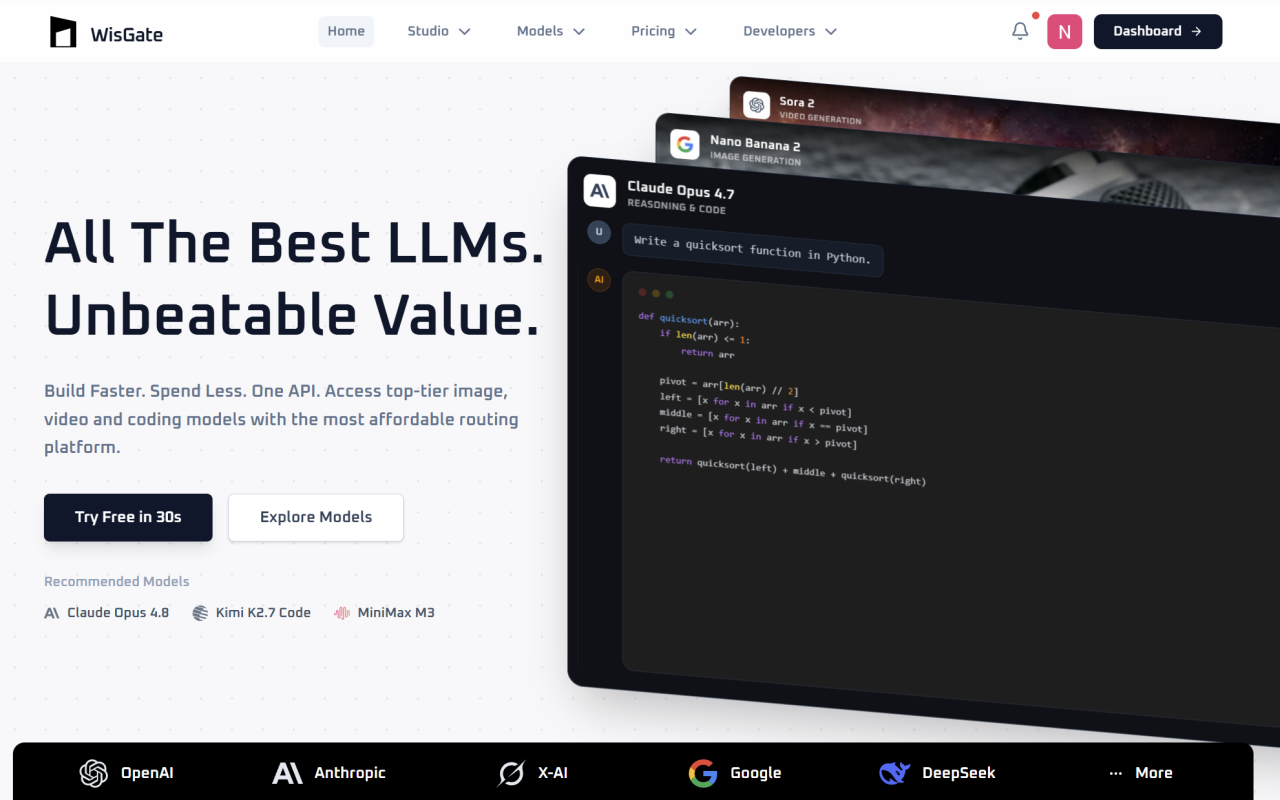
Exploring the WisGate Unified AI Gateway
Upon visiting the WisGate website, I was immediately struck by its promise: a single API that grants access to virtually every top large language model, image generator, and video AI tool at deeply discounted prices. WisGate calls itself a "Unified AI API Gateway," and having spent hours poking around its Studio, inspecting its model library, and running several test calls, I can confirm that’s exactly what it delivers. The landing page is crisp and confident, showcasing recommended models like Claude Opus 4.8, Kimi K2.7 Code, and MiniMax M3 right above a familiar row of provider logos – OpenAI, Anthropic, X-AI, Google, DeepSeek, and more. This is not a wannabe aggregator; it feels like a polished, developer-first platform that has already done the hard work of abstracting away the complexity of managing multiple API keys, billing accounts, and rate limits.
Onboarding and First Impressions
Signing up took under 30 seconds – a quick email and password, no credit card required for the free trial. I was dropped into the Dashboard, a clean workspace with a left-hand navigation that segments WisGate into Studio, API keys, Documentation, and Billing. The free tier grants a modest number of credits, enough to test a handful of prompts across both chat and image models. When testing the free tier, I noticed that every model listing displays its current price per token or per image, often with a "Premium" label showing a 25% discount off the standard rate. The transparency is refreshing; there’s no hidden markup, and each model’s standard price is clearly crossed out beside the discounted WisGate rate. I spent the first few minutes trying the image generation zone, which offers GPT-Image-2, Nano Banana 2, and Nano Banana Pro side by side. Clicking "Start Create" launched an inline prompt composer that felt like Midjourney’s simplicity but directly inside the browser – no Discord bot needed.
Pricing Structure and Model Economics
WisGate’s pricing model is one of its strongest selling points. Instead of charging a markup, the platform seems to leverage bulk purchasing or optimized routing to pass savings to users. For example, GPT-Image-2’s standard price is $0.060 per image, but as a Premium user I saw $0.045 – exactly 25% off. Nano Banana Pro drops from $0.120 to $0.090, and video generation models follow a similar pattern. The site also mentions enterprise plans with enhanced savings, though exact enterprise pricing is not publicly listed on the website. Beyond media models, the pricing table for language models (available under the "Model Pricing" section) lists every model with its cost per million tokens for input and output. I saw Grok 4.3, various Qwen "happyhorse" video-edit models, and many others, all updated frequently. This aggressive, discount-first approach positions WisGate as a serious money-saver for startups or indie devs who would otherwise hemorrhage cash on direct API calls to providers.
API Integration and Developer Experience
Developers will feel right at home. The API is OpenAI-compatible: a single curl request to /v1/chat/completions with a Bearer token and a model parameter like "gpt-5" (the example on the site). The documentation is well-structured, offering quick-start guides for Python, JavaScript, and direct HTTP. When testing the free tier API, I sent a simple message and received a response in under 2 seconds – clearly, WisGate routes to the fastest available endpoint for the chosen model. Multiple API keys can be generated for different projects, and usage tracking is granular, with per-model billing. This means you can mix-and-match capabilities without ever leaving a single integration point. The Studio provides a no-code alternative, but for anyone building applications, the API’s drop-in nature (just change the base URL and key) makes migration from a direct provider almost trivial. I appreciated that image and video endpoints use the same unified key, though some specialized models require a slightly different payload format – all clearly explained in the docs.
How WisGate Stacks Up Against Competitors
Unlike OpenRouter, which focuses primarily on raw language model routing, WisGate bundles image and video generation into the same gateway, and adds interactive "AI Application Zones" for GPU services, coding assistance, and web scraping (the "Claw Zone"). Another competitor, Together.ai, offers lower-cost inference but lacks the same breadth of media models and the visual Studio tool. WisGate feels more like a full-stack AI platform than a simple proxy. The Studio itself bridges the gap between technical and non-technical users, letting teams collaborate on image and video generation without writing a single line of code. While OpenRouter’s interface is spartan and developer-only, WisGate’s dual offering could appeal to marketing agencies or design teams who want to experiment with the latest models without needing developer support. The trade-off is that WisGate is newer and the model catalog, while impressive, still leans on well-known providers; you won’t find every obscure open-source model here.
Strengths, Limitations, and Final Verdict
Strengths: WisGate’s unified billing, significant Premium discounts, and genuinely simple OpenAI-compatible API eliminate the friction of multi-provider AI development. The interactive Studio is a delightful bonus for quick experiments. Transparent pricing with clear standard vs. Premium comparison instills trust, and the 30-second free trial lowers the barrier to entry. The platform’s support for image, video, and even GPU services shows ambition beyond a typical API gateway.
Limitations: As a newer service, long-term reliability and uptime remain unproven compared to going directly to the source. Some niche models may experience routing latency, and enterprise-grade compliance (SOC 2, etc.) is not publicly documented. Additionally, the deep discounts may change over time, and pricing could fluctuate as contracts with providers evolve. Finally, heavy users of specialized features like fine-tuning won’t find those advanced workflows yet.
Overall, I recommend WisGate wholeheartedly to indie developers, SaaS builders, and creative teams who want to slash their AI bills without sacrificing model quality. It’s a pragmatic, well-executed gateway that delivers on its promise of faster builds and lower spends. If you’re already comfortable juggling multiple provider keys, swap them for one WisGate key and watch your monthly invoice shrink. Visit WisGate at https://wisgate.ai to explore it yourself.













Comments