
Landing on the Page: First Impressions
Upon visiting pistester.com, the first thing you notice is how stripped-back everything is. There is no elaborate onboarding wizard, no modal pop-up begging for your email, and no pricing table to scan before you can do anything. A single input field asks: "What Should We Call You?" with a 0/40 character counter beside it. Beneath that, a bold orange "Start Quiz" button. That is it. The site operates on a single-page design where all three stages — creating your quiz, sharing it, and viewing the leaderboard — unfold in sequence without ever reloading. The aesthetic is minimal: lots of white space, a playful rounded typeface, and splashes of neon green and coral that give it a vaguely retro-internet energy without tipping into garish territory.
The pitch is delivered in a cheeky tone: "Expose the fake friends. Crown the real ones." Scrolling down reveals a tidy three-step explainer — Spill Your Secrets, Send the Link, Expose the Truth — alongside a FAQ section that answers the obvious questions before you ask them. There is no dashboard, no account management, no persistent identity. You type a name, you build a quiz, you get a link. That link is your only connection to the quiz you created. Lose it, and the quiz functionally disappears from your grasp.
How the Quiz Creation Flow Actually Works
Clicking "Start Quiz" launches you directly into a 10-question creator. Each screen presents a single multiple-choice question with four answer options. Questions are drawn randomly from a pool of 30 across five humor-themed categories, which the site claims produces 759,375 possible combinations. When I tested it, the questions ranged from the inoffensively playful — "What's your spirit animal?" — to the mildly unhinged, including a question about how you handle public embarrassment that offered options like "Own it dramatically" and "Pretend I'm on a phone call."
The interface during creation is dead simple. One question per screen, large tappable answer cards, and a progress indicator at the top. There is no back button, which means you cannot revise previous answers — a small but frustrating oversight if you fat-finger a selection. Once you finish all 10, a "Create Quiz" button appears. Tap it, and the site generates a unique shareable URL in the format pistester.com/?id= followed by a string identifier. You are shown this link alongside copy-to-clipboard functionality and direct share buttons for X/Twitter, Facebook, and generic link sharing. There is also a live leaderboard panel that starts at zero friends played, waiting to populate.
You can edit your quiz only if no friends have taken it yet. Once the first person submits answers, the quiz locks permanently. You can delete the quiz and all associated results at any time, but editing is off the table. This is a sensible design choice for fairness, though it might frustrate someone who spots a mistake after sharing the link.
The Friend Experience and the Leaderboard
When friends open your link, they land on a page that reads "Think You Know [Your Name]? Prove It." They enter their own name, then face the same 10 questions — but this time they must guess what you answered. Each correct match scores one point. At the end, they see their score out of 10 and a share button to post their result publicly. The scoring screen also nudges them to create their own quiz, which is a smart viral loop baked into the core experience.
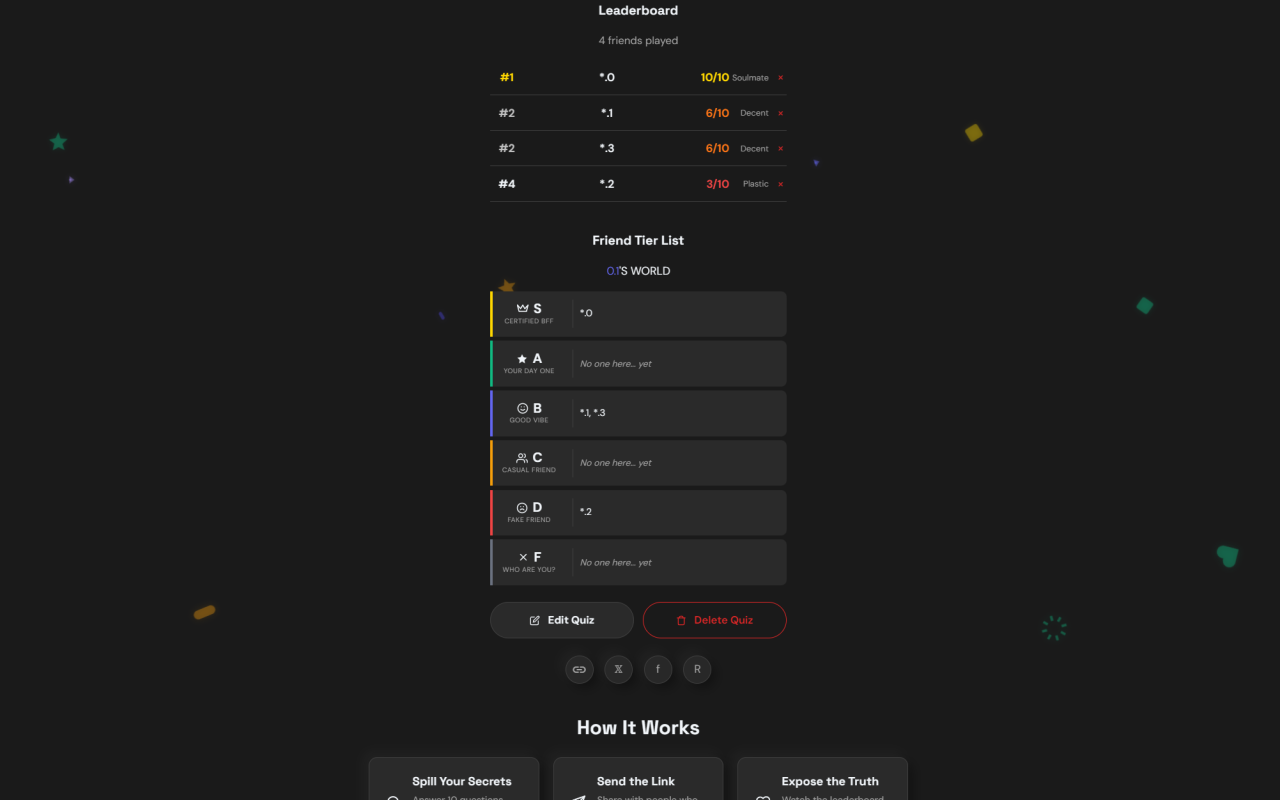
Back on your quiz's leaderboard, every friend who completes the test appears with their score and a tier label. The tier system is where PIS Tester's humor lives: high scorers land in "Ride or Die" territory, mid-range players get labels like "Plastic Bond," and low scorers are banished to "Who Dis?" — a playful but pointed judgment. In a tie, the earlier submission ranks higher. The leaderboard updates live as new friends submit, which creates a satisfying, competitive drip-feed if you share the quiz with a group chat.
There is no limit to how many friends can take your quiz, and there is no authentication required from any participant. This frictionless design is the tool's greatest asset. Anyone with the link can play instantly, whether on mobile or desktop. The pages render responsively and the tappable answer cards work well on a phone screen, which is likely where most participants will encounter it.
Where's the AI? The Curious Category Misfit
Here is where things get interesting — and a little ironic. PIS Tester is listed in the 345tool directory under "Text AI > AI Design," yet the tool's own FAQ proudly declares: "It's a pure social game — no AI, no gimmicks, just fun." There is no machine learning model generating questions, no natural language processing analyzing responses, and no algorithmic personalization beyond random draw from a fixed question bank. The questions are pre-written by humans. The scoring is literal one-to-one answer matching. The tier labels are static strings mapped to score ranges.
This category mismatch is not a flaw in the tool itself, but it does raise an eyebrow about how broadly the "AI" label is applied across tool directories. PIS Tester is a static web app with a randomizer — a well-executed one, but fundamentally no more AI-driven than a BuzzFeed quiz from 2015. If you arrive expecting any kind of intelligent or adaptive experience, you will be disappointed. If you arrive wanting a lightweight, human-crafted social game, you will feel right at home.
What PIS Tester Gets Right — and Where It Falls Short
The tool's greatest strength is its complete lack of friction. No sign-up, no verification, no paywall, no ads — nothing stands between you and a functioning quiz in under two minutes. It is refreshing in an internet landscape where even the simplest utilities often demand an email address before you can breathe. The humor in the question writing is genuinely enjoyable, with a tone that balances self-deprecation and playful confrontation without veering into meanness. The friend tier labels are the right kind of silly, and the viral share loop is well-designed.
Pricing is straightforward: PIS Tester is completely free with no usage limits. There is no paid plan, no premium tier, no hidden upsell. You can create as many quizzes as you want, share them endlessly, and never hit a paywall. This makes sense given the tool's lightweight technical footprint — it costs very little to host a static app with no user accounts and minimal server-side logic.
However, the limitations are real and worth noting. The 30-question pool, while randomized, is small enough that repeat players will eventually encounter familiar questions. There is no custom question option — you cannot write your own prompts, which means every quiz is confined to the pre-written categories. The inability to go back and revise an answer during creation is a UX paper cut that could be fixed with a simple back arrow. And once your quiz is locked after the first submission, you are stuck with any rushed or accidental answers. The quiz link is also your only key back to the leaderboard; there is no account to collect your quizzes under, so managing multiple quizzes requires saving multiple bookmarks or chat messages.
Who This Tool Actually Serves
PIS Tester is not trying to be a serious assessment platform or a team-building exercise for corporate retreats. It is a party game in URL form — something you fire off in a group chat at 11 PM when everyone is bored and the conversation needs a spark. It works best in tight-knit social circles where the humor lands and the competition feels personal. If you are the kind of person who enjoys knowing which of your friends actually remembers your coffee order, you will get a kick out of it.
For content creators, streamers, or anyone with a small audience, the quiz link format makes it easy to drop into a community post or a live chat and watch the leaderboard fill up in real time. The virality loop baked into the result screen means participants often become creators themselves, which extends the tool's reach naturally. That said, the lack of customization options limits how much you can tailor the experience to a specific community or inside-joke culture.
Final Verdict
PIS Tester delivers exactly what it promises: a free, fast, and genuinely funny friendship quiz that requires nothing from you except ten honest (or strategically chosen) answers about yourself. It is not AI, it is not complex, and it does not pretend to be either. The humor carries the experience, the leaderboard adds just enough competitive stakes, and the zero-friction design means you will actually use it rather than bookmark it and forget. The small question pool and inability to write custom prompts are real constraints, but for a free social tool built by a small independent collective, the trade-off feels reasonable. If you want to find out which of your friends has been paying attention — and which ones have been nodding along for years — this is a surprisingly effective, low-stakes way to do it. Visit PIS Tester at https://pistester.com to explore it yourself.


Commentaires