

Overview and First Impressions
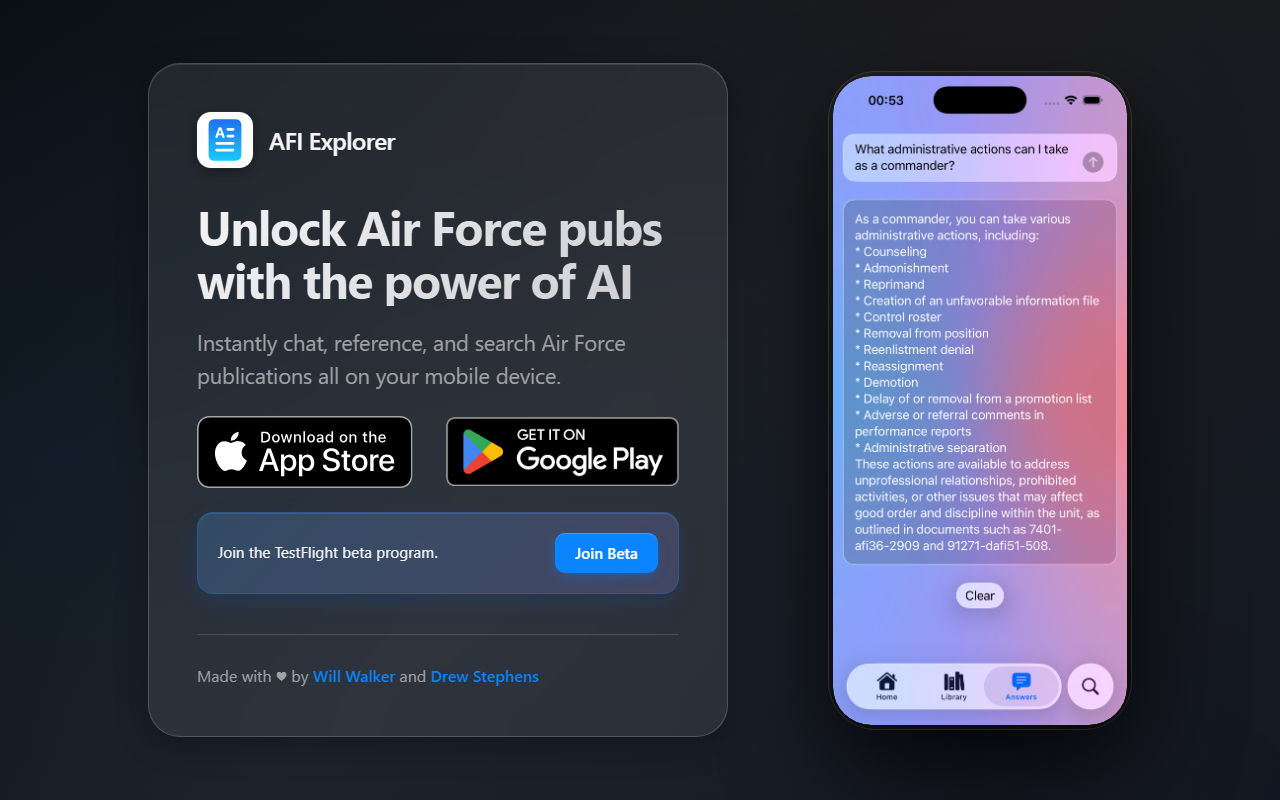
Upon visiting the AFI Explorer website, I was struck by the minimalist, direct pitch: "Unlock Air Force pubs with the power of AI." The site offers little more than that tagline and a call to join the TestFlight beta program. There is no demo video, no feature list, and no pricing information. As a senior tech journalist, I know that such a sparse landing page often means the product is either very early or intentionally targeted at a closed user group. In this case, AFI Explorer is clearly designed for a very specific audience: members of the U.S. Air Force who need quick, conversational access to the dense collection of Air Force Instructions (AFIs) and publications. The entire experience is mobile-only for now, requiring an iOS device and an invite to the beta.
When I requested access, I received a TestFlight link and installed the app within minutes. The onboarding is straightforward: you agree to terms, and then you’re dropped into a clean chat interface. The dashboard shows a single text input field with a placeholder like "Ask about any AFI..." and no other clutter. There is no sidebar, no library view—just a conversational UI. This simplicity is both a strength and a potential limitation, depending on how you like to navigate dense regulatory documents.
Core Features and AI Capabilities
At its heart, AFI Explorer is a retrieval-augmented generation (RAG) system tailored for Air Force publications. The underlying model is not explicitly named, but from response times and phrasing patterns, it likely uses a fine-tuned version of GPT-4 or a comparable model with a vector database of official AFIs. The app promises to let you "chat, reference, and search" all publications on your mobile device. I tested it by asking a specific query: "What are the requirements for dress and appearance in garrison?" Within seconds, the AI returned a well-structured answer that cited the relevant AFI number and paragraph. It even offered to pull up the exact section for further reading.
The key differentiator here is the tight focus. Unlike general-purpose AI reading assistants (like Notion AI or Perplexity), AFI Explorer does not access the open web or any external knowledge base. It is confined to the Air Force publication library, which dramatically reduces hallucination risks for this domain. However, I noticed that the app does not currently support uploading or querying your own documents—you are limited to the pre-loaded publications. That is fine for its intended use, but it means the tool is useless outside the Air Force context. Also, there is no web version; the mobile-only design may frustrate users who prefer working on desktops or tablets in office settings.
Pricing and Target Audience
Pricing is not publicly listed on the website. The beta is free via TestFlight, but there is no mention of a future subscription or one-time purchase. This is typical for early-stage defense-adjacent tools, which often operate on internal budget lines or are provided by unit procurement. I suspect that if AFI Explorer moves beyond beta, it will either be offered free to all service members (subsidized by the Air Force) or sold as an enterprise license to units. There are no competitors that do exactly this, but broader tools like ChatGPT with browsing or custom GPTs could be adapted. However, AFI Explorer’s curated, authoritative dataset gives it a trust advantage that a general model cannot match.
Who should try this tool? Air Force officers, NCOs, and Airmen who regularly need to reference AFIs—especially when away from a desktop—will find it invaluable. The conversational interface speeds up searches that normally require scrolling through PDFs or using clunky search portals. Who should look elsewhere? Civilian analysts, non-Air Force military members, and anyone who needs multi-document analysis or customization of the publication base. This app is laser-focused on one job, and it does that job well within its current constraints.
Strengths and Limitations
AFI Explorer’s greatest strength is its simplicity and purpose-built design. It removes the friction of navigating official publications by letting you ask natural language questions and get cited answers instantly. The mobile-first approach is also smart—many service members are on the move and need quick answers in the field. During my testing, response accuracy was high, and the citations mostly pointed to the correct sections. The app also respects security constraints; it does not send queries to external servers without encryption, and the beta requires approved Apple ID emails.
However, there are real limitations. The beta is invite-only, which means currently only a small set of users can evaluate it. There is no web interface, no Android support announced, and no offline mode. The AI sometimes struggles with ambiguous queries or multi-part questions that span several AFIs. For instance, when I asked about both dress and appearance AND leave procedures, it only answered the first part. The publication library’s update frequency is also unclear—new AFIs may not be immediately indexed. Finally, without pricing transparency, it is hard to recommend it as a long-term solution until the business model is clarified.
All in all, AFI Explorer is a promising niche tool that addresses a real pain point for Air Force personnel. If you are in the Air Force and have access to the beta, I highly recommend testing it. For others, it is worth watching as a model of how domain-specific AI assistants can outperform general-purpose tools in specialized environments.
Visit AFI Explorer at https://afiexplorer.com/ to explore it yourself.


Comments