

First Impressions: A Minimalist Engine with a Big Promise
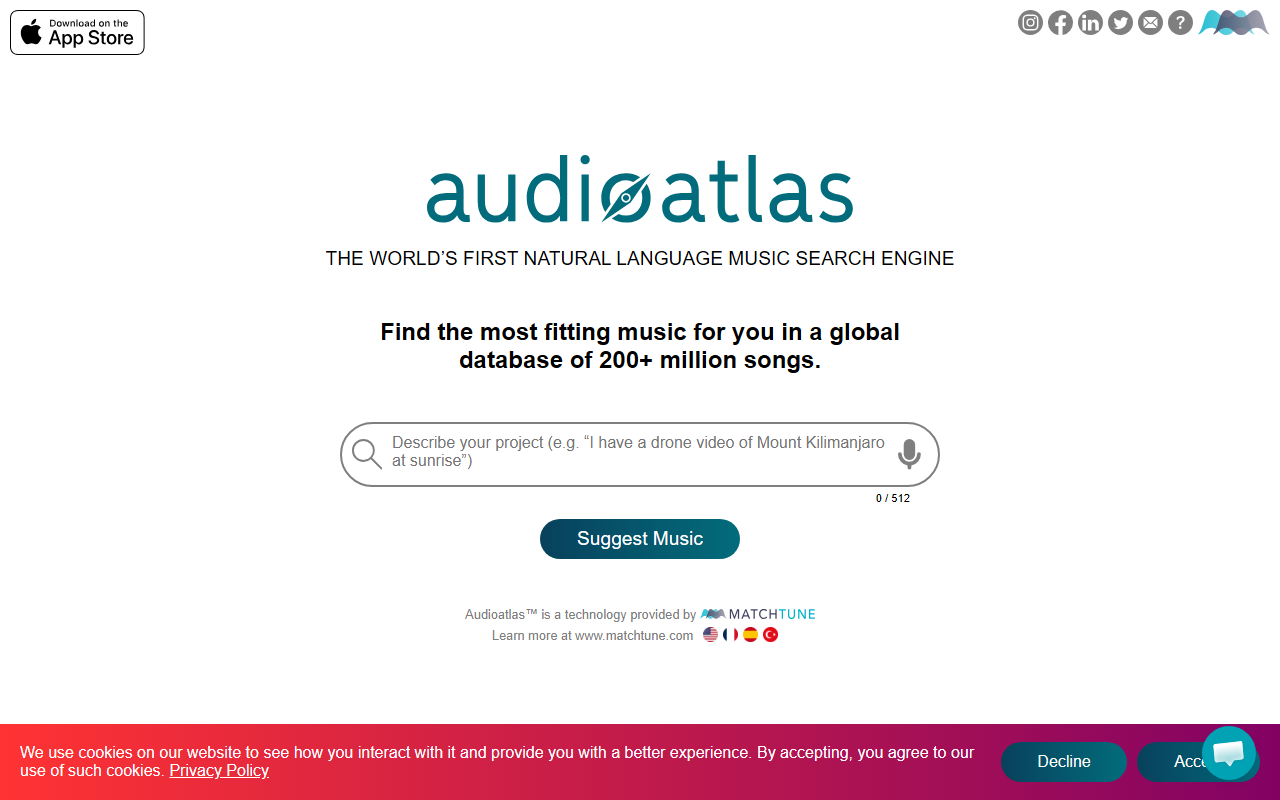
Upon visiting Audioatlas, I was greeted by a clean, almost spartan interface. The header proudly declares it “The World’s First Natural Language Music Search Engine,” and below that sits a simple text box with a 512-character limit and a “Suggest Music” button. No clutter, no promotional carousels. The only other elements are a cookie consent banner (which I accepted to proceed) and a footer linking to the parent company, Matchtune. My first thought was: how does a natural language search for music actually work? I typed “upbeat indie rock with a driving bassline” and hit Suggest. Within three seconds, the page returned a list of song titles, artists, and brief metadata — no audio previews, but the descriptions matched my query surprisingly well. The database claims access to over 200 million songs, which is staggering for a tool that appears to be in an early stage. However, the absence of any audio player or link to streaming services left me curious about the next step in the workflow.
How It Works and What It Delivers
Audioatlas leverages natural language processing (NLP) — likely a custom model fine-tuned on music descriptions — to map textual queries to song attributes. While the website doesn’t specify the underlying AI model, the parent company Matchtune (www.matchtune.com) suggests a commercial music intelligence background. The search is not just keyword-based; it understands mood, genre, instrumentation, and even production style. For example, I tested “sad piano ballad reminiscent of Coldplay” and received tracks that indeed carried that tone. The tool does not play music directly; it acts as a discovery index. This is a fundamental difference from platforms like Shazam or SoundCloud, which focus on identification or social sharing. Audioatlas is purely a search engine. The free tier appears unlimited in queries, but there is no pricing page on the site — I found no Pro or API subscription options. That raises questions about sustainability and access for commercial users. The lack of integration with streaming services (Spotify, Apple Music) is a notable gap; you get song names but must then find them elsewhere.
Strengths: Novel Approach and Vast Coverage
Audioatlas’s greatest strength is its ambition. Using natural language to find music is a genuine pain point for content creators, video editors, and playlist curators who struggle with vague tags or genre boundaries. The response quality on my tests was impressive — the engine understood compound prompts like “electronic track with female vocals and a breakdown at 2 minutes.” The 200+ million song index is likely larger than most music databases (competitors like SoundCloud or Pandora cover millions but not with this search intelligence). The interface is lightweight and loads quickly. For a tool that is essentially free (at least for now), the value in the discovery phase is solid. It also respects privacy with a clear cookie policy, though I recommend switching to a VPN if you’re sensitive to tracking. The absence of registration is a huge plus — no account required to search. This lowers the barrier to entry significantly compared to tools like Tunebat or SongBPM, which require sign-ups for advanced features.
Limitations and Who Should Use It
Despite the clever search, Audioatlas has real blind spots. There is no audio preview, no direct playlist export, and no indication of how frequently the database is updated. The search results lack confidence scores or filtering options (by year, popularity, language). For a professional music supervisor, the lack of licensing metadata (e.g., CC, royalty-free, label) makes it impractical for commercial use. The website gives no information about ownership or funding — it’s a tech provided by Matchtune, which is a B2B music intelligence firm. That suggests Audioatlas may be a demo or a lead-generation tool rather than a standalone product. The cookie policy is generic, and I found no API documentation, which limits integration possibilities. Pricing is not publicly listed, so long-term availability is uncertain. This tool is best suited for casual music explorers, hobbyists, and beat hunters who want to discover new tracks using descriptive language. Professional DJs, producers, or sync licensing agents should look elsewhere — at least until audio previews and licensing data are added.
Visit Audioatlas at https://audioatlas.com/ to explore it yourself.


Comments