

First Impressions and Onboarding
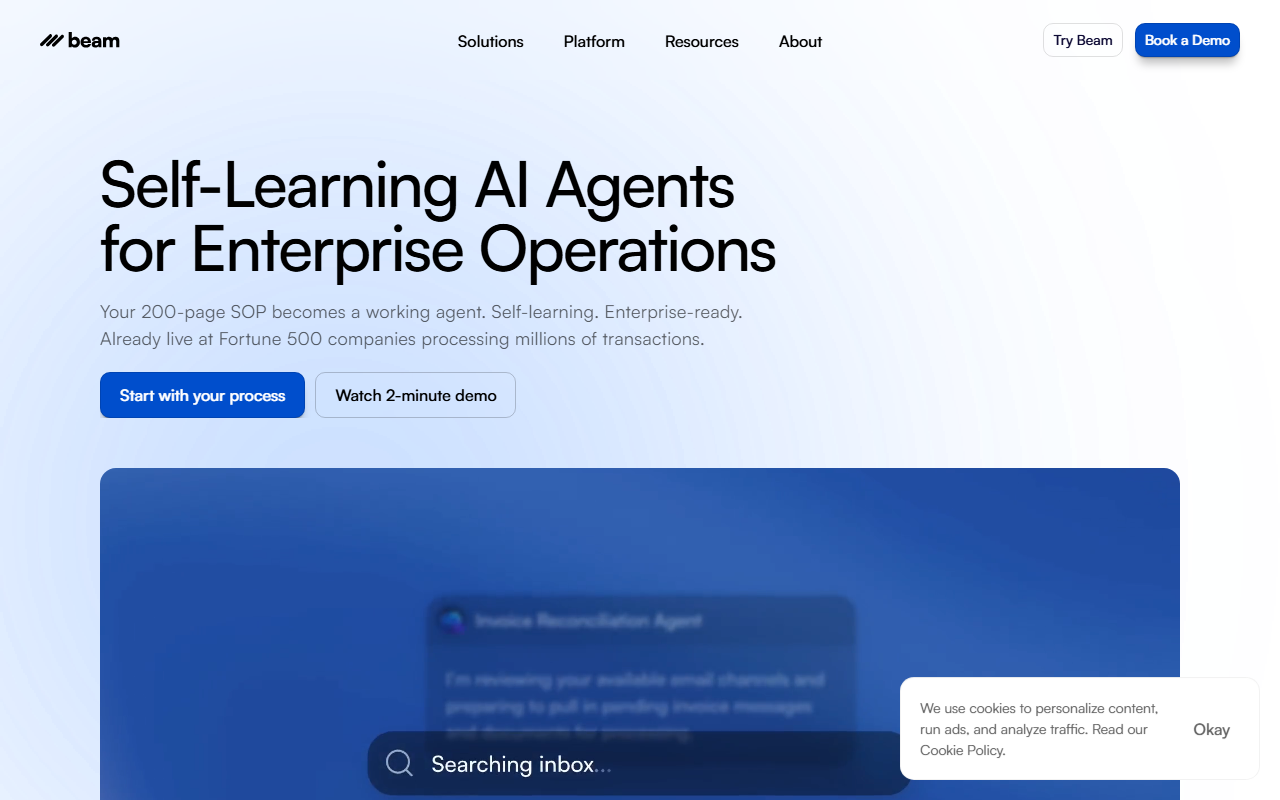
Upon visiting Beam AI’s website, I was immediately struck by the polished, enterprise-first tone. The homepage leads with a bold promise: “Your 200-page SOP becomes a working agent.” No demo request gate, no sign-up wall — just a clear value proposition and a “Watch 2-minute demo” button. The dashboard isn’t publicly accessible, but the site offers a strong sense of the product’s flow: upload a process document (like a standard operating procedure), and the platform converts it into an autonomous AI agent. The interface appears intentionally minimal, emphasizing a no-code chat-based builder where you describe the workflow and the system generates the agent. I was particularly impressed by the dedicated suites for Finance and HR — including agents for invoice reconciliation, accounts receivable, and debt collection. The site claims over 10 million AI agent tasks processed for Fortune 500 companies, which gives immediate credibility to its enterprise readiness.
Core Capabilities and Technology
Beam AI positions itself as a “self-learning OS for AI-native companies.” The platform’s core technology revolves around turning written procedures into executable AI agents without programming. The agents learn from each interaction — if an exception occurs, the system adapts and gets smarter over time. A notable feature is the “human-in-the-loop” design: critical tasks require human approval, while routine operations run fully autonomously. This is a pragmatic balance that addresses the trust and compliance requirements of finance and HR departments. Under the hood, Beam AI uses proprietary models optimized for structured business processes, though the site does not disclose whether it leverages large language models (like GPT-4 or Claude) or its own fine-tuned models. The platform integrates with existing enterprise systems (ERP, CRM, etc.), which is crucial for adoption. Unlike general-purpose automation tools such as UiPath or Automation Anywhere, Beam AI focuses specifically on AI-driven agents that learn rather than rule-based bots. This makes it more adaptive but also narrower in scope. The no-code chat interface lowers the barrier for business analysts, but truly complex workflows might still require technical guidance.
Pricing and Market Position
Pricing is not publicly listed on the website. Beam AI appears to operate on a custom enterprise licensing model, likely based on agent usage or number of processes automated. This is typical for platforms targeting large organizations. Competitors include AI agent platforms like Adept (which focuses on browser-based agents) and more established RPA vendors like UiPath with AI co-pilots. However, Beam AI differentiates itself by offering pre-built agent suites for finance and HR, claiming 98% accuracy and 10x speed improvements. The site features testimonials from BPO firms like Booth & Partners, suggesting strong traction in the shared services space. The company claims to serve “Fortune 500 companies and scale-ups,” which implies a solid funding or revenue base, though no specific investment rounds are mentioned. For a mid-market company looking to offload repetitive operational tasks, Beam AI seems like a compelling option — but the lack of transparent pricing and a free tier makes it hard to evaluate without a sales demo.
Who Should Use Beam AI?
Beam AI is best suited for enterprise operations leaders in finance, HR, and shared services who need to automate complex, document-heavy workflows without relying on a team of developers. The self-learning capability is a genuine strength — it reduces maintenance overhead as processes evolve. The platform is not ideal for one-person startups or small businesses needing simple task automation; the enterprise focus and custom pricing make it overkill. A significant limitation is the opaque onboarding process — you cannot simply sign up and start building. There is no mention of a sandbox or trial environment on the website, which may deter smaller teams. Additionally, the tool’s heavy emphasis on finance and HR means other departments (like sales or support) are less directly served. That said, for organizations already managing thousands of manual transactions per week, Beam AI offers a mature, battle-tested solution. The promise of turning a 200-page SOP into a working agent is not just marketing fluff — the testimonials and case studies suggest real-world validation.
Visit Beam AI at https://beam.ai/ to explore it yourself.


Comments