

First Impressions: Navigating the CVAI 2026 Symposium Site
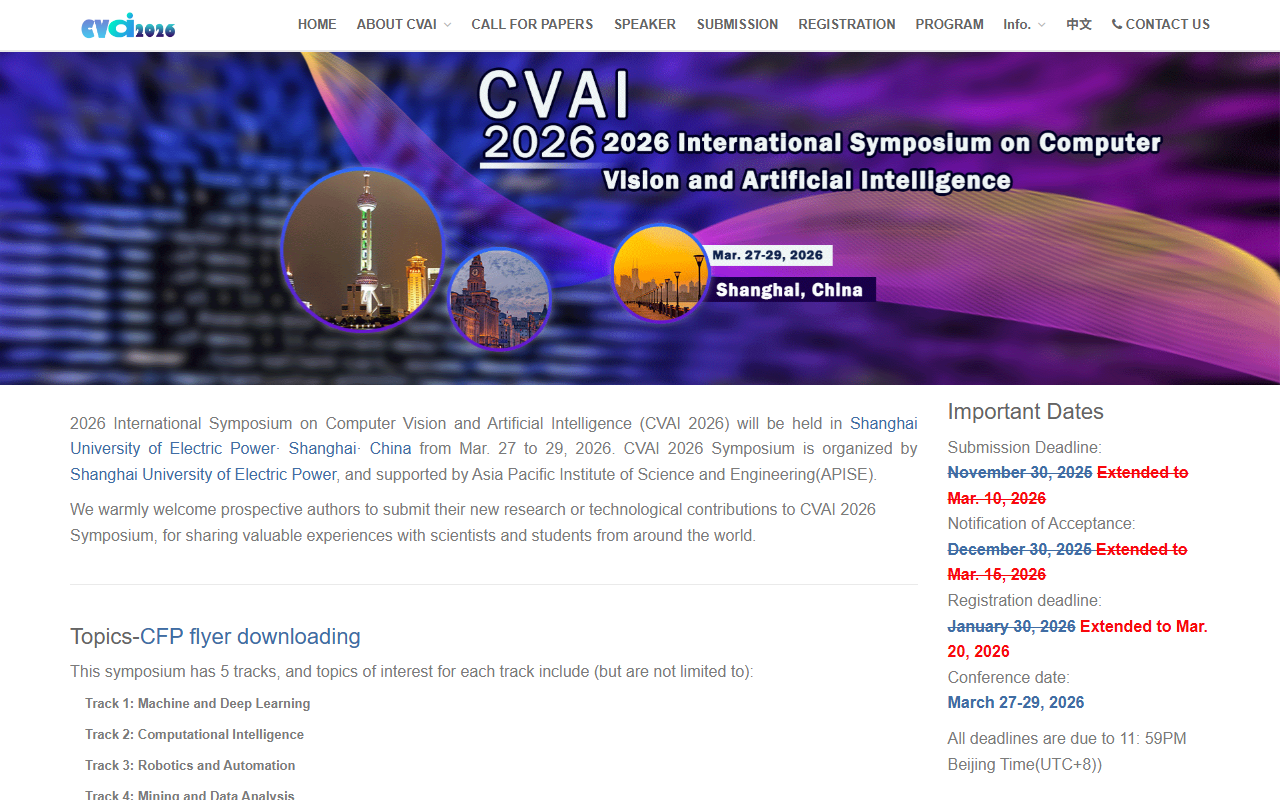
Upon visiting the CVAI 2026 website at cvai2026.org, I immediately noticed the clean but sparse layout. The homepage presents a banner with conference details: dates (March 27–29, 2026), location (Shanghai University of Electric Power), and organizers. The navigation is straightforward, with sections for topics, important dates, submission methods, and templates. There is no dashboard, onboarding flow, or interactive tool—this is a static informational site for an academic symposium, not a software platform. As a tech journalist, I was initially confused by the "Image AI > Learning Platform" category, but the site itself is purely a conference landing page. The only interactive element is the external submission system (Microsoft CMT), which redirects users for paper uploads.
What CVAI 2026 Offers: Problem & Technical Details
CVAI 2026 solves the problem of disseminating cutting-edge research in computer vision and artificial intelligence through a peer-reviewed symposium. It serves as a venue for academics and industry researchers to present new work, network, and discuss topics across five tracks: Machine and Deep Learning, Computational Intelligence, Robotics and Automation, Mining and Data Analysis, and Image Processing and Computer Vision. The symposium uses an electronic submission system (CMT) and provides APISE templates for both oral and poster presentations. Important dates include a submission deadline of September 25, 2025, and a registration deadline of November 25, 2025. The program schedule is available as a downloadable PDF. There is no API, no integrated learning platform, and no pricing listed for attendance—only registration deadlines. The conference is organized by Shanghai University of Electric Power and supported by Asia Pacific Institute of Science and Engineering (APISE).
Positioning in the Market: Strengths and Limitations
CVAI 2026 competes with other computer vision conferences like CVPR, ICCV, and ECCV, but on a smaller, more specialized scale. Unlike these top-tier conferences, CVAI focuses on a more localized audience in Asia and provides a platform for emerging researchers. The strengths include a well-defined scope, clear deadlines, and a structured submission process via Microsoft CMT. The website is functional but lacks depth—no online papers, no interactive schedule, and no community features. The biggest limitation is that it is not a learning platform in the traditional sense; it is a conference announcement site. For someone seeking a self-paced AI learning tool, alternatives like Coursera, Fast.ai, or Papers With Code would be far more appropriate. CVAI 2026 is best suited for researchers and graduate students who want to submit papers or attend a focused symposium in Shanghai. Industry practitioners looking for practical AI tutorials should look elsewhere.
Final Verdict: Honest Recommendation
CVAI 2026 serves its purpose as a conference information portal, but it does not fulfill the promise of a learning platform. The site is reliable for checking deadlines, downloading templates, and accessing the submission link. However, there is no free tier, no demo, and no interactive content. If you are actively researching in computer vision or AI and can travel to Shanghai in March 2026, this symposium is a legitimate venue to present work. Everyone else—especially those expecting a software tool or online course—should skip this. Visit CVAI 2026 at https://cvai2026.org/ to explore it yourself.




Comments