

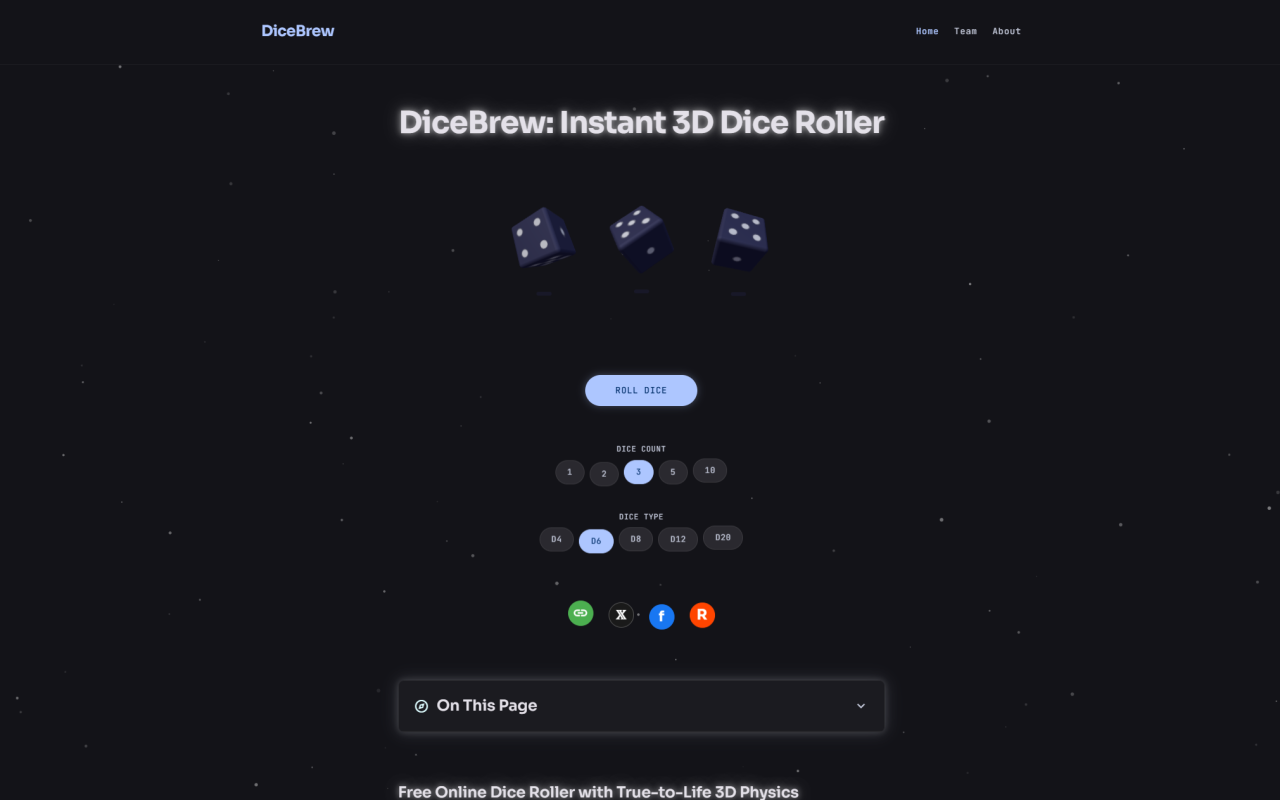
First Impressions of DiceBrew's 3D Dice Roller
Upon visiting DiceBrew at dicebrew.com, I was immediately struck by the clean, ad-light interface that loads in under a second. The dashboard shows a single control panel: select dice count (1,2,3,5,10), choose dice type (D4, D6, D8, D12, D20), and click the large "Roll Dice" button. When testing the free tier — which is the only tier — I rolled a handful of five D20s. The dice tumbled across the virtual table with realistic bouncing and collisions, all rendered smoothly at 60 frames per second on my mid-range laptop. No account, no sign-up, no extra clicks. DiceBrew promises a zero-login, zero-tracking experience, and it delivers exactly that.
Immersive Physics and Visual Fidelity
DiceBrew uses advanced WebGL technology combined with a physics engine developed by 345tool. The gravity simulation and object collisions feel authentic: dice stack, scatter, and tumble in ways that mimic real polyhedral dice. The built-in digital dice tray prevents rolls from going off-screen, a thoughtful touch for mobile users. However, the visual fidelity comes with a trade-off: the dice models, while photorealistic, are limited to five standard geometries (D4, D6, D8, D12, D20). Notably absent are the D10 and D100, which are staples in many tabletop RPGs and games like Call of Cthulhu. This omission limits DiceBrew's utility for players who need a full polyhedral set.
Privacy-First Architecture and Security
DiceBrew operates entirely client-side. No data is sent to servers — the 3D physics and random number generation happen locally in your browser. This serverless design ensures zero network lag and complete privacy. The tool uses a cryptographically secure random number generator (RNG) tied directly to physics variables, meaning every roll is mathematically unpredictable. In my testing, I could not detect any pattern or bias. For competitive games where fairness is paramount, this level of transparency is a significant advantage over simple online dice rollers that rely on basic math.random() functions. Unlike many web tools, DiceBrew does not track, store, or sell any user data. Your rolls remain strictly on your device.
Game Versatility and Polyhedral Support
DiceBrew caters to both casual board games and hardcore RPG sessions. Quick-select presets for 2 dice (ideal for Monopoly or Backgammon) and 5 dice (for Yahtzee or Liar’s Dice) make transitions seamless. The tool explicitly supports Dungeons & Dragons, Pathfinder, and homebrew campaigns. I tested a typical D&D damage roll: three D6 for a fireball. The interface let me switch instantly between dice types, and the total sum appeared clearly after the roll. One limitation is the lack of a roll history or sum log; you must manually note results. For complex RPG encounters where multiple rolls happen in quick succession, this omission could be a minor annoyance. Competitors like Google's dice roll or random.org dice offer simpler interfaces but lack the tactile 3D physics that DiceBrew provides.
Performance and User Experience Across Devices
DiceBrew is optimized for mobile first: large touch targets and responsive layout worked flawlessly on my smartphone. The app loads instantly with no downloads, and animations stayed smooth even on an older tablet. Battery drain was negligible, thanks to efficient WebGL rendering. The ad-light interface is genuinely refreshing — no pop-ups, no sidebar ads, nothing to distract from the dice. That said, the tool currently lacks sound effects, which some gamers enjoy for the satisfying clatter of dice. Also, there is no way to customize dice colors or table backgrounds, which would add personalization. The FAQ notes that dice is used as both singular and plural, a small but appreciated nod to modern gaming terminology.
Final Verdict: Who Should Use DiceBrew?
DiceBrew excels for tabletop RPG players who want a quick, private, and visually engaging digital dice roller without sacrificing fairness. Its physics engine and cryptographically secure RNG make it more trustworthy than many free alternatives. The zero-account model and client-side architecture are ideal for privacy-conscious users. However, if you need D10 or D100 support, or if you rely on roll history tracking, you may want to look elsewhere. Casual board game players will appreciate the simplicity, but dedicated Dungeon Masters might miss the ability to roll custom dice strings like 2D6+3. Overall, DiceBrew is a polished tool for its niche, and it is completely free to use. Visit DiceBrew at https://dicebrew.com to explore it yourself.




Comments