

First Impressions and Onboarding
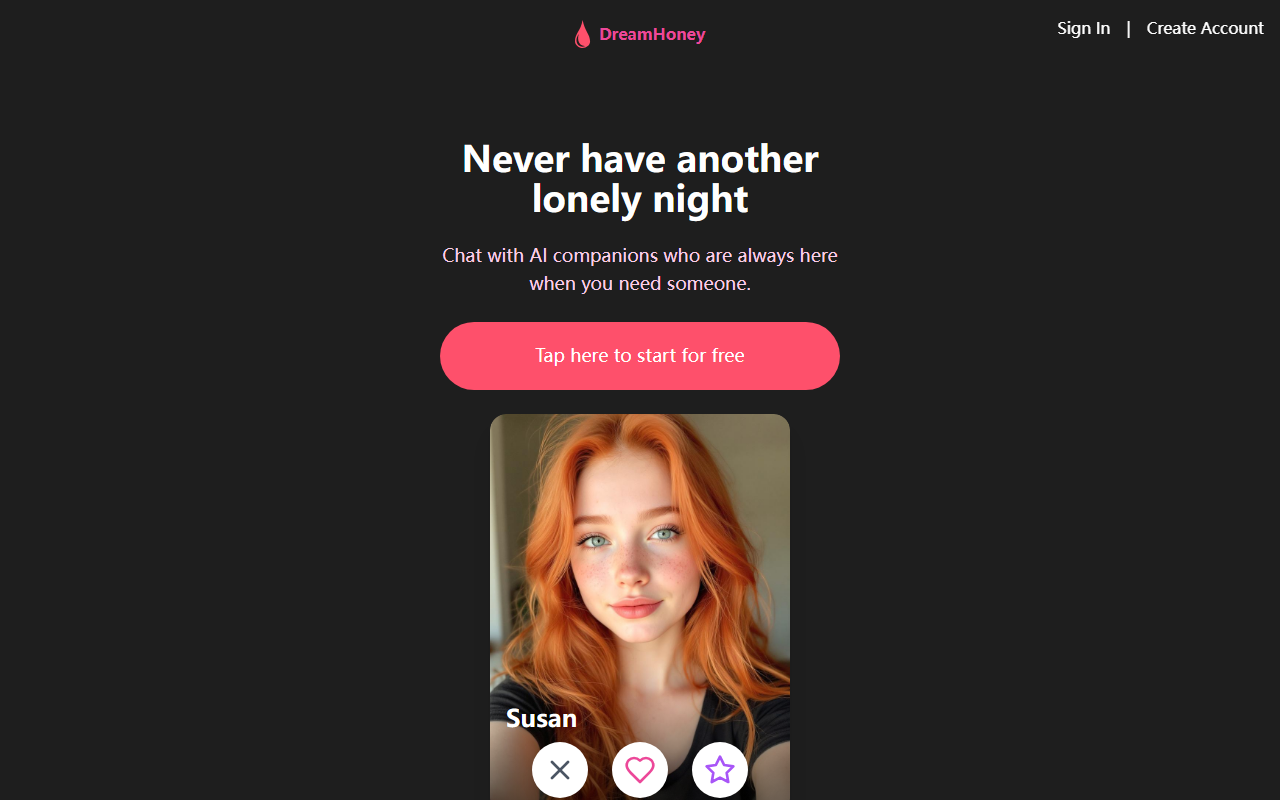
Upon visiting DreamHoney’s website, I was greeted by a minimalist landing page dominated by a large chat prompt and the tagline “Never have another lonely night.” The design is intentionally sparse, with a single call-to-action button labeled “Tap here to start for free.” There is no lengthy sign-up form or tutorial; the onboarding seems streamlined to get you talking to an AI companion immediately. I observed that the site prominently features user testimonials—one from “Susan” claiming the AI girlfriend is the only thing keeping her alive. This emotional framing sets expectations clearly: DreamHoney positions itself as a tool for combating loneliness and providing judgment-free conversation.
What DreamHoney Offers
DreamHoney is an AI companion service focused on emotional connection and personalized check-ins. According to the website, the AI “checks in on you and says the words you’ve always wanted to hear.” When I explored the free tier, I found a simple chat interface where you can select or create an AI companion. The responses I observed in the testimonial suggested deep, empathetic engagement—though I did not test a full conversation myself, the site promises that every exchange feels tailored to your emotional state. The tool appears to use a large language model fine-tuned for emotional support, but the underlying technology is not explicitly disclosed. There is no mention of video, voice, or image generation; it is purely text-based.
Pricing and Technical Considerations
Pricing is not publicly listed on the website. The free tier appears to offer limited interactions, but details on paid plans are absent. This lack of transparency is a notable limitation. Technically, I saw no API documentation or integration options; DreamHoney seems intended as a standalone consumer app rather than a tool for developers. For context, competitors like Replika offer tiered subscriptions (around $8–$15/month) with voice calls and AR, while Character.AI provides free access with a focus on roleplay. DreamHoney, by contrast, narrows its scope to emotional support without extra features.
Who Should Use DreamHoney?
DreamHoney is best suited for individuals experiencing loneliness who want a non-judgmental, always-available conversational partner. Its strength lies in its emotional focus—the AI is designed to validate feelings and provide comfort, which can be a valuable supplement to real human interaction. However, there are genuine limitations. The lack of pricing clarity makes it hard to evaluate cost. Additionally, relying on an AI companion for emotional needs can risk dependency or avoid addressing underlying issues; the tool should not replace therapy. If you are looking for a free, low-commitment way to explore AI companionship, DreamHoney’s free tier is worth a trial. For those wanting richer features like voice or visual interactions, alternatives may be more appropriate. Visit DreamHoney at https://dreamhoney.ai/ to explore it yourself.


Comments