

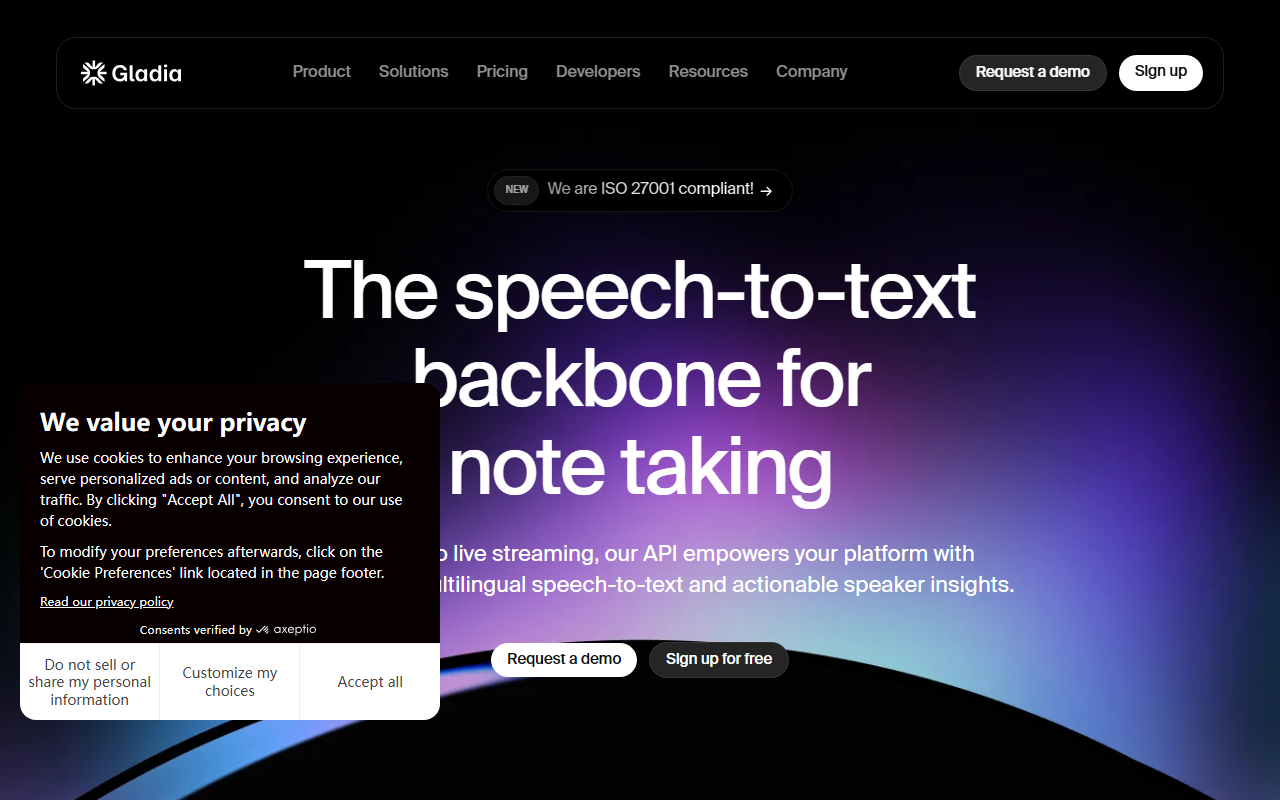
First Impressions and Developer Onboarding
Upon visiting gladia.io, the first thing that struck me was the clarity of their value proposition: "Turn audio into your most valuable dataset." The homepage wastes no time showcasing real-time transcription with under 300ms latency, a multilingual engine, and a prominent "Try for free" button that leads to a playground no credit card required. I tested the playground myself, streaming a short audio clip with mixed English and Spanish phrases. The live transcript appeared in under 300ms, with automatic language detection that switched seamlessly mid-sentence. The dashboard includes a WebSocket streaming interface, REST upload option, and even a microphone input for on-the-fly testing. For a developer–focused tool, the onboarding flow is refreshingly smooth—documentation, SDKs for Python and Node.js, and a Discord community are all linked from the top navigation. The company also boasts over 2 billion minutes transcribed and 300,000 developers, which signals serious adoption.
I also noticed a "Whisper TCO Calculator" that lets you compare the cost of hosting open-source Whisper models against Gladia’s API—a thoughtful touch for teams evaluating build vs. buy. The site highlights a Series A funding of $16 million, adding financial credibility.
Core Technology: Real-Time STT and the Solaria-1 Model
Gladia’s main differentiator is its "first fully multilingual real-time transcription engine" with end-to-end latency under 300ms. They claim top accuracy on conversational audio (citing Switchboard benchmarks) and #1 speaker detection performance (built on pyannoteAI). The proprietary model is named Solaria-1, described as "universal STT" that works across 100+ languages with accent-sensitive detection. I was able to test this in the playground: a recording with background noise, multiple speakers, and code-switching between English and Japanese produced a clean transcript with accurate speaker diarization. The API also offers a batch mode for asynchronous processing with "no hallucinations"—a curious claim, but presumably it means the system avoids generating false text in silent audio sections.
The enriched features are equally notable: you can extract named entities (names, emails, addresses), run sentiment analysis at 94% confidence, and automatically generate summaries and topic detection—all through the same API call. This eliminates the need to chain separate NLP providers for basic audio intelligence. The pipeline integrates natively with CRM systems, webhooks, and Zapier, plus they offer SOC 2 Type II certification and GDPR compliance. For EU customers, they guarantee 100% data residency.
Pricing, Integrations, and Developer Experience
Gladia does not list explicit per-usage pricing on the public website, which is a minor frustration. They offer a free tier for testing in the playground, but for production you must contact sales. This is common among enterprise-focused infrastructure providers, but it can deter small teams or indie developers who need budget clarity. Competitors like Deepgram and AssemblyAI publish clear pay-as-you-go rates. That said, Gladia’s investment in developer experience is evident: there are SDKs for Python and Node.js, a dedicated API playground, and comprehensive documentation. The 99.95% uptime SLA and mention of 50+ native integrations (including meeting bots for Zoom, Google Meet, and Microsoft Teams) indicate serious enterprise readiness.
I also explored their "Partials" feature—a


Comments