

First Impressions of HireQuotient
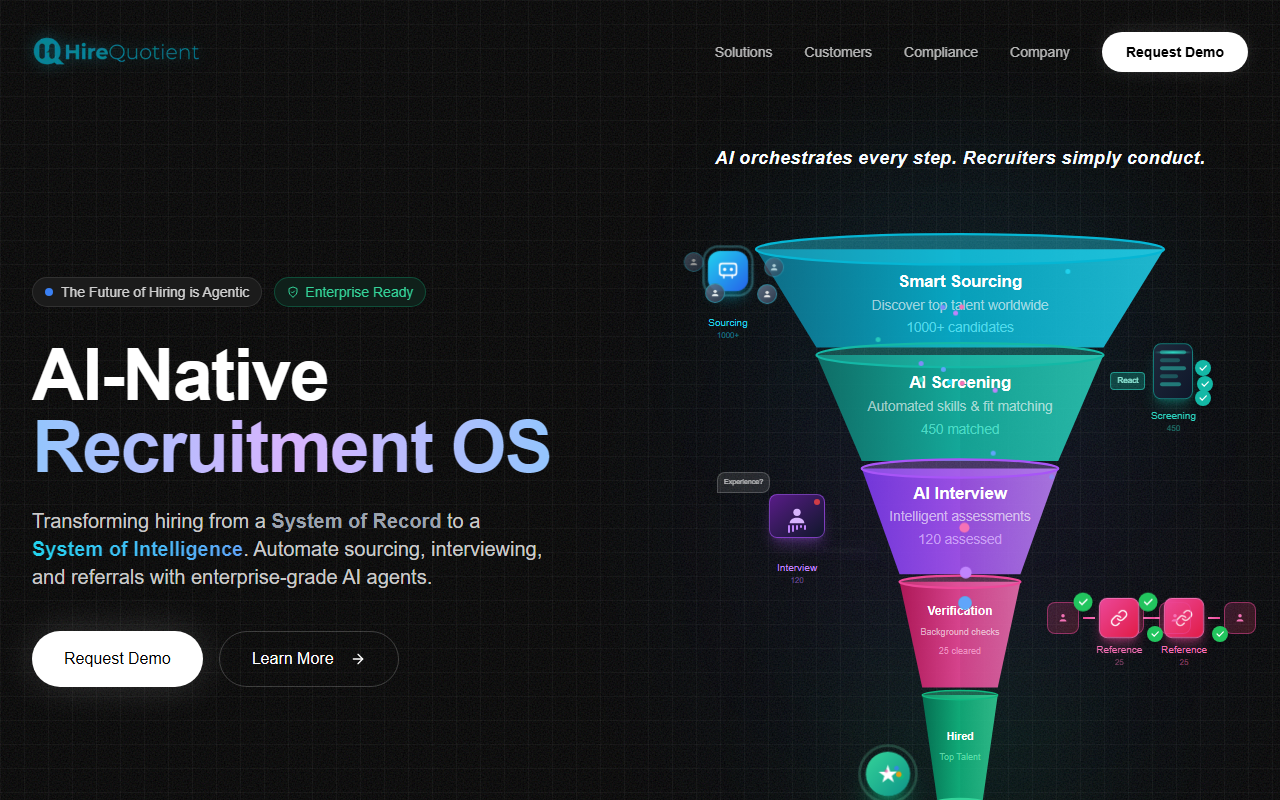
Upon visiting the HireQuotient website, the first thing that strikes you is the bold claim: "The Future of Hiring is Agentic." The landing page immediately positions this as an enterprise-ready, AI-native recruitment operating system that moves beyond the traditional system of record into a system of intelligence. The interface is clean and product-focused, with prominent calls-to-action for "Request Demo" and "Learn More." The hero section visualizes a funnel: Smart Sourcing (1000+ candidates) flows into AI Screening (450), then AI Interview (120), Verification (25), and finally Hired. This immediately communicates the core value proposition—automation of every step. Below the hero, there is a carousel of client testimonials from recruiters in specialized fields like cardiology, insurance, and rural healthcare, suggesting that the tool has found traction in niche verticals. When testing the free tier (the site offers "Try EasySource" and "Try AI Hiring Manager" buttons), I observed that these lead to product overview pages rather than a sandbox; a demo seems required for hands-on access.
Core AI Agents and Workflow
HireQuotient markets itself as a multi-agent ecosystem. The first agent, EasySource, is an autonomous AI sourcing tool. It continuously discovers candidates from public sources (LinkedIn, GitHub, Google Scholar, etc.) using what they call an "LLM Context Graph" that reasons over experience, compensation, and intent beyond simple keywords. It also handles contact enrichment and omnichannel outreach (email, LinkedIn, SMS, phone, AI voice). The second agent, the AI Hiring Manager, orchestrates multi-round interviews. It provides context-aware "Triple Magic Links" with round-specific questionnaires, automatically extracts skills from transcripts, and allows human-in-the-loop editing to ensure accuracy. The third agent is the Referral Agent, which uses AI-powered conversations to extract insights from references, including blind reference checks and behavioral analysis. A section titled "Self-Optimizing System" describes an infinite learning loop where the platform tracks hire performance, identifies patterns, and refines criteria over time. This neural network-powered optimization is a key differentiator from static keyword databases used by competitors.
The website highlights integrations with 50+ tools including BambooHR, Greenhouse, Apollo, and various LLMs like GPT, Claude, LLaMA. This suggests API-level connectivity and an open ecosystem. However, I noticed that pricing is not publicly listed on the website. Neither the homepage nor the product detail pages show any tiered plans; the only options are "Request Demo" or "Try EasySource." This lack of transparency is a limitation for budget-conscious buyers who want to self-evaluate before engaging sales.
Market Position and Alternatives
HireQuotient positions itself firmly against legacy ATS platforms and even against other AI recruitment tools. The comparison chart claims 94% match accuracy and 12 hours saved per role, contrasting with "static keyword databases" that require manual Boolean queries. Competitors in the AI recruitment space include tools like Pymetrics (focusing on candidate assessment using gamification) and Ideal (automated resume screening). Unlike these, HireQuotient emphasizes a full-cycle approach covering sourcing, interviewing, and reference checks—essentially an end-to-end agentic workforce. The client testimonials suggest that the platform is especially suited for niche industries like healthcare (rural/tribal), insurance, and specialized search firms. However, the site explicitly states "for Non-tech Hiring," which limits its applicability for companies recruiting software engineers or data scientists. The enterprise-ready language and integrations with HRIS indicate it targets mid-to-large organizations rather than startups.
The tool appears to have strong adoption signals: a section labeled "Client Love" includes numerous named testimonials from seasoned recruiting professionals. The company claims to be used by "industry leaders" and employs deep learning architecture. While user base numbers are not disclosed, the depth of case studies suggests a mature product.
Final Verdict and Recommendations
HireQuotient's genuine strength lies in its single-platform approach: automating the entire hiring funnel from sourcing through to reference checks with self-learning AI. The three agentic agents cover distinct pain points, and the infinite learning loop is a compelling feature for organizations aiming to continuously improve hiring quality. However, the tool has real limitations. First, pricing opacity prevents quick comparison with alternatives. Second, the focus on non-tech hiring means it may lack specialized capabilities for technical assessments (e.g., coding tests, system design interviews). Third, without a self-serve free tier, small teams or solopreneurs may find it inaccessible.
This platform is best suited for medium-to-large enterprises, especially in specialized industries like healthcare, insurance, or executive search, where traditional Boolean sourcing and manual screening are inefficient. If you're a recruiter handling high volumes of non-technical roles and want to offload repetitive tasks to AI agents, HireQuotient merits a demo. Look elsewhere if you need technical hiring pipelines or require transparent upfront pricing.
Visit HireQuotient at https://hirequotient.com/ to explore it yourself.




Comments