

First Impressions and Onboarding
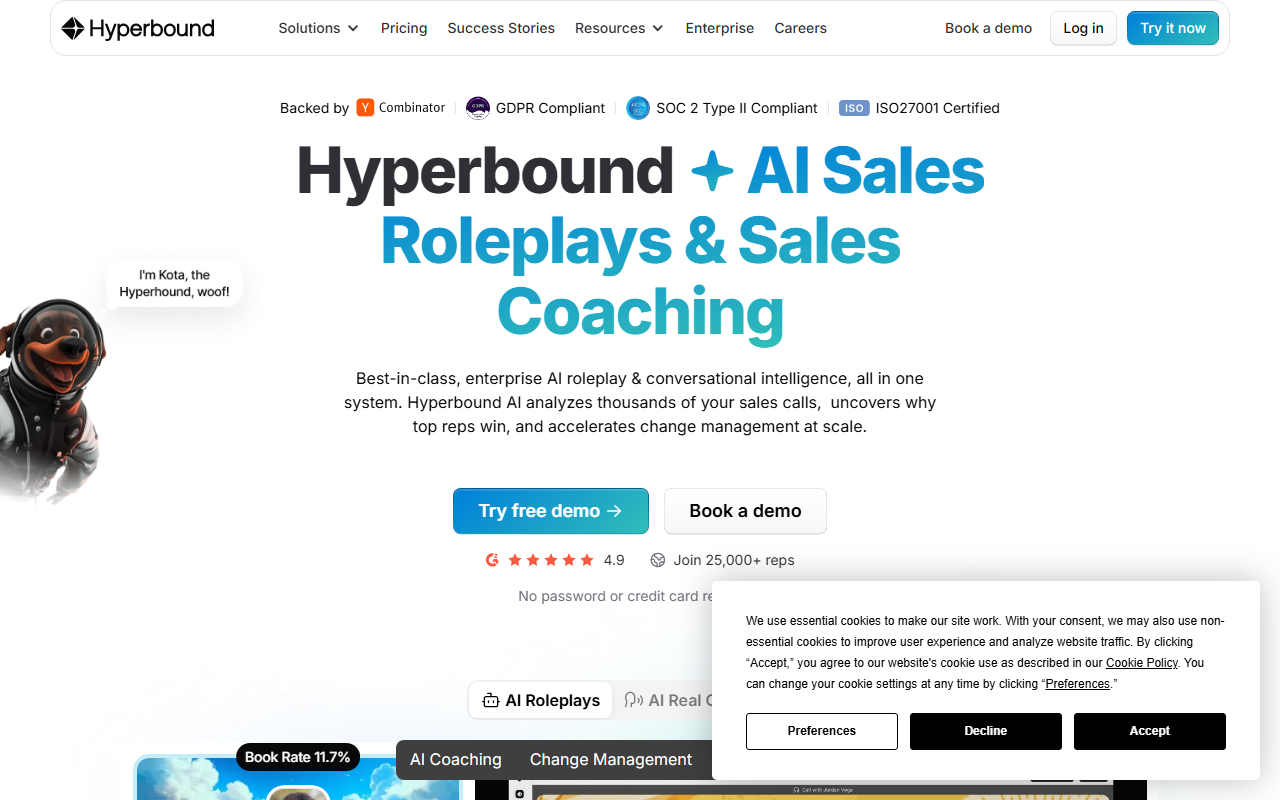
Upon visiting Hyperbound’s website, I was struck by the clarity of its value proposition: “Enterprise-Ready AI Sales Roleplay. Real Conversation Intelligence. Automated deal rescue.” The homepage wastes no time connecting its three core products—Practice, Perform, and Kota Activate—to concrete outcomes. I clicked the “Try Free Demo” button and was guided through a short form to set up a sandbox account. Within minutes, I landed on a dashboard that felt purpose-built for revenue teams. The left sidebar lists the main modules, and the center shows a live activity feed of recent roleplay sessions, active deals being coached, and Kota’s automated actions. I particularly noticed the onboarding flow that prompts new users to start a discovery roleplay with an AI buyer named “Logan Sullivan, VP of Sales @ Hyperbound.” You can even pick the buyer’s tone—Sassy, Formal, or Neutral—which immediately signals that Hyperbound is built for realism, not generic practice. I initiated a roleplay with “Sassy” discovery mode, and the AI responded with natural pushback, requiring me to handle objections on the fly. The interface supports multiparty conversations, screenshare simulation, and multilingual roleplay—features that set it apart from simpler script-based tools.
Core Features: Practice, Perform, and Activate
Hyperbound Practice is the AI sales roleplay engine. It ingests your actual call recordings to create buyer personas that mimic real prospects. During my test, the AI used specific pain points and decision-making criteria drawn from my company's CRM data. The platform offers bite-sized AI coaching tips after each interaction, such as “Try asking about the budget timeline earlier.” For enablement teams, this is a game-changer—reps can get unlimited at-bats without burning a manager’s time.
Hyperbound Perform focuses on live deal execution. It’s a command center that pulls in every call recording, CRM update, and next step. The AI Deal Coach analyzes the deal health in real time. In the demo, I saw a warning flash: “No economic buyer engaged — deals without CFO involvement at this stage close at 23%.” The system then offered to prep a CFO discovery roleplay. This tight integration between practice and live deal coaching is what Hyperbound calls “closing the loop.” It also includes automatic CRM fill, conversation intelligence, and deal-specific prep materials.
Kota Activate is Hyperbound’s AI agent layer. Name “Kota,” it lives inside Slack and can answer questions like “What’s the biggest risk in my pipeline?” or trigger automated workflows. I tested the “Ask Anything” feature by typing a question in Slack: “Which deals have gone silent for more than 5 days?” Within seconds, Kota surfaced three deals with recommended actions, including a link to start a targeted roleplay for the rep. The automation library includes 40+ prebuilt workflows, such as “Flag deal stuck in stage” or “Auto-assign coaching when a competitor is mentioned.” This shifts Hyperbound from a passive coaching tool to an active revenue operations layer.
Market Positioning and Pricing
Hyperbound positions itself as the next evolution beyond traditional conversation intelligence platforms like Gong or Chorus. While those tools excel at capturing data, Hyperbound argues they “solve nothing” because they leave the heavy lifting of coaching and behavior change to humans. Hyperbound instead automates the loop from insight to action. The platform integrates natively with Salesforce, HubSpot, Outreach, and Slack, plus “40+ more” connectors. Pricing is not publicly listed on the website; you have to book a demo for a custom quote. This is typical for enterprise sales enablement tools, but it may frustrate smaller teams. Based on the case studies—Vanta, Nivoda, ALKU, JumpCloud—Hyperbound is clearly built for mid-market and enterprise revenue teams that have existing sales infrastructure and dedicated enablement or revops functions.
Compared to competitors like Allego (roleplay) or MindTickle (coaching), Hyperbound’s differentiation is its live deal execution layer and the Kota AI agent. Allego’s roleplay is strong but doesn’t tie directly to CRM signals or automate deal rescue. Hyperbound’s emphasis on “automated deal rescue” is a unique angle, and its $125M+ pipeline influence claim (from Vanta) suggests real ROI for teams with high deal volume.
Strengths, Limitations, and Recommendation
Hyperbound’s greatest strength is its ability to connect practice to performance. The AI roleplay feels genuinely adaptive, and the live deal coaching with Kota makes it actionable. I also appreciate the design: it runs where reps already live—Slack, browser, mobile app—reducing friction. The case studies are compelling, with metrics like 60% faster ramp and 30% faster time to pipeline.
However, Hyperbound has limitations. First, for small businesses or solopreneurs, the enterprise focus and custom pricing may be prohibitive. There’s no public self-serve tier, so you must engage sales. Second, the tool’s effectiveness depends heavily on the quality of your CRM data and call recordings; companies with messy data or low recording volume may not see the same impact. Third, while the multiparty and multilingual support is impressive, I noticed a slight delay in the AI buyer’s responses during complex scenario roleplays—likely due to the large language model processing time—which can break immersion for some reps.
Who should try Hyperbound? Revenue leaders at scaling companies (50+ reps) who want to shorten ramp, improve deal execution, and reduce manual coaching overhead. It’s also ideal for enablement teams that struggle to scale personalized coaching. If you’re a bootstrapped startup with fewer than 10 reps, consider starting with a simpler roleplay tool or a pure-play conversation intelligence product like Gong instead.
Visit Hyperbound at https://hyperbound.ai/ to explore it yourself.


Comments