
First Impressions of Just Learn
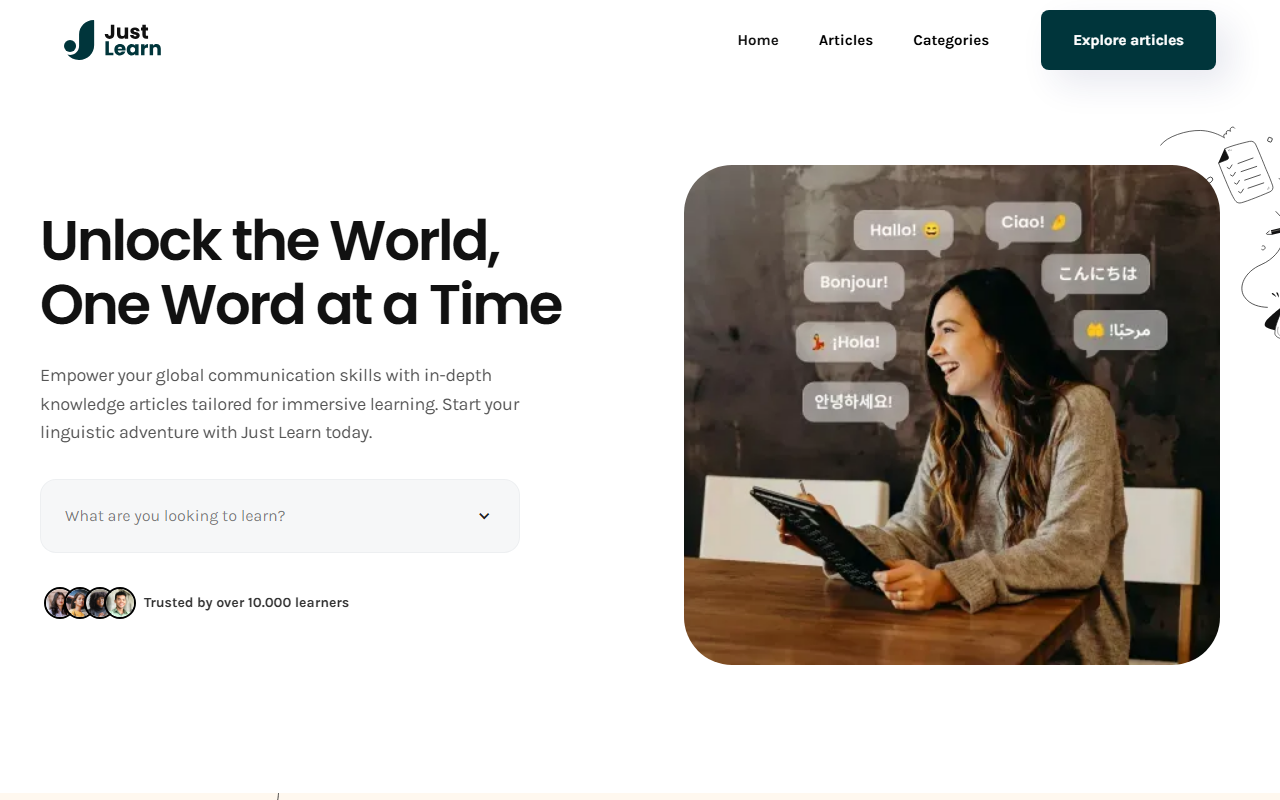
Upon visiting JustLearn.com, I was greeted by a clean, minimalist interface. The landing page immediately highlights the tagline “Unlock the World, One Word at a Time” and promises in-depth knowledge articles for immersive learning. There is no pop-up or forced sign-up; the onboarding is frictionless. The dashboard shows a row of language tiles—English, Spanish, Portuguese, Arabic, Aramaic, Chinese, Dutch, French, German, Greek, Italian, Japanese, Russian, Swedish. Each tile leads to a list of articles, grouped by language. Browsing the free tier, I could access all articles without logging in. The site also has a newsletter subscription form for daily learning tips. The overall design is simple and ad-free, which I appreciated.
What Just Learn Does and How It Works
Just Learn is a content-driven language learning platform that focuses on reading articles written in the target language. It does not offer AI-powered chatbots, adaptive exercises, or speech recognition. Instead, it solves the problem of finding authentic, level-appropriate reading material for intermediate learners. I tested the English section and read “No English Allowed: The Power of Full Immersion in Language Learning.” The article was well-written, about 500 words, with clear language and practical tips. The articles are written for learners—they use common vocabulary and avoid overly complex syntax. The technology behind the platform is a basic CMS with no visible AI features. There is no API, no integrations, and no mention of any underlying models. The site states it is trusted by over 10,000 learners, likely a self-reported figure from email subscribers or social followers. Pricing is not publicly listed anywhere on the website, suggesting the content is entirely free (supported by a newsletter).
Market Position and Target Audience
Unlike competitors such as Duolingo or Babbel, which rely on gamified exercises and AI-driven personalization, Just Learn is wholly focused on static reading content. It sits closer to services like LingQ or Beelinguapp, but without the audio support, flashcards, or spaced repetition. For context, LingQ offers a vast library of graded readers with built-in dictionary lookup, while Beelinguapp pairs articles with native audio. Just Learn offers only text articles with no interactive features. The platform is best suited for intermediate learners who already have basic grammar and vocabulary and want to practice reading fluency. Beginners may find the lack of scaffolding frustrating. Advanced learners will likely outgrow the content quickly, as there are no adjusted difficulty levels. The tool is ideal for self-directed learners who enjoy consuming long-form content in their target language and want a distraction-free environment.
Strengths, Limitations, and Verdict
Strengths: The content is curated and clearly written for language learners, covering practical topics like travel phrases and common mistakes. The interface is clean, mobile-friendly, and requires no registration to access all articles. Support for 14 languages, including less common ones like Aramaic, is a nice bonus. Limitations: The platform lacks any interactive elements—no quizzes, no audio, no progress tracking. The articles are not graded by level, so learners must self-assess suitability. There is no AI personalization or feedback, which feels out of step with the “Text AI > Learning Platform” category. The newsletter subscription is well-intended but the site shows “Thank you” messages even before any data is submitted, which raises a minor trust flag. Overall, Just Learn is a lightweight resource, not a full-featured learning system. I recommend it as a supplementary reading library for intermediate learners who want to expand vocabulary through real-world texts. Beginners and those seeking structured lessons should look elsewhere.
Visit Just Learn at https://justlearn.com/ to explore it yourself.


Comments