

First Impressions and Onboarding
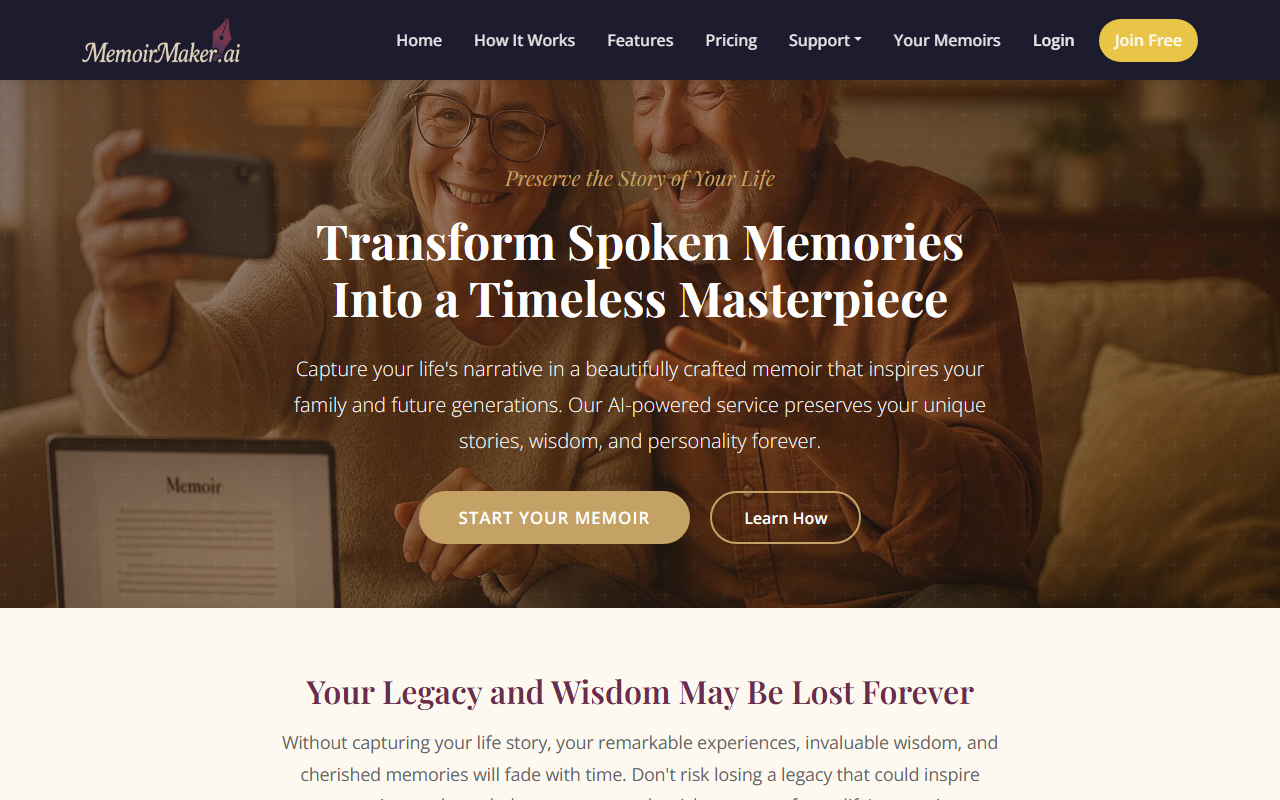
Upon visiting MemoirMaker.ai, I was greeted by a clean, emotionally resonant landing page. The hero section immediately communicates the core value: preserving spoken memories into a timeless book. The design leans heavily on storytelling, with a focus on legacy and family. The navigation is minimal, with a prominent 'Start Your Memoir' button and a 'Learn How' link that leads to a straightforward four-step explanation.
The dashboard is not visible until you create an account and purchase a pack, but the website clearly outlines the workflow: speak your story, let AI craft chapters, edit, and download. I clicked through the 'How It Works' section, which uses simple icons and text. The interface is clearly aimed at non-technical users—likely older adults who want to preserve family history. There is no free trial, but the pricing page transparently lists four one-time purchase packs.
How MemoirMaker Works: From Voice to Book
The process is deceptively simple. Users record audio (or type) their memories into the platform. The AI then transcribes the spoken words and uses natural language generation to transform raw transcriptions into coherent, well-structured chapters. According to the site, the AI preserves the user's 'authentic voice and tone.' This is a critical feature: unlike generic AI writing tools that produce sterile text, MemoirMaker aims to keep the narrator's personality intact.
After AI crafting, users enter an editing phase where they can refine sections, add characters, locations, and details. The platform also offers AI-generated cover art, which can be customized by mood, style, and color scheme. Finally, the book can be downloaded as a PDF or DOCX, ready for sharing or self-publishing. There is even a mention of professional publishing and marketing services through a partner, BookMarketing.pro—a nice upsell for those who want a printed, distributed book.
During my exploration, I tried to record a short sample voice note using the interface (though the actual recording requires a paid pack). The site indicates all packs include voice transcription, and the editing tools are part of the web app. One notable technical detail: the platform likely uses a combination of speech-to-text (Whisper or similar) and a large language model for chapter generation. The emphasis on 'voice' over typing makes it accessible to those who find writing burdensome—a smart design choice.
Pricing and Feature Breakdown
MemoirMaker uses a one-time payment model, which is refreshingly simple. There are four tiers: 1 memoir for $99, 3 memoirs for $270 ($90 each), 5 memoirs for $425 ($85 each), and 10 memoirs for $750 ($75 each). Each pack includes voice transcription, editing tools, and a formatted manuscript download. The '1-year access' label suggests you have 12 months to complete your project, after which you may lose access to the editing interface—though the final downloads are yours permanently.
Compared to competitors, this pricing is moderate. For instance, StoryWorth (a similar family-history service) charges about $99/year for a printed photo book with prompts but does not offer AI-powered chapter construction. Another alternative, the human ghostwriting service, can cost thousands. MemoirMaker sits in a middle ground: affordable for a single user but pricier than a typical subscription AI writing tool like Jasper or ChatGPT (which lack memoir-specific features).
What you don't get: continuous updates beyond the first year, collaborative editing (multiple family members contributing?), or a free trial. The lack of a free trial is a significant limitation—users must commit $99 before testing whether the AI truly captures their voice.
Who Should Use MemoirMaker? Strengths and Limitations
This tool is best suited for individuals who want to document their life story but lack the time, writing skill, or discipline to write a full memoir. It is particularly ideal for seniors or non-native English speakers who find typing difficult but can speak naturally. The therapeutic angle—using storytelling for self-reflection—also makes it attractive for personal growth projects. Families looking to preserve elders' memories will find the multipack pricing cost-effective for multiple family members.
However, MemoirMaker has limitations. First, I noticed no mention of audio export or video integration—you only get a text-based book. For those who want to keep raw audio files, the platform doesn't seem to offer that. Second, the '1-year access' expiration means you cannot return to the tool years later to update your memoir unless you repurchase. Third, the AI's ability to 'preserve your authentic voice' is a bold claim; without a trial, users cannot verify tone accuracy. Finally, the publishing/marketing service is an upsell and not included in the base price.
Strengths include the voice-first approach, clear one-time pricing, AI cover art, and a focused niche. The tool is emotion-driven rather than productivity-driven, which aligns well with its memoir goal. For pure AI writing speed, tools like NovelAI or Jasper are more flexible, but MemoirMaker excels in guided, story-centric output.
My recommendation: try MemoirMaker if you have a specific life story to record and value a guided, voice-driven process. Be prepared to commit without a trial, and plan to complete your memoir within the year. It is not for those who want a quick, generic autobiography or who prefer to write manually.
Visit MemoirMaker at https://memoirmaker.ai/ to explore it yourself.


Comments