

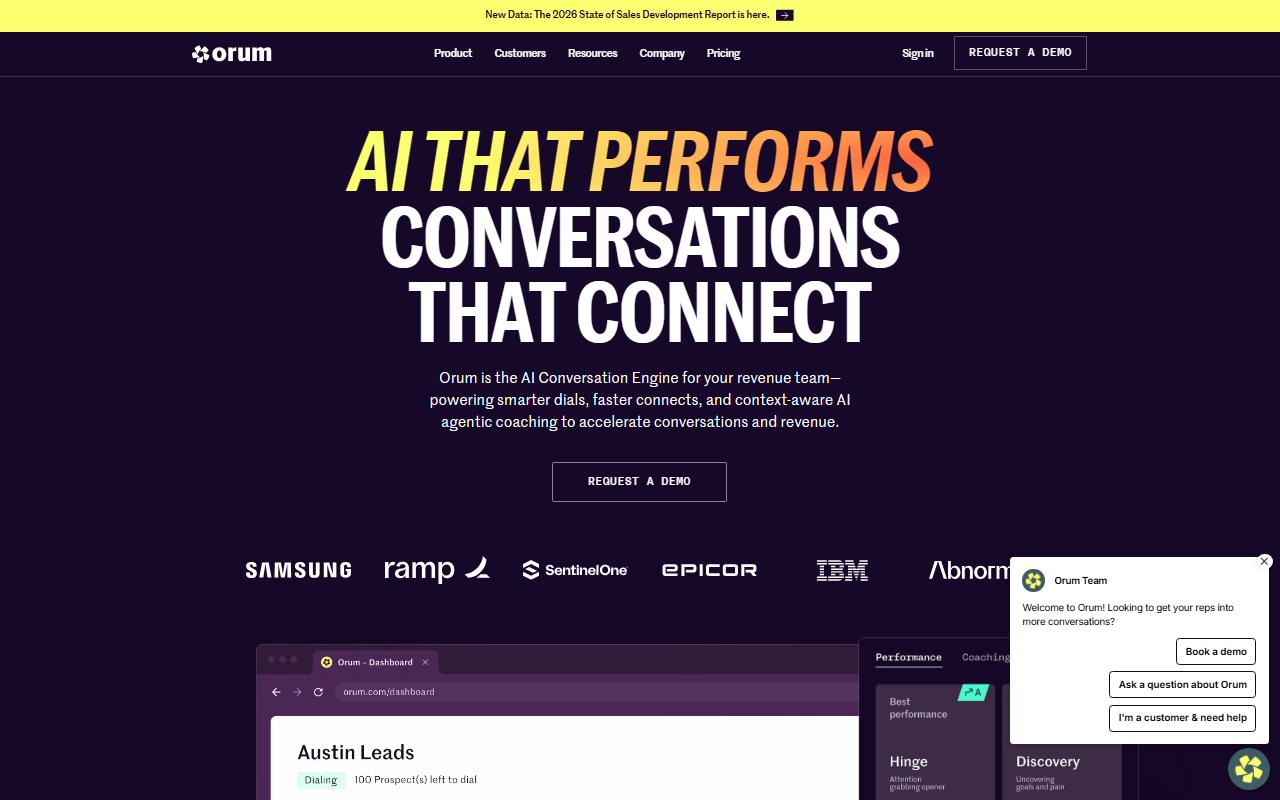
Orum’s Interface and Onboarding Experience
Upon visiting Orum’s website, the first thing I noticed is a clean, modern dashboard that emphasizes video demonstrations and customer testimonials. The homepage immediately presents a value proposition: “Reliable Pipeline Starts Here.” The navigation is straightforward, with clear links to Product, Customers, Resources, Company, and Pricing. However, the Pricing page does not display exact numbers—only a “Request a demo” call-to-action. This suggests Orum targets enterprise buyers who expect custom quotes.
When I explored the product tour, I found a simulated dialing interface with call statuses like “Do Not Disturb mode” and “Spam likely,” alongside real-time activity feeds showing reps booking meetings. The onboarding flow appears to be handled by a dedicated implementation team, with claims that most teams go live in days, not weeks. From a first-person perspective, I appreciated the emphasis on reducing friction: reps can start dialing quickly because Orum integrates with existing CRMs and SEPs (Salesforce, HubSpot, Outreach, Salesloft) without ripping and replacing the tech stack.
The site also includes a “See Orum in Action” video, but the browser-native video tag fails to load in my environment—a minor technical hiccup. Still, the written use cases and customer stories (e.g., 2x more meetings with fewer reps, 20% more meetings booked) provide concrete evidence of the platform’s impact.
Core Features: Dialer, Coaching, and Salesfloor
Orum’s primary offering is a purpose-built dialer designed to maximize live conversations. Unlike generic softphone systems, Orum includes parallel dialing with millisecond detection to handle two simultaneous pickups, automatically connecting you to the first answerer while dropping the second into a “Canceled Calls” bucket for easy callbacks. This feature solves a real pain point for SDRs who waste time on dead ends.
The AI Coaching Suite is another highlight. Orum claims its AI is trained on over 1 billion real sales calls, making it context-aware rather than a generic wrapper. Managers can automatically surface winning talk tracks and turn them into repeatable coaching moments. The system listens to every call, which is a significant time multiplier for managers who can’t sit in on every conversation.
The virtual Salesfloor recreates the culture of an in-person sales floor for remote teams. Reps can see leaderboards, celebrate wins (I saw a feed showing “Booked a demo with the VP of Sales” and “Hit 15 live connects in one hour”), and managers can intervene in real time. This feature addresses the isolation many remote sales reps feel. Additionally, Orum includes connect rate intelligence, number rotation, and spam protection to keep dialing healthy as teams scale. International calling is supported across 160+ countries, which is crucial for global sales organizations.
Pricing and Competitive Landscape
Exact pricing is not publicly listed on the website. The FAQ mentions “core plans like Launch and Ascend,” with per-user billing annually and add-ons for Webhooks and AI Coaching. There are lighter-use roles for part-time dialers. Because the price is hidden, potential buyers must schedule a demo or sign in to see numbers. This is common for enterprise SaaS but may frustrate smaller teams wanting upfront transparency.
Competitors include Outreach, Salesloft, and Gong Engage. Unlike those platforms, which often bundle calling into broader engagement suites, Orum focuses exclusively on high-efficiency dialing and pipeline generation. It sits alongside your sales engagement platform (SEP) rather than replacing it. For SDR teams already using Outreach or Salesloft for sequencing, Orum fills the gap with a superior dialer and AI coaching. Another alternative is Aircall, but Aircall lacks the AI coaching and parallel dialing features that Orum emphasizes.
Orum is trusted by thousands of SDR teams and holds SOC 2 Type II, ISO certification, and GDPR readiness—important for enterprise compliance. Customer stories from OnBoard, Abnormal Security, and Punch! add social proof.
Strengths, Limitations, and Recommendation
Orum’s biggest strength is its singular focus on converting calls into pipeline. The parallel dialing, AI coaching, and salesfloor features work together as a system, not a collection of bolt-ons. The AI trained on billions of calls gives it an edge over generic voice analytics. Integration with major CRMs and SEPs is seamless, and onboarding is fast.
However, there are limitations. The lack of public pricing makes it difficult for budget-conscious teams to evaluate upfront. The heavy reliance on “request a demo” creates a barrier to entry. Additionally, Orum is not a full sales engagement platform—it does not handle email sequencing or LinkedIn automation. Teams that need an all-in-one solution might prefer Outreach or Salesloft. Also, the video elements on the site didn’t load in my test, which may indicate occasional tech issues.
Orum is best suited for mid-market and enterprise SDR teams that already have a SEP and want to supercharge their cold calling. It’s also ideal for remote teams struggling with culture and coaching. If you’re a solo founder or a tiny startup, the pricing and scale might be overkill. For teams serious about turning the phone into a reliable pipeline engine, Orum is worth a demo.
Visit Orum at https://orum.com/ to explore it yourself.


Comments