

First Impressions and Onboarding
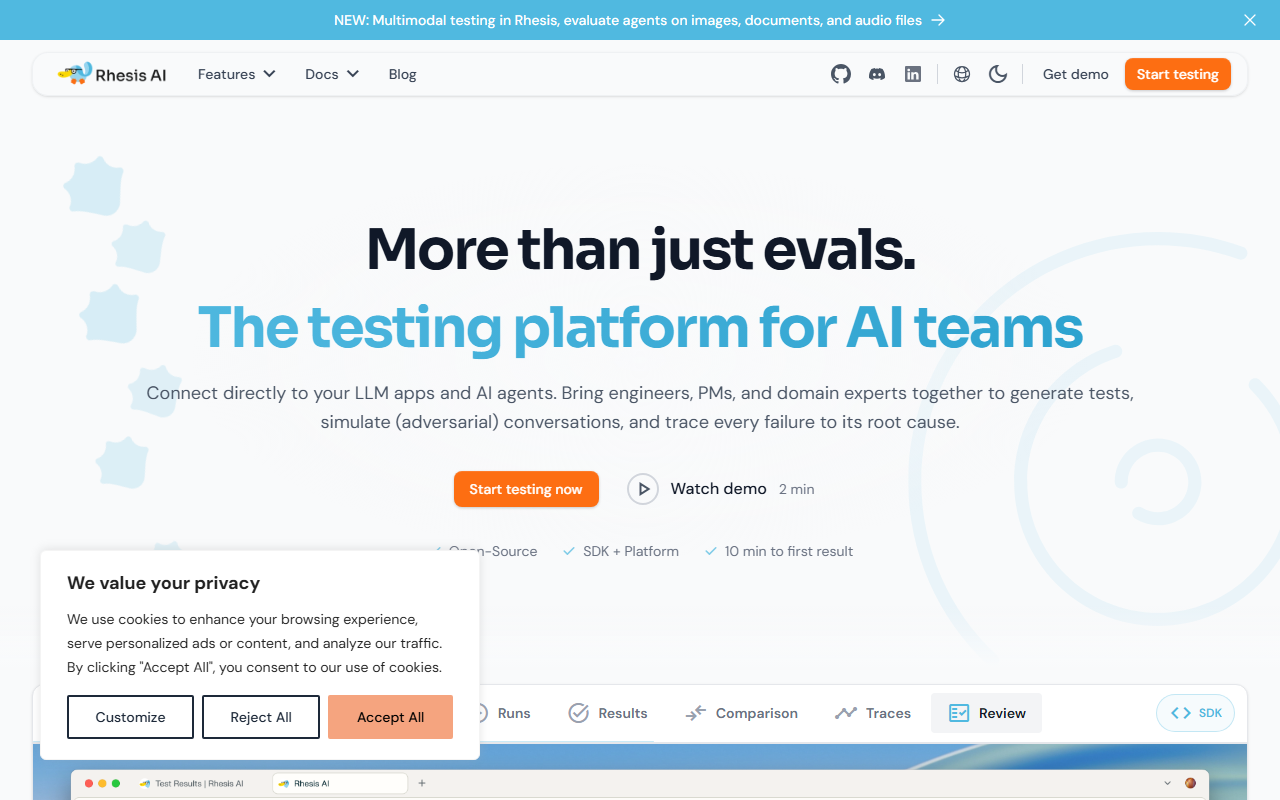
Upon visiting the Rhesis AI website at rhesis.ai, I was greeted by a clean, developer-focused landing page that immediately communicates its value: an open-source platform for testing LLM and AI agent applications as a team. The headline explicitly mentions test generation, user simulation, and regression detection—three pain points I've personally encountered when working with language models. There is no immediate sign-up gate; instead, the site directs visitors to the GitHub repository for documentation and installation instructions. This aligns with the open-source ethos, but it also means new users must be comfortable with self-hosting or deploying the platform themselves. The onboarding flow, as far as I could observe from the repository and docs, involves cloning the repo, configuring environment variables, and running Docker containers. For teams already using CI/CD pipelines, this is straightforward; for less technical stakeholders, it may present a barrier.
Core Features and Technology
Rhesis AI positions itself as a testing framework for LLM and AI agent applications. Under the hood, it likely leverages popular evaluation libraries and metrics (such as correctness, faithfulness, or context recall) but wraps them into a collaborative workspace. The platform promises to generate tests automatically—a feature that could analyze your prompt templates or agent orchestration code to suggest test cases. It also claims to simulate real users, meaning you can define virtual personas or interaction patterns to stress-test your system before release. The regression detection aspect is crucial: as you iterate on prompts or models, Rhesis AI compares new outputs against a baseline and flags degrading performance. While I couldn't test the free tier directly (the website doesn't offer a hosted demo), the architecture suggests a client-server setup with a web dashboard for viewing test results, managing datasets, and tracking regressions over time. The technology stack is not explicitly stated, but as an open-source Node.js/Python project, it likely integrates with LangChain, OpenAI, or other provider APIs for evaluation.
Pricing, Comparison, and Ideal User
Pricing is not publicly listed on the website. Because Rhesis AI is open-source, teams can self-host it at no cost—only paying for their own infrastructure and the API calls to LLM providers. There is no mention of a managed cloud tier, so the primary model is self-service. This contrasts with commercial competitors like LangSmith (by LangChain) and DeepEval, which offer hosted dashboards and paid plans with additional features. Rhesis AI's focus on team collaboration and open-source sets it apart: you own your data and can customize the platform. It is best suited for development teams who want tight integration with their workflow, have DevOps capacity, and value transparency over convenience. Teams without dedicated infrastructure support or those needing instant onboarding may prefer LangSmith's SaaS offering. For academic groups, startups, or enterprises with compliance requirements, Rhesis AI's open-source nature is a strong advantage.
Strengths and Limitations
The platform's greatest strength is its open-source foundation. It avoids vendor lock-in, allows deep customization, and can be audited for security. The focus on team collaboration—sharing test suites, reviewing evals, and tracking regressions—fills a gap in many open-source evaluation tools, which often remain single-user scripts. Additionally, the concept of simulating real users is more advanced than simple prompt-level testing; it mimics production behavior. However, there are real limitations. First, the documentation and community support are still maturing. As an early-stage project, you may encounter bugs or missing features that require digging into source code. Second, the platform assumes a certain level of technical proficiency—non-developer QA or product managers might struggle to set up and interpret results without engineering hand-holding. Third, without a hosted trial, potential users cannot quickly evaluate the tool before committing to self-hosting. Finally, test generation quality depends heavily on the input data you provide; automated suggestions may miss domain-specific nuances. Overall, Rhesis AI is a promising option for teams that already embrace open-source tooling and want a collaborative testing layer for their LLM projects.
Visit Rhesis AI at https://rhesis.ai/ to explore it yourself.


Comments