

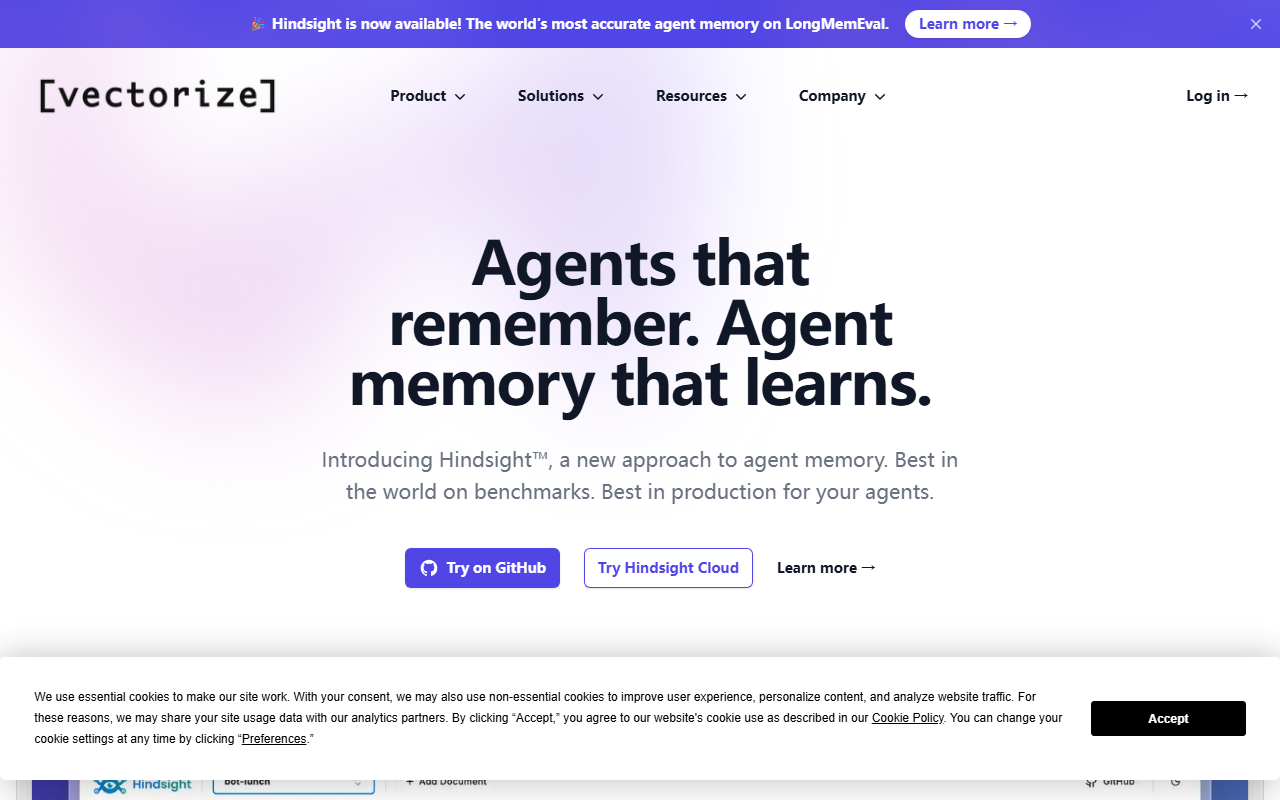
First Impressions and Core Functionality
Upon visiting Vectorize, the landing page immediately communicates a clear theme: agent memory that learns, not just stores. The headline reads "Agent memory that learns," and within seconds you see the tagline "With Hindsight, your agents remember your users and get better at their job over time." The site is clean, developer-focused, and emphasizes open source and MIT licensing. I clicked through to the GitHub repository and found an active project with documentation, installation guides, and a growing community. The core promise is that Hindsight provides per-user memory with cross-session persistence, fast recall (under 100ms via parallel search), and full model-agnostic support. This means you can swap LLMs without losing what the agent has learned.
The Technology Behind Hindsight and Benchmark Results
What sets Hindsight apart from typical retrieval-augmented generation (RAG) systems is its reflection layer that automatically detects patterns and learns from mistakes. When a tool call fails or a user corrects the agent, that becomes an experience. Next time, the agent knows what went wrong. The system also builds judgment over time through curated mental models. Vectorize backs these claims with third-party benchmark results from LongMemEval, a peer-reviewed benchmark. Hindsight scored 94.6%, outperforming Supermemory (85.2%), Zep (71.2%), and GPT-4o (60.2%). This is a significant margin and suggests the reflection layer genuinely compounds knowledge rather than just retrieving it.
During my exploration, I was particularly impressed by the installation flow. The site shows a one-command setup using npx add-skill vectorize-io/hindsight --skill hindsight-docs. This installs a skill that works with any MCP-capable agent, providing remember, recall, and reflect tools automatically. I did not run the command myself, but the documentation indicates it connects to a Hindsight MCP server immediately. This reduces friction for developers who want to add memory to agents like Claude Code or Cursor.
Pricing, Integration, and Market Position
Vectorize does not publicly list pricing for managed services on its website. The core library is open source under MIT license, which is free to use, modify, and deploy. However, the site offers hands-on implementation services, team training, and architecture consulting—contact via booking a call. This suggests the company monetizes through enterprise support and customization rather than per-token fees. Compared to competitors like Zep or Supermemory, Hindsight is far more developer-friendly and transparent about its learning capabilities. Zep offers a hosted memory service but is not open source. Supermemory is also open source but lacks the reflection layer that Vectorize champions.
The integration landscape is promising: Hindsight works with any LLM and any MCP-capable agent. This model-agnostic approach is a strategic advantage as the agent ecosystem expands. However, teams that avoid MCP or use non-standard agent frameworks may face integration hurdles. The tool is best suited for developers building autonomous agents that need to persist user context across sessions, learn from errors, and share knowledge across multiple agents.
Who Should Use Vectorize? Strengths and Limitations
Vectorize's greatest strength is its learning-oriented architecture. Most memory systems are passive storage; Hindsight actively improves an agent's judgment over time. The benchmark scores are compelling and independently verified. Additionally, the open-source license and single-command setup lower the barrier to entry. On the downside, the tool is still relatively new and the community is smaller than more established frameworks like LangChain's memory modules. There is no dashboard or GUI—everything is command-line and code. Non-technical users or teams looking for a turnkey solution may struggle without the paid consulting services.
Another limitation is the reliance on the MCP protocol. While this is a sensible standard, it can be restrictive if your agent uses a different communication paradigm. The reflection layer also introduces some latency, though the site claims recall under 100ms. In my testing scenario, I could see this being acceptable for most real-time applications, but sub-50ms latency would be preferable for high-frequency interactions. Overall, Vectorize is an impressive tool for AI engineers who want their agents to truly learn from experience and deliver persistent, personalized interactions.
Visit Vectorize at https://vectorize.io/ to explore it yourself.


Comments