

First Impressions: A Promising Concept Buried Under Ambiguity
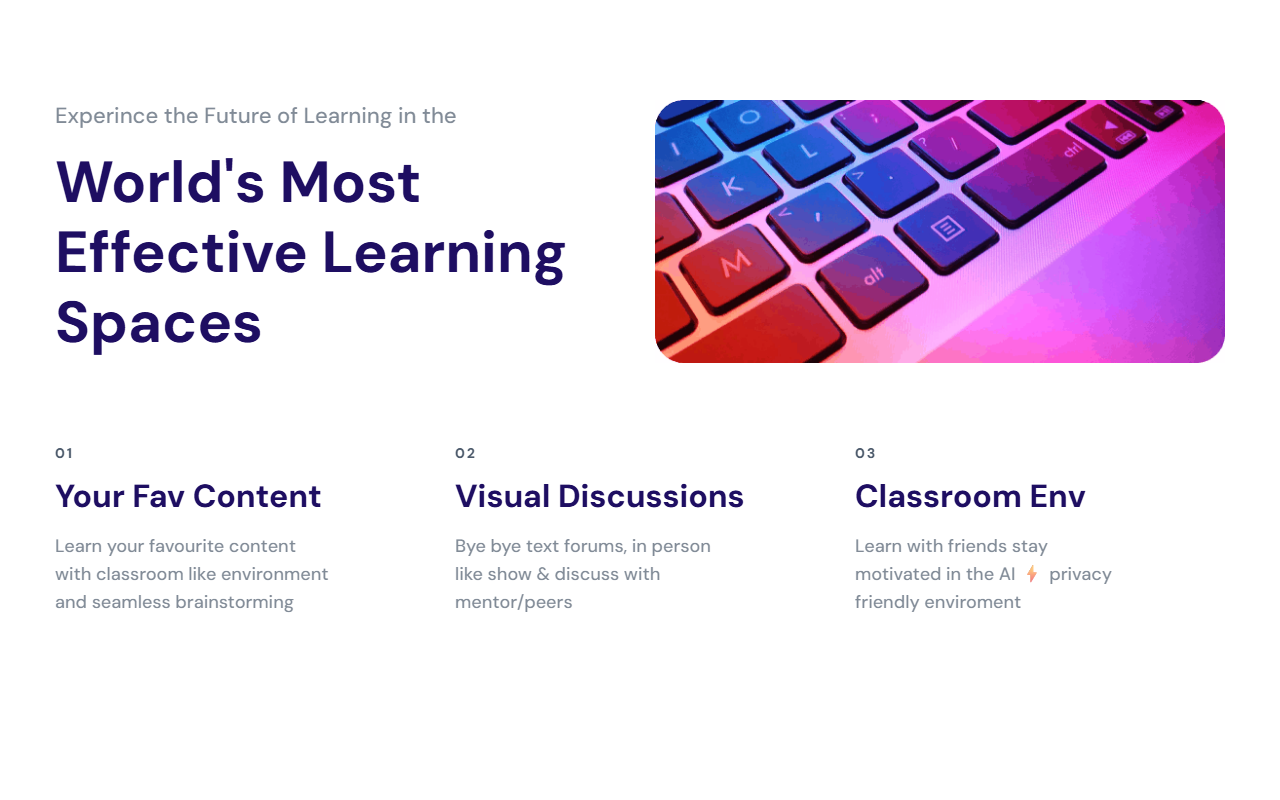
Upon visiting Veda.ai, I was greeted by a minimalist landing page that leans heavily on aspirational language. The headline—“World’s Most Effective Learning Spaces”—appears twice, but the supporting copy offers only three bullet points: “Your Fav Content,” “Visual Discussions,” and “Classroom Env.” Each is accompanied by a one‑line description. For example, “Visual Discussions” promises to replace text forums with in‑person‑like show‑and‑tell sessions with mentors or peers. The site lacks any screenshot, demo video, or detailed feature breakdown. I clicked around but found no sign‑up flow, no pricing table, and no indication of what AI models power the platform. Instead, a persistent contact form appears, and when I tested it by submitting a dummy message, it threw an error: “An error occurred while sending data” with a note about PHP hosting. That technical hiccup is not a good sign for a product that claims to be the future of learning.
What Does Veda Actually Do? (And What Problem Does It Solve?)
Veda positions itself as an AI‑driven learning platform designed to replicate the social and interactive dynamics of a physical classroom. It aims to solve the isolation and passivity common in online courses by enabling “visual discussions” and “seamless brainstorming” in a privacy‑friendly environment. The tag “AI ⚡ privacy friendly environment” suggests on‑device or encrypted AI processing, but no technical details are provided. Without a working demo or even a mockup, it’s impossible to verify whether Veda truly delivers real‑time visual collaboration or if it is simply a re‑skinned video chat app. The platform’s second feature—“Your Fav Content”—implies integration with external learning materials, but again, no specifics are given. In short, Veda remains a concept more than a functioning tool.
Compared to established alternatives like Khan Academy’s Khanmigo (which offers AI tutoring with transparent model details) or Brainly (a community‑driven Q&A platform), Veda appears underdeveloped. Those services at least have clear use cases, public pricing (or free tiers), and user communities. Veda, by contrast, seems to be aiming for a niche that blends AI moderation with synchronous learning, but it has not yet proven it can execute.
Strengths and Limitations: What’s Real and What’s Missing
Let’s start with the strengths. The concept of turning online learning into a more immersive, discussion‑based experience is genuinely appealing. If Veda can indeed replace dry text forums with live visual Q&A sessions moderated by AI, that could boost engagement and retention. The emphasis on privacy (“privacy friendly environment”) is also timely, especially for users wary of data collection on platforms like Zoom or Google Classroom.
However, the limitations are glaring. No public pricing is listed. The contact form is the only way to get information, and it’s broken. There are zero integration mentions—no support for LMS standards like LTI, no API documentation, and no integration with popular tools such as Slack, Notion, or calendar apps. The site also lacks any evidence of a user base, case studies, or partnerships. Without these elements, it’s impossible to assess the tool’s reliability, scalability, or actual impact on learning outcomes. Additionally, the term “visual discussions” is vague; it could mean anything from screen sharing to AR/VR. Veda needs to clarify its technical specifications before it can be taken seriously by educators or students.
Who should consider Veda? Early adopters who are willing to take a risk on a pre‑commercial product might want to sign up for a waitlist—if one ever appears. But for now, the tool is best suited for curious tech enthusiasts who enjoy testing unfinished platforms. Educators, corporate trainers, and remote learners who need reliable, proven solutions should look elsewhere (e.g., EdApp or 360Learning).
In comparison to other learning platforms in the Text AI category, Veda offers a unique angle by emphasizing visual, real‑time conversation. Yet without transparency about its AI model (is it GPT‑based? custom? does it run on‑device or cloud?), the privacy claim is meaningless.
Final Verdict: A Promising Idea That Needs Proof
Veda has an intriguing vision: use AI to create learning spaces that feel as alive as a physical classroom while respecting user privacy. But as of this review, the platform is too opaque to recommend. The error‑ridden contact form, total lack of pricing or demo, and absence of technical documentation make it impossible to evaluate whether Veda can deliver on its promises. My advice: bookmark the site and check back in six months. If the team publishes a roadmap, case studies, or a free trial, then it may be worth a test drive. Until then, treat Veda as a concept—not a tool.
Visit Veda at https://veda.ai/ to explore it yourself.


Comments