

What Is WordLift and How Does It Work?
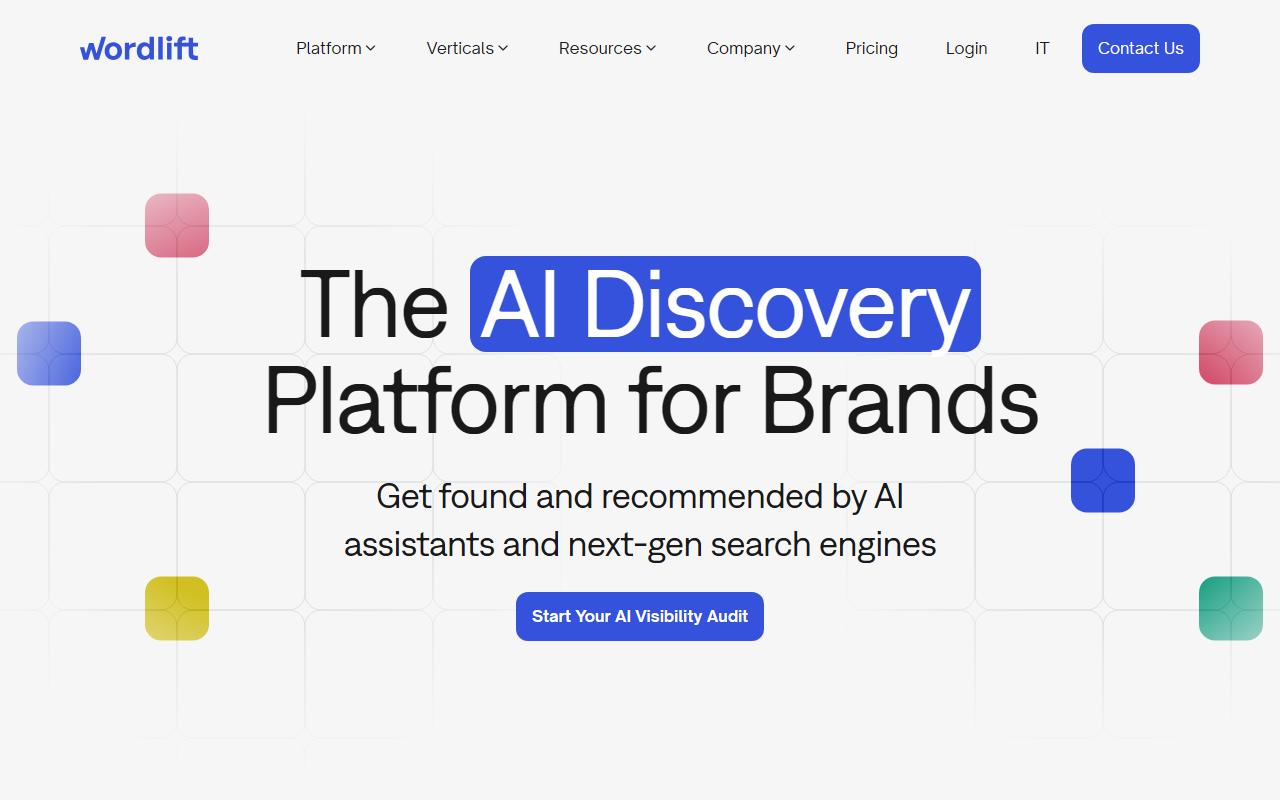
Upon visiting WordLift’s website, I was greeted by a clear value proposition: “The AI Discovery Platform for Brands.” This isn’t your typical keyword-stuffing SEO tool. WordLift is built around semantic SEO and structured data. It creates Dynamic Knowledge Graphs that link your content, products, and customer journeys. The platform offers four main solution blocks: Reach (visibility through knowledge graphs and markup), Engage (AI-generated content and journey optimization), Convert (AI agents that enhance customer dialogues), and Thrive (business intelligence and training). Under the hood, it uses ontologies to generate industry-specific knowledge and connects data via the GS1 Digital Link standard. The technology is heavily focused on preparing your brand for AI-driven search ecosystems like ChatGPT, Perplexity, and Google’s AI Overviews.
Hands-On: Exploring the Platform and Free Tools
I started with the free AI Visibility Audit – a tool prominently featured on the homepage. The onboarding was smooth: I entered a URL, and within seconds the tool returned a score with actionable recommendations. The dashboard shows how well your site is optimized for AI assistants, including checks for structured data, entity clarity, and knowledge graph connectivity. This is a concrete interaction that demonstrates WordLift’s core strength. I also explored the Free AI SEO Tools section, which offers several lightweight utilities for schema markup and content analysis. For developers, there is comprehensive API documentation and an API status page, indicating a mature, scalable platform. One workflow I observed: you can define customer journeys for specific product categories and have WordLift automatically generate optimized content and markup. The interface itself is clean but dense – not for beginners. The free audit is a useful entry point, but the full platform likely requires a demo to understand the depth.
Pricing and Market Position
Pricing is not publicly listed anywhere on the website. WordLift uses a contact-sales model, which is common for enterprise SEO platforms but can be a hurdle for small businesses. Based on the features (knowledge graphs, AI agents, custom ontologies), this is clearly aimed at mid-to-large enterprises and agencies. Competitors include BrightEdge and Conductor for enterprise content optimization, and Yoast SEO for simpler structured data. However, WordLift stands out with its dedicated focus on AI visibility – it doesn’t just optimize for Google, it optimizes for how AI assistants discover and recommend products. The case studies on the site claim impressive results: 30% sales boost for e-commerce, 50% more visibility for legal firms, and 321% growth for news & media in five months. These figures are worth noting, but as with any vendor-provided data, independent verification is recommended.
Strengths, Limitations, and Final Recommendation
Strengths: WordLift’s deep integration of knowledge graphs and structured data is genuinely ahead of the curve. The platform helps you speak the language of AI assistants, which is becoming essential as search moves toward generative answers. The developer-friendly API and focus on interoperability make it a strong choice for tech-savvy marketing teams. The free audit tool provides immediate value without any commitment.
Limitations: The lack of transparent pricing is a major con for budget-conscious teams. The learning curve is steep – understanding ontologies and knowledge graphs requires a shift in SEO mindset. Smaller businesses with simple content needs will likely find cheaper, simpler alternatives like RankMath or Surfer SEO sufficient. Additionally, the platform appears to be heavily focused on product and e-commerce, so pure content publishers may feel underserved.
Who should use it? Enterprise e-commerce brands, large media publishers, and SEO agencies that want to future-proof their strategies for AI search. If you manage complex product catalogs or need to align multiple data sources, WordLift is worth the investment. If you run a small blog or local business, look elsewhere.
Visit WordLift at https://wordlift.io/ to explore it yourself.


Comments