
What Is 345Coin and Who Is It For?
When you land on coinrot.com, the first thing you notice is the bold tagline: "The Truth Emerges the Instant It Spins." This is not your typical binary decision widget. 345Coin is a fully client-side 3D coin flipping simulator powered by WebGL and hardware acceleration. It was built by the 345tool collective, an indie developer group focused on creating fast, privacy-first, single-purpose web utilities. The tool is designed for anyone who needs an unbiased, physically realistic coin toss—whether that is for settling everyday arguments, tabletop RPG rulings, classroom probability demonstrations, or simply observing real-time physics in a browser. Unlike the flood of cheap 2D coin flippers that merely toggle a random number and display a pre-rendered image, 345Coin commits to simulating real torque, velocity, gravitational acceleration, and collision detection for every flip. The result is a surprisingly immersive experience that straddles the line between practical decision-making aid and lightweight physics sandbox.
First Impressions: Clean, Minimalist, and Immediately Usable
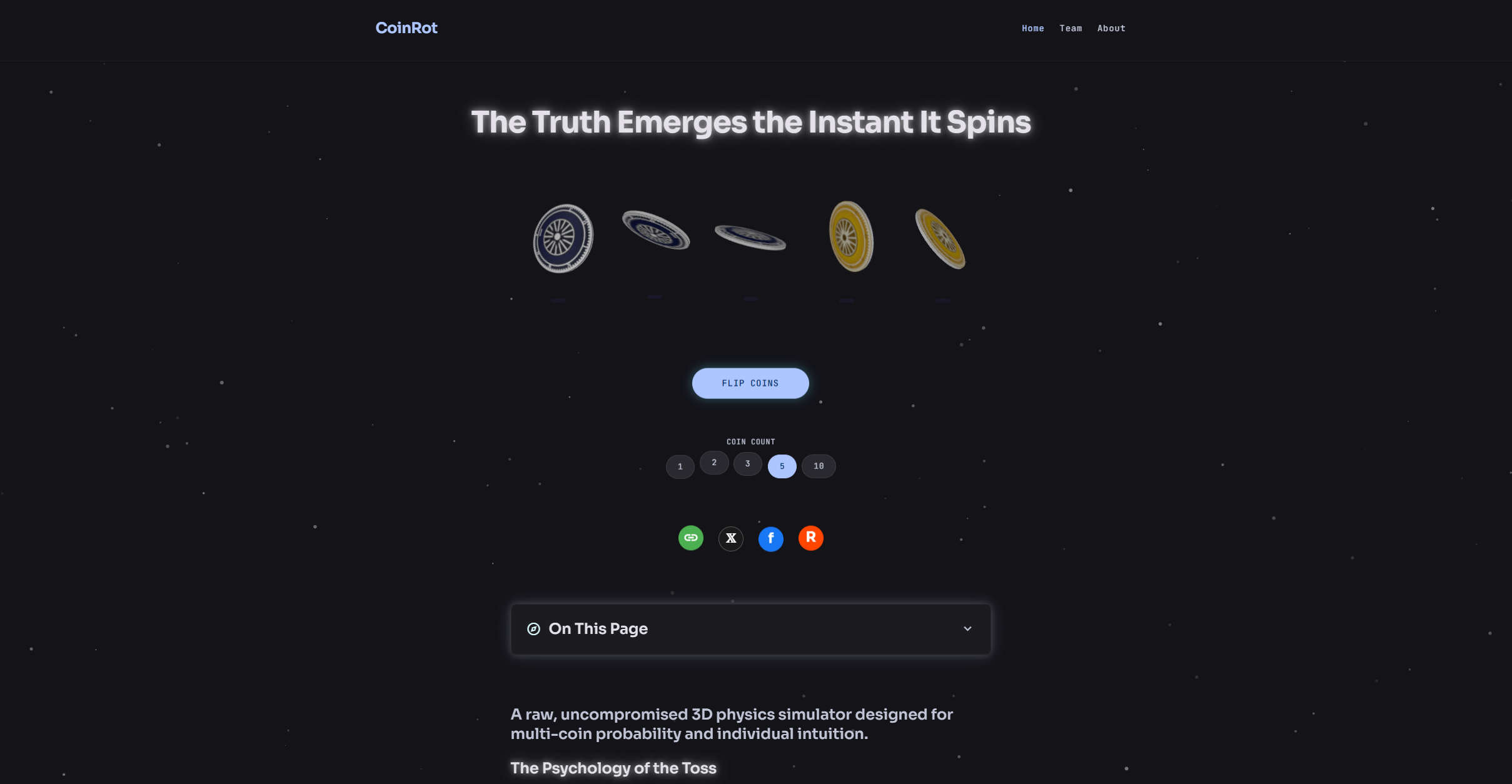
Visiting the site reveals a single, distraction-free interface. There are no sign-up forms, no pop-up cookie banners, and no multi-step onboarding flows. The main canvas dominates the viewport, displaying a single 3D coin rendered in a high-contrast Gold (Heads) and Deep Blue (Tails) palette. Below the canvas sits a clean control bar where you can select the number of coins to flip—options include 1, 2, 3, 5, or 10. A prominent "Flip Coins" button triggers the action. The entire experience loads instantly. There is no splash screen, no tutorial overlay, and no imposed delay. The coin itself begins with a gentle idle spin, showcasing the 3D model's realistic shading and smooth rotational animation before you even interact with it. I was also pleased to see share buttons for X (formerly Twitter) and Facebook, plus a URL-copy function, making it easy to send a specific coin-flip result to a friend or student. The interface is responsive and works well on both desktop and mobile browsers. The choice of Gold and Deep Blue is deliberate—as the site explains, it maximizes luminance contrast for users with color vision deficiencies, including red-green and blue-yellow blindness. This level of accessibility consideration was unexpected for such a simple tool and speaks to the team's attention to detail.
The Physics Engine: More Than a Pretty Animation
Curious about the technical claims, I tested the single-coin mode extensively. Each flip produces noticeably different behavior. The coin launches with varying velocity and spin axis, wobbles chaotically as it catches virtual air resistance, and then rattles against an invisible surface before settling. No two flips look the same. This is not a pre-rendered animation loop. According to the team's technical blog, the engine uses pure client-side cryptographic entropy (via the browser's crypto.getRandomValues method) to inject randomized force deltas into every launch. This means each coin receives its own unique initial thrust, torque, and angular momentum. The simulation then runs through a real-time rigid body solver that calculates gravitational acceleration, kinetic energy transfer, and collision responses frame by frame. The team also explicitly replaced standard Euler angle rotations with Quaternion-based transformations to avoid gimbal lock—a common issue where 3D rotations collapse into two dimensions, causing visual stuttering. In practice, this means the coin's idle spin and flip animations remain buttery smooth at a consistent 60 frames per second. The rendering is handled through a locked-down version of Three.js, but the physics logic is custom-coded rather than relying on a heavy third-party physics library. The result is a download footprint that stays lean while delivering what feels like a genuine physics simulation.
Multi-Coin Mode: From Decision Tool to Probability Lab
Where 345Coin truly distinguishes itself from typical coin flippers is the multi-coin mode. Selecting 3, 5, or 10 coins launches an entire cluster of independent rigid bodies into the same virtual space. What happens next is fascinating to watch. Coins collide with each other mid-air, bounce off one another upon landing, and settle into overlapping final positions that reflect genuine physical intersection. The engine treats each coin as an independent entity with its own mass, velocity, and angular momentum. When two coins occupy the same Cartesian space, anti-clipping bounding fields trigger realistic ricochets. For educators, this opens up a practical use case: you can run quick binomial distribution experiments right in the browser. Flipping 10 coins repeatedly and recording the heads-to-tails ratio visually demonstrates the Law of Large Numbers—the statistical principle that empirical results converge toward theoretical 50/50 probability as the number of trials increases. For tabletop gamers, the multi-coin feature is a natural fit for resolving complex multi-target effects or mass dice-roll alternatives. And for the curious user, it is simply entertaining to watch a handful of coins tumble and collide in a way that feels physically authentic. One minor limitation: there is no built-in history log or statistical tally. You have to manually track results if you need cumulative data. But given the tool's stateless design, this omission makes sense.
Privacy and Data Sovereignty
In an era where every free web tool seems to come with a hidden tracking tag, 345Coin's privacy stance is refreshingly absolute. The site explicitly states that it is "completely stateless." There are no registration walls, no mandatory logins, and zero user-tracking scripts. The entire computation runs on your local GPU via WebGL. No data is sent to a server during a flip. The random seed is generated from your browser's native cryptographic module, not from a remote API. The moment you close the browser tab, every trace of your session—coin count, flip results, interface state—dissolves into nothingness. I verified this by inspecting the network tab in developer tools: the only requests made were the initial page load assets. No analytics pings, no session beacons, no background API calls. This makes 345Coin an excellent choice for classroom or workplace environments where data privacy policies restrict the use of external services. It also means the tool works entirely offline after the initial page load, provided assets are cached. For users who care about digital sovereignty, this is a significant selling point.
Pricing and Final Verdict
Pricing details are not publicly listed on the website because 345Coin is completely free. There are no hidden tiers, subscription upsells, or premium features locked behind a paywall. You simply visit the site and flip coins immediately, as many times as you want, with as many coins as you want. The project is maintained by the 345tool team as part of their broader collection of privacy-first web utilities. The lack of any monetization mechanism raises questions about long-term sustainability, but for now, the tool remains entirely open and unrestricted. So, who should use 345Coin? If you need a quick, unbiased coin flip for a personal decision, it works flawlessly. If you are a teacher explaining probability concepts, the multi-coin mode offers a visual and interactive demonstration that static worksheets cannot match. If you are a tabletop RPG player looking for a thematic way to resolve coin-based mechanics, the 3D realism adds a nice touch of drama. And if you simply appreciate well-engineered web software that respects your privacy, 345Coin is a pleasure to interact with. The only real missing features are a results history tracker and a dark mode toggle (the bright gold palette can feel intense in low-light environments), but these are minor quibbles for a tool that does exactly what it promises. Visit 345Coin at coinrot.com to explore it yourself.


Comments