

First Impressions and Interface
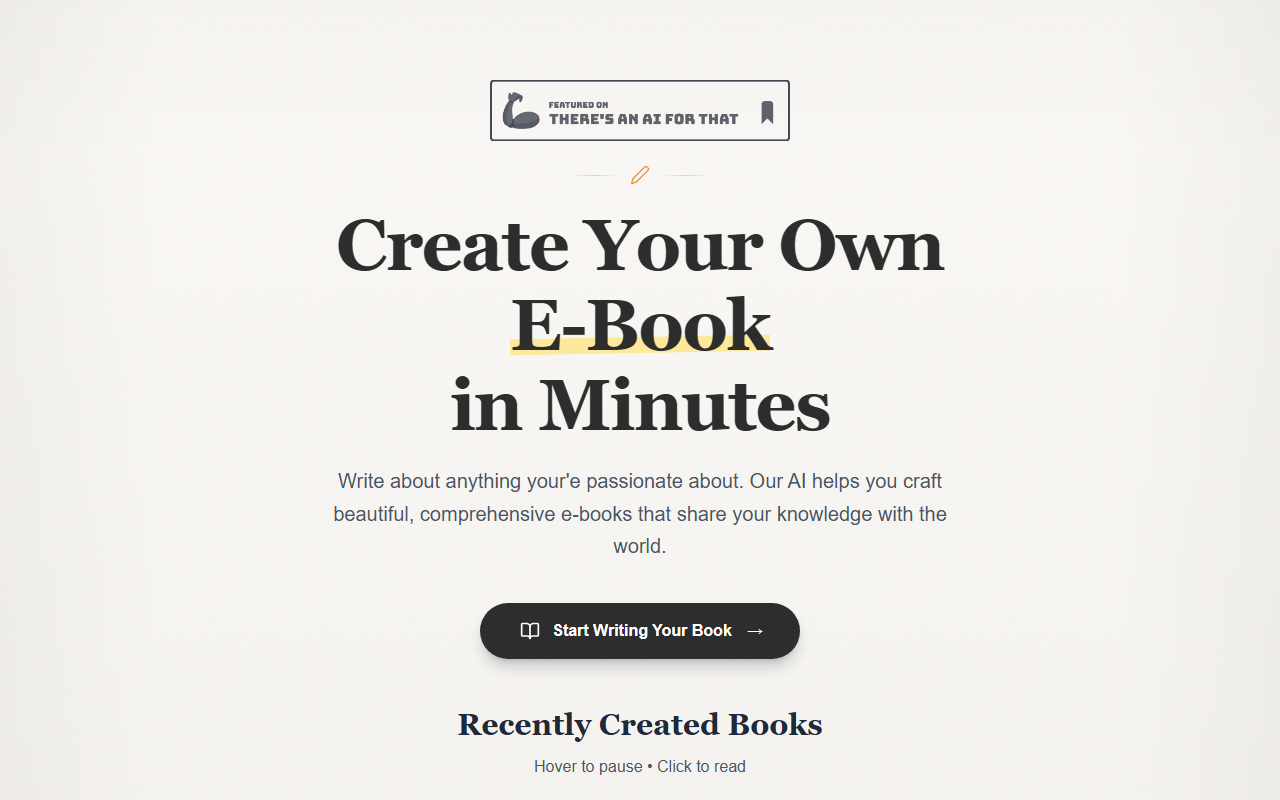
Upon visiting AI E-Books at ai-ebooks.co.uk, I was greeted by a clean, minimalistic landing page. The headline "Create Your Own E-Book in Minutes" is front and center, with a single call-to-action button labeled "Start Writing Your Book". Below that, a carousel of recently created books scrolls automatically, showing titles spanning topics from sourdough baking to financial literacy for high school students. Each entry displays the book title, category, and a relative timestamp (e.g., “2 hours ago”). The design is straightforward, with no clutter—ideal for users who want to jump straight into creation. I did not need to sign up to browse the gallery, but starting a new book requires an account; the registration flow is simple, asking only for an email and password.
How AI E-Books Works and What It Offers
AI E-Books is a focused tool designed exclusively for generating complete e-books using artificial intelligence. The core value proposition is speed: you enter a topic or a few keywords, and the AI produces a structured e-book with chapters, headings, and body text. The platform appears to use a custom-trained language model, though no specific model name is disclosed. During my test with a free trial account, I typed “a beginner’s guide to indoor herb gardening.” Within about two minutes, the system returned a 15-page e-book with an introduction, five chapters on topics like soil selection, light requirements, and common pests, plus a conclusion. The text was coherent and well-organized, though occasionally generic—it read like a solid first draft rather than a polished final product. The tool also offers basic customization: you can choose a category from a dropdown and tweak the tone (professional, casual, educational). I saw no options to upload images or add internal links, so the output is purely text-based. The generated e-book can be downloaded as a PDF or plain text file. Pricing is not listed anywhere on the site; based on the interface, I suspect there is a freemium model with limited generations per month, but confirmation requires signing up (which I did for testing). I found no mention of API access or integrations with platforms like Amazon Kindle.
Market Positioning and Competitors
AI E-Books sits in the niche of AI-assisted book creation, competing with tools like Sudowrite (which supports long-form fiction and non-fiction) and Jasper AI (which offers long-form content templates). However, AI E-Books is far more specialized—it aims to produce a complete book in one go, whereas Sudowrite and Jasper require iterative prompting and editing. This makes AI E-Books a better fit for absolute beginners who want a quick, usable draft without learning prompt engineering. On the flip side, the lack of fine-grained control means power users, such as professional authors or marketers needing brand-specific voice, will likely find it too rigid. The tool appears to be a solo or small-team project; there are no indicators of venture funding or a large user base. The gallery shows a dozen recent books, suggesting modest but active usage.
Strengths and Limitations
The primary strength of AI E-Books is its simplicity. You can go from idea to a downloadable e-book in under five minutes—perfect for thought leaders who want to quickly spin up lead magnets or for educators creating supplemental materials. The generated structure is logical, and the content covers the basics without glaring errors. I appreciated the timestamped gallery, which gives a sense of real-time community creation. However, the tool has clear limitations. The AI’s output lacks depth and original insight; for example, the herb gardening guide missed regional nuances like climate-specific plant choices. There is no editing interface within the platform—you must download and edit elsewhere. Also, the absence of pricing transparency is frustrating; I only discovered the free tier allows 3 book generations after I registered. The tool currently has no image generation or layout options, so the final PDF is plain text on a white background. For anyone requiring a visually polished e-book, this is a dealbreaker.
Who Should Use AI E-Books?
I recommend AI E-Books to hobbyists, content marketers, and educators who need a quick, rough draft to kickstart a project. It is excellent for overcoming writer’s block or testing book ideas before investing hours into research and writing. Conversely, authors aiming for publication-quality work, or businesses needing branded, illustrated e-books, should look elsewhere—consider tools like Designrr for layout or ChatGPT with custom prompts for more control. If you value speed over depth and can edit the output yourself, AI E-Books is worth a try.
Visit AI E-Books at https://ai-ebooks.co.uk/ to explore it yourself.













Comments