

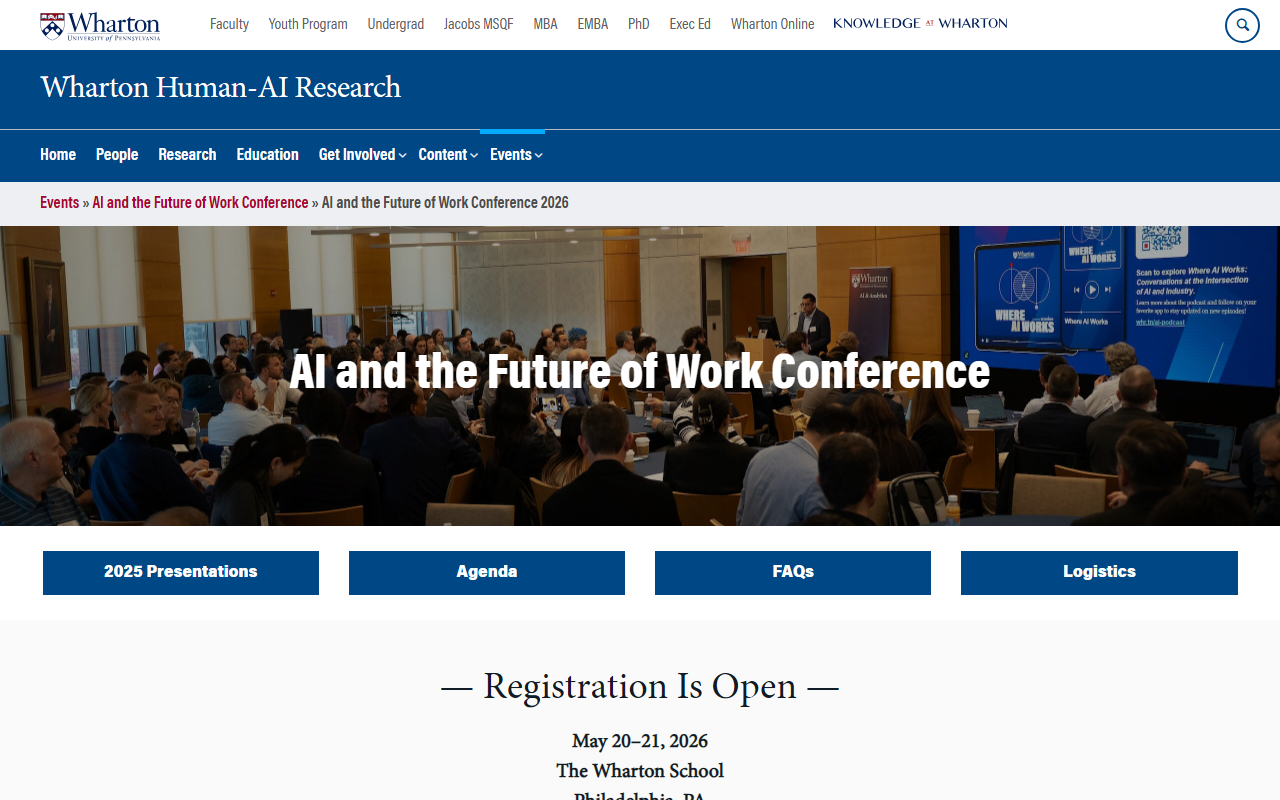
First Impressions and Interface
Upon visiting the Wharton Human-AI Research website, I was immediately struck by its clean, academic design. The homepage introduces the mission of advancing human-centered AI for business innovation, prominently featuring a 'Join Our Mailing List' button that I tested. The navigation is straightforward, with sections for faculty, reports, events, and executive education. The layout prioritizes research insights over flashy graphics, which felt appropriate for a university-affiliated platform. When exploring the 'AI Insights' section, I found detailed summaries of webinars like the AI Adoption Report and the Wharton Blueprint for AI Agent Adoption, each linking to full content.
Deep Dive into Offerings
The platform distinguishes itself through a blend of free and paid resources. Free offerings include in-depth industry reports such as the Wharton-Accenture Skills Index and the Accountable Acceleration study, alongside three podcast series: Creative Intelligence, The Road to Accountable AI, and Where AI Works. The AI Horizons webinar series, led by faculty co-directors Stefano Puntoni and Kartik Hosanagar, provides cutting-edge research talks. For professionals, the executive education programs—like 'Generative AI and Business Transformation' and 'Strategies for Accountable AI'—offer structured learning, though pricing is not publicly listed on the website. The technology underpinning these resources relies on faculty expertise and partnerships (e.g., with Accenture and GBK Collective) rather than a proprietary AI model, which makes this more of a curated learning platform than a tool you interact with directly.
Strengths and Limitations
The primary strength of Wharton Human-AI Research is its authoritative source: content is grounded in Wharton faculty research and real-world enterprise data. I found the reports, especially the AI Agent Adoption Blueprint, to be practical and grounded in behavioral science. The free webinars and podcasts are high-quality and accessible without registration. However, a notable limitation is the lack of hands-on AI tools or interactive learning modules. The site functions more as a repository of insights and a gateway to paid executive courses. Additionally, the focus is heavily on enterprise and business strategy, with less content for individual developers or technical practitioners. Unlike platforms such as Stanford HAI or MIT IDE, Wharton’s emphasis is squarely on the human and organizational side of AI adoption.
Who Should Use This Platform
Wharton Human-AI Research is best suited for business leaders, managers, and academics seeking evidence-based frameworks for AI strategy. It is ideal for professionals who want to stay ahead of AI governance and workforce trends without deep technical expertise. Conversely, those looking for hands-on AI coding tutorials or product demos should look elsewhere—this platform does not offer that. For context, Stanford HAI provides a similar mix of research and policy briefs, while MIT’s IDE focuses on digital economy impacts. Given Wharton’s strong brand and the depth of its free content, I recommend this resource for anyone responsible for AI adoption or strategy in an organization. The executive education programs could be a wise investment for companies scaling AI initiatives.
Visit Wharton Human-AI Research at https://ai.wharton.upenn.edu/ to explore it yourself.













Comments