

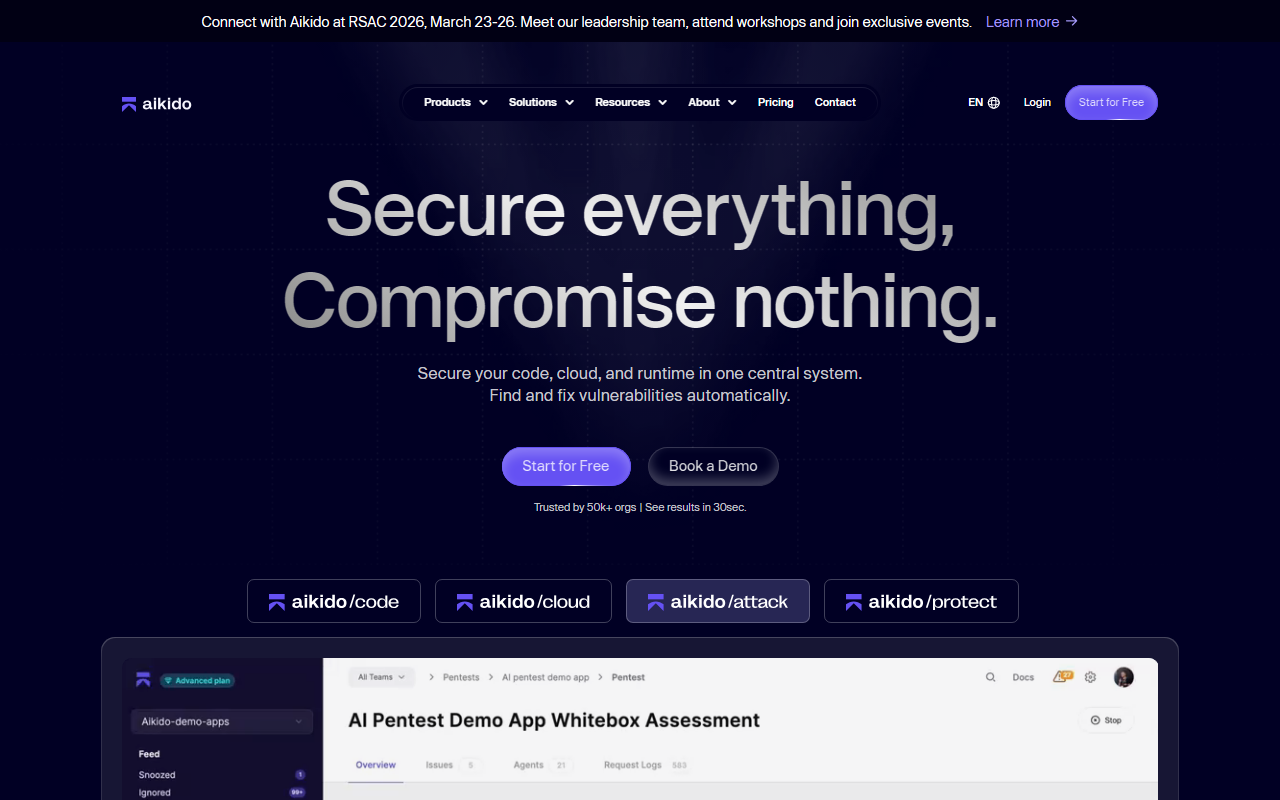
First Impressions and Platform Scope
Upon visiting aikido.dev, I was immediately struck by the clarity of their value proposition: secure everything without slowing developers. The site presents a unified platform spanning code scanning (SAST, SCA, secrets, IaC), cloud security (CSPM, container scanning), AI-driven pentesting, and runtime protection. This is ambitious — most tools cover only one or two domains. The onboarding flow promises a 30-second setup with GitHub/GitLab/Bitbucket integration. I tried the free tier (no credit card required) and within minutes had my first repository scan underway. The dashboard is clean, with a left sidebar organizing Code, Cloud, Attack, and Protect modules. Each module opens to a focused view with real-time scan status and alert counts. The standout feature is the platform's claim of "only get alerts that matter to you" — a direct jab at the alert fatigue many security teams face.
Core Capabilities and Workflow Integration
I tested the free tier with a Node.js project. The scan covered open‑source dependencies (SCA), static analysis (SAST), and secrets detection. Aikido found a critical CVE in a logging library and also flagged an exposed AWS secret key. The real magic is AutoTriage: alerts are evaluated in context of the actual code and infrastructure, deprioritizing issues that don't pose real risk. For example, the CVE was marked as "not exploitable" because the vulnerable function was never called in my code. This saved me hours of manual investigation. The AutoFix feature generates pull requests for fixes directly in the repo — I saw a proposed PR to update the library version. Bulk fixes are also possible with one click, which is a huge time‑saver for teams. The platform also includes AI Code Quality reviews for bug risks and anti‑patterns, though I found these less mature than dedicated tools like SonarQube. Integration with CI/CD pipelines is seamless: Aikido offers native GitHub Actions, GitLab CI, and Jenkins plugins. The documentation is thorough, and the trust center explains data handling (read‑only access, short‑lived tokens, separate Docker containers per scan).
Pricing and Market Positioning
Pricing is not publicly listed on the website. The free tier provides scanning for one repository and limited cloud scans, which is generous for evaluation. For full features, users must book a demo with sales. This lack of transparency is a minor frustration, though common among enterprise security tools. Aikido competes with Snyk (code and dependency scanning), Wiz (cloud security), and GitGuardian (secrets). Unlike Snyk, which focuses primarily on open‑source dependencies, Aikido aims to be a single pane of glass for code, cloud, runtime, and even developer device protection. The AI‑driven pentesting module (Aikido /Attack) is particularly unique — it uses autonomous agents to simulate attacks and generate audit‑grade reports in hours. The platform claims to be trusted by 50k+ organizations and rated 4.7/5, suggesting solid adoption among mid‑market companies. However, for very small teams or individual developers, the breadth of features might feel overwhelming, and the reliance on AI triage could miss context that a human expert would catch.
Final Verdict: Who Should Use Aikido?
Aikido’s strength is its unification: one platform for code, cloud, runtime, and devices. It excels at reducing noise through context‑aware triaging and automated fixes, making it ideal for DevSecOps teams that are understaffed or drowning in alerts. The AI pentesting and runtime protection add layers that competitors often charge extra for. Limitations include a learning curve due to the sheer number of features, and the AI code quality reviews feel less polished than dedicated code review tools. The lack of public pricing may deter smaller shops. Overall, if your organization needs to consolidate multiple point security tools without sacrificing developer velocity, Aikido is a compelling choice. I recommend starting with the free tier to test noise reduction and AutoFix on a real project. Visit Aikido at https://aikido.dev/ to explore it yourself.













Comments