

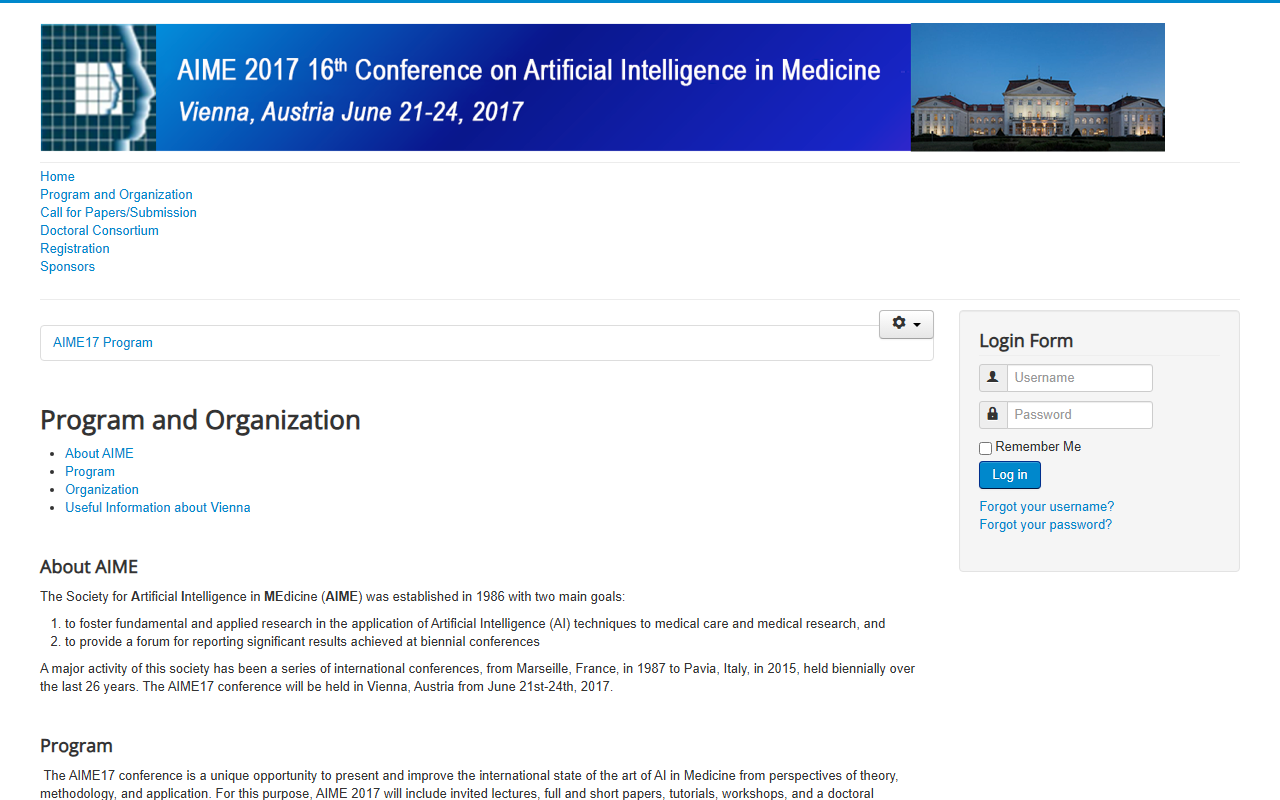
What Is AIME 17?
The Society for Artificial Intelligence in MEdicine (AIME) runs a biennial conference series. The AIME 17 website provides the program, keynote abstracts, and tutorial outlines for the June 2017 event in Vienna. Despite its "Learning Platform" category, this is not a self‑paced tool—it is a static archive of an academic conference. The site lists two main goals: fostering AI‑in‑medicine research and providing a forum for results.
First Impressions and Onboarding
Upon visiting the site, the layout feels dated. The navigation bar offers sections like "Program" and "Useful Information about Vienna," but there is no interactive dashboard or onboarding flow. The homepage is mostly text with bold headings and protected email addresses. As a journalist exploring the free tier, I found no registration or demo—everything is freely accessible. The lack of modern design may deter users expecting a hands‑on AI learning platform.
When testing the navigation, I clicked through the program schedule. The page lists tutorials on NLP for clinical information extraction, probabilistic graphical models, and fuzzy Arden Syntax. These are high‑quality academic topics, but each tutorial is presented only as a title and instructor list. No sample materials, videos, or exercises are provided. The site functions as a static brochure, not a learning environment.
Content and Learning Resources
The strength lies in the conference’s academic depth. Keynote speakers are notable: Stefan Schulz discusses SNOMED CT interoperability; Ken Barker covers WatsonQA for medical text. The program includes doctoral consortium, workshops (e.g., AI for Diabetes, Rich Semantics from Medical Texts), and full papers. However, as of 2025, the content is eight years old. No updates after 2017 are visible. The site does not host any interactive AI tools, APIs, or practice exercises. It is purely informational.
For context, competitors like Coursera or edX offer modern AI‑in‑medicine courses with video lectures, quizzes, and forums. AIME 17 provides only a static program. The site also lacks any user accounts, progress tracking, or community features.
Pricing and Suitability
Pricing is not publicly listed on the website. The conference itself likely had registration fees, but the online archive is free to browse. There are no premium tiers or API access. This resource is best suited for academic researchers looking for an overview of 2017’s state‑of‑the‑art. Learners seeking current, interactive courses should look elsewhere. The site’s limited scope and outdated content are genuine limitations.
Verdict
Honestly, AIME 17 is not an AI learning platform—it is a conference archive. I recommend it only for historians of AI in medicine or researchers tracking past keynote topics. For practical learning, consider alternatives like IBM Watson Health tutorials or modern MOOCs. Visit AIME at https://aime17.aimedicine.info/ to explore it yourself.







Comments