

First Impressions and Onboarding
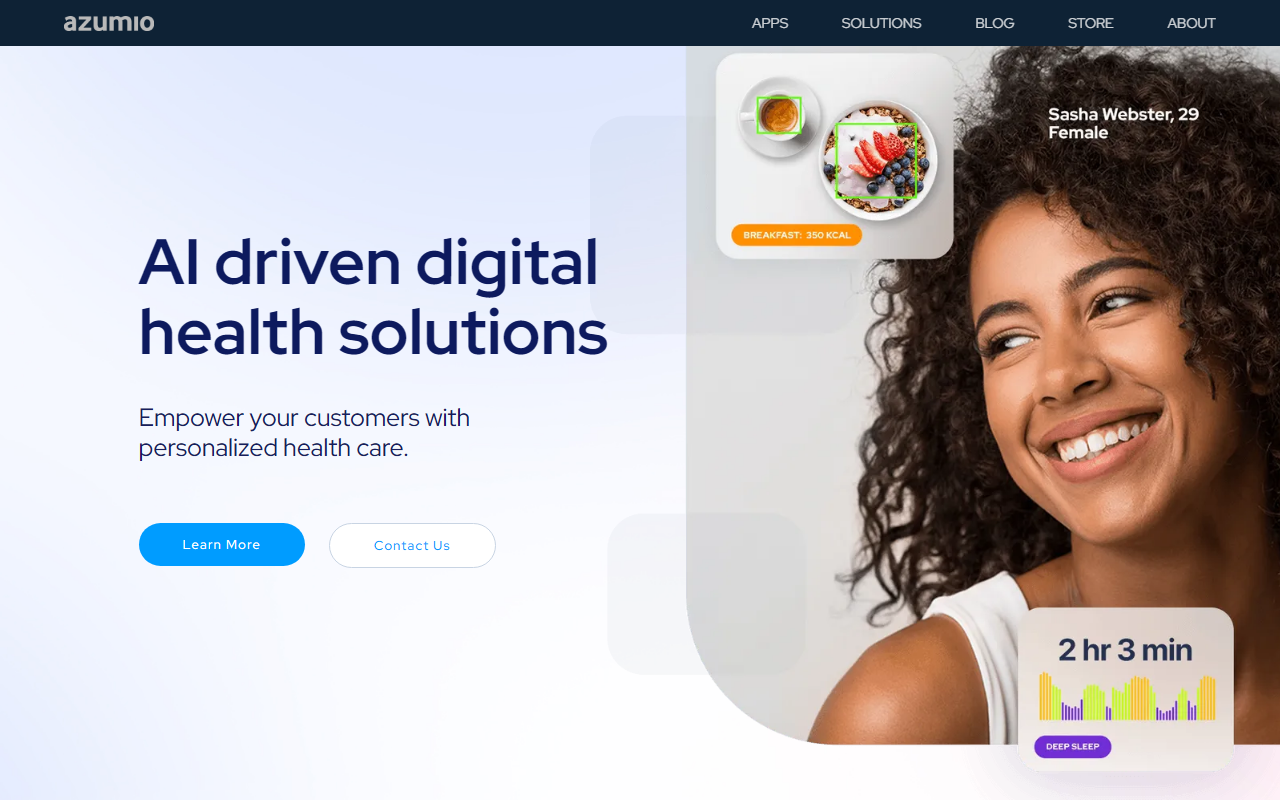
Upon visiting Azumio's website, I was immediately struck by the clean, business-oriented layout. The hero section prominently declares "AI driven digital health solutions" and directs visitors toward "Learn More" and "Contact Us" buttons. There is no public dashboard or sign-up form visible — the site is designed to pitch enterprise solutions rather than offer instant access. I scrolled through the pages and found four main business products: Food Recognition AI, Azumio 360, Instant Diabetes Test, and Meal IQ. Each section includes a brief description and a "Learn More" link, but no pricing or detailed documentation is provided until you contact their sales team. For a hands-on feel, I downloaded the Calorie Mama AI app from the iOS App Store to test the food recognition feature. The onboarding flow was smooth: I snapped a photo of a sandwich, and within two seconds the app returned a nutrition breakdown including calories, protein, and carbs. The deep learning model seemed accurate for common foods, though it struggled with a blended smoothie. This quick test gave me confidence that Azumio's AI actually works in a consumer setting, which mirrors the enterprise API capabilities they tout.
Core Offerings and Technology
Azumio's technology stack centers around deep learning AI for health biomarkers. Their Food Recognition AI uses convolutional neural networks trained on millions of food images to identify meals from a single photo. The Instant Diabetes Test claims to be “the first digital biomarker for Type 2 Diabetes” — trained on large datasets of health metrics to detect risk factors without a blood sample. Meal IQ goes a step further by predicting how specific foods affect blood glucose levels, likely using regression models and food composition databases. The unifying platform is Azumio 360, an all-in-one API that aggregates tracking for diet, fitness, sleep, and heart rate. This API appears to integrate with their suite of consumer apps — Instant Heart Rate, Glucose Buddy, Fitness Buddy, Argus, and Sleep Time — which have collectively amassed over 100 million downloads. Technically, the APIs seem RESTful (no public docs were shown, but business clients would negotiate access). Pricing is not publicly listed on the website, which is typical for enterprise B2B solutions. However, the consumer apps are free with in-app purchases; for example, Calorie Mama AI offers a free tier with basic photo-based tracking, while a premium subscription unlocks meal planning and detailed analytics. Developers should note that Azumio does not appear to offer a self-serve developer portal — access is likely vetted through a sales process.
Market Position and Use Cases
Azumio competes in the crowded digital health API space, with alternatives like Fitbit’s Web API, Apple HealthKit, and specialized food recognition APIs such as Spoonacular or LogMeal. Unlike those competitors, Azumio focuses on a holistic suite covering diet, diabetes, sleep, and heart rate under one vendor, which simplifies procurement for health app developers or insurance companies building wellness programs. The company’s key strength is its extensive consumer validation: over 100 million downloads across five apps, 1 billion heartbeats measured per day, and 1 million food photos taken daily. These numbers suggest their AI models have been trained on massive, real-world datasets, likely improving accuracy. However, a major limitation is the lack of transparent pricing and self-service documentation. Smaller startups or indie developers may find the sales‑heavy process prohibitive. Additionally, the food recognition AI, while impressive, sometimes fails with mixed dishes or non‑Western cuisines (as I saw with the smoothie). Azumio is best suited for mid‑to‑large healthcare enterprises, insurance providers, or app development firms that need reliable, pre‑validated AI models for patient engagement or wellness tracking. Smaller teams should explore open‑source alternatives or lighter APIs first.
Final Verdict
Azumio delivers a genuinely impressive collection of AI‑powered health solutions backed by millions of daily data points. The no‑code integration promise of Azumio 360 and the specificity of the Instant Diabetes Test set it apart from general‑purpose health APIs. I was particularly impressed by the speed and accuracy of the food recognition in Calorie Mama AI, even if it has minor blind spots. That said, the lack of public pricing and the enterprise‑only access model limit its accessibility. If you are building a consumer health app or a corporate wellness platform and need a proven, all‑in‑one backend for nutrition, activity, and sleep tracking, Azumio is worth a serious conversation. For hobbyists or bootstrapped startups, the barrier might be too high. Visit Azumio at https://azumio.com/ to explore it yourself.













Comments