

First Impressions and Onboarding
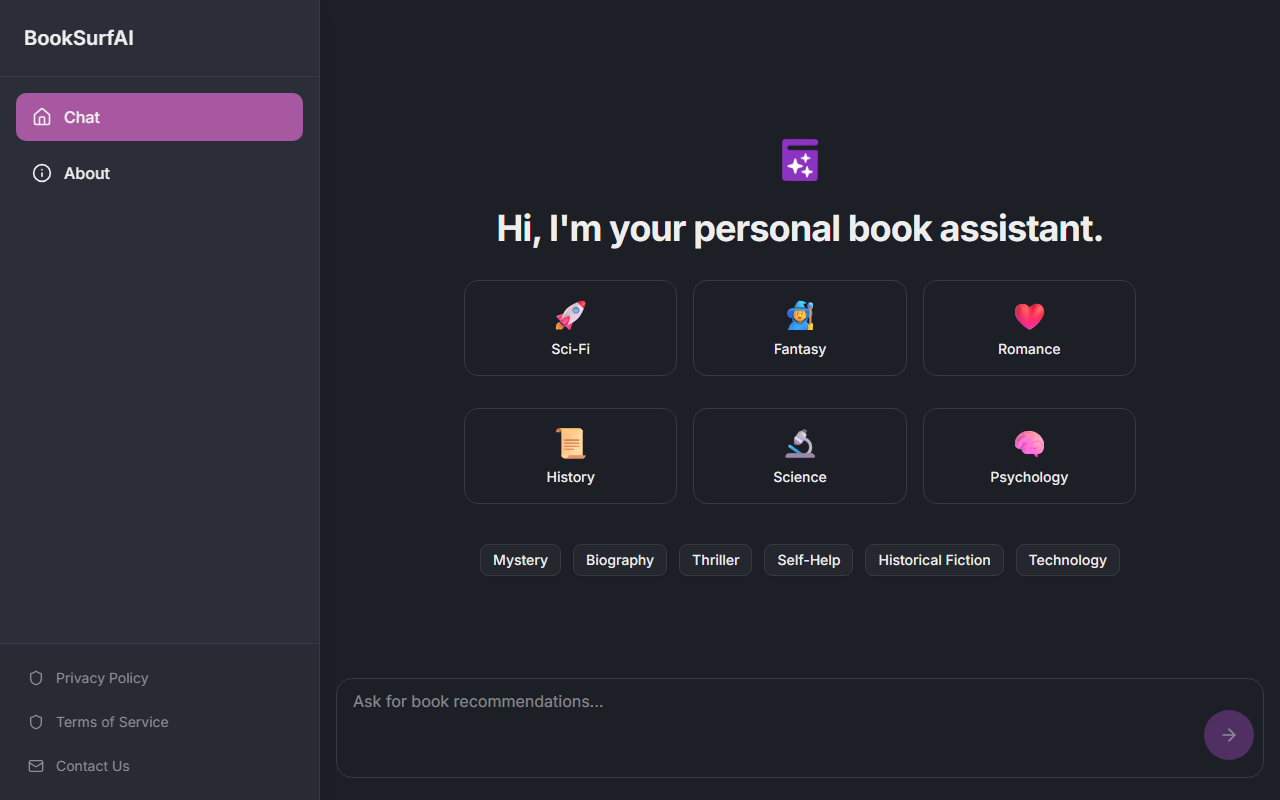
Upon visiting BookSurfAI, I was greeted by a clean, almost spartan landing page. The headline, 'Hi, I'm your personal book assistant,' sits above a horizontal row of genre chips: Sci-Fi, Fantasy, Romance, History, Science, Psychology, Mystery, Biography, Thriller, Self-Help, Historical Fiction, and Technology. There are no sign-up prompts, no fancy graphics—just a single-page tool that loads instantly. Clicking any genre immediately triggers a response, and the page slides down to reveal a set of book recommendations. That’s essentially the entire flow: pick a genre, get books. No search bar, no filters for sub-genres, author names, or publication year. It’s refreshingly simple, but also limiting. The onboarding is zero-friction—perfect for casual browsing, but less suited for power users who want more control over the suggestions.
The AI Engine and Recommendation Quality
Behind the scenes, BookSurfAI uses an undisclosed AI model—likely a fine-tuned language model rather than a collaborative filtering system (common in traditional recommendation engines). I tested the free tier (the only tier visible) by clicking 'Science' and then 'Historical Fiction.' Each request returned a list of roughly 20 book titles with brief descriptions. For Science, the AI suggested works like 'The Selfish Gene' by Richard Dawkins and 'A Brief History of Time' by Stephen Hawking—obvious choices that align with mainstream picks. Historical Fiction gave me 'The Book Thief' and 'All the Light We Cannot See.' The descriptions were concise (one to two sentences) and grammatically sound, but lacked the personalized depth you’d get from a reading history–based tool like Goodreads or a conversational AI like ChatGPT when prompted with context. The tool does not remember previous queries or allow you to refine results; it’s a one-shot generator per session. This makes it a solid quick-reference tool but not a long-term reading companion.
Pricing and Market Positioning
Pricing is not publicly listed on the website. There are no plans, tiers, or subscription buttons. This suggests BookSurfAI is either a free-to-use promotional project or a very early stage experiment. For context, alternative tools like Goodreads offer community reviews and recommendations at no cost, while dedicated AI reading coaches such as LitHabits charge for deeper personalization. BookSurfAI sits in a niche: it’s faster than browsing Goodreads lists and more focused than a general chatbot, but it lacks the social curation or user profile features that help discover hidden gems. The site does not disclose any company backing, funding, or user statistics. The privacy policy and terms of service links are present, implying the tool collects usage data, but I found no details on what model powers the recommendations or whether it uses your input to improve. For readers who want a quick genre-based list without creating an account, BookSurfAI is a lightweight option, but serious bibliophiles should look elsewhere for depth and community.
Final Verdict
BookSurfAI excels in two areas: speed and simplicity. If you’re in a bookstore or on a commute and need three solid book ideas in a genre, this tool delivers in seconds. The lack of friction makes it a great gateway for non-technical readers. However, the limitations are equally clear. The absence of pricing suggests it may not be sustainable long-term. The recommendation quality is decent but not groundbreaking—it sticks to popular titles. No API is available, no integration with library catalogs or Kindle, and no way to save results. I’d recommend BookSurfAI to casual readers who just want a quick nudge in a specific genre, but skip it if you need nuanced, personalized suggestions or a reading log. For now, it’s a neat experiment, not a full-fledged tool. Visit BookSurfAI at https://booksurfai.com/ to explore it yourself.










Comments